LLM — da5004_2024T3_ET_FN
Source: da5004_2024T3_ET_FN.pdf · Academic questions: 21 · Separately counted children: 0
Provenance: Large_Language_Models/da5004_2024T3_ET_FN.pdf · SHA-256 9673ae8d3a7498f580eafa795d3a154c7561f2053e69c36884fc27718e40afcd
Scope: Large Language Models (LLM) section (Section 8, Section Id: 64065375424) spanning from page 1 at y=59.68 to page 12 at y=35.11 (Question 209 answer). Preceding Section 7 content on page 1 and succeeding Section 9 (i-NLP) content on page 12 are excluded as out of subject scope.
Questions
Shared context 188
Question ID: 6406531040920
Type: General Note
PDF pages: 2
General Note:
- If you find the given information is insufficient in any of the Numerical Answer Type (NAT) questions, enter -1 as the answer.
- In all your calculations, take at least two digits. For example, if the intermediate result is 1.860875, then take it as 1.86 to the next step.
Question 189
Question ID: 6406531040921
Type: SA · Marks: 3
PDF pages: 2, 3
Shared context: ctx-188
The input embeddings for the words “learning”, “brings” and “joy” are \(h_1 = [0.5, 0.25, 1]\), \(h_2 = [0.1, 0.25, 0]\), and \(h_3 = [0.1, 0.1, 0.9]\), respectively. Note that the embeddings are row vectors. The projection matrices are as follows
The following quantities are computed as
Let \(e_{ij}\) denote the unnormalized attention score, \(a_{ij}\) denote the normalized attention score (ignore the scaling by \(\sqrt{d_k}\)) and \(z_i\) denote the linear combination of the value vectors for the \(i\)-th word.
Enter the value of the first element, i.e., with index (0,0) of the matrix containing the partial derivatives, \(\frac{\partial a_{ij}}{\partial e_{ij}}\)
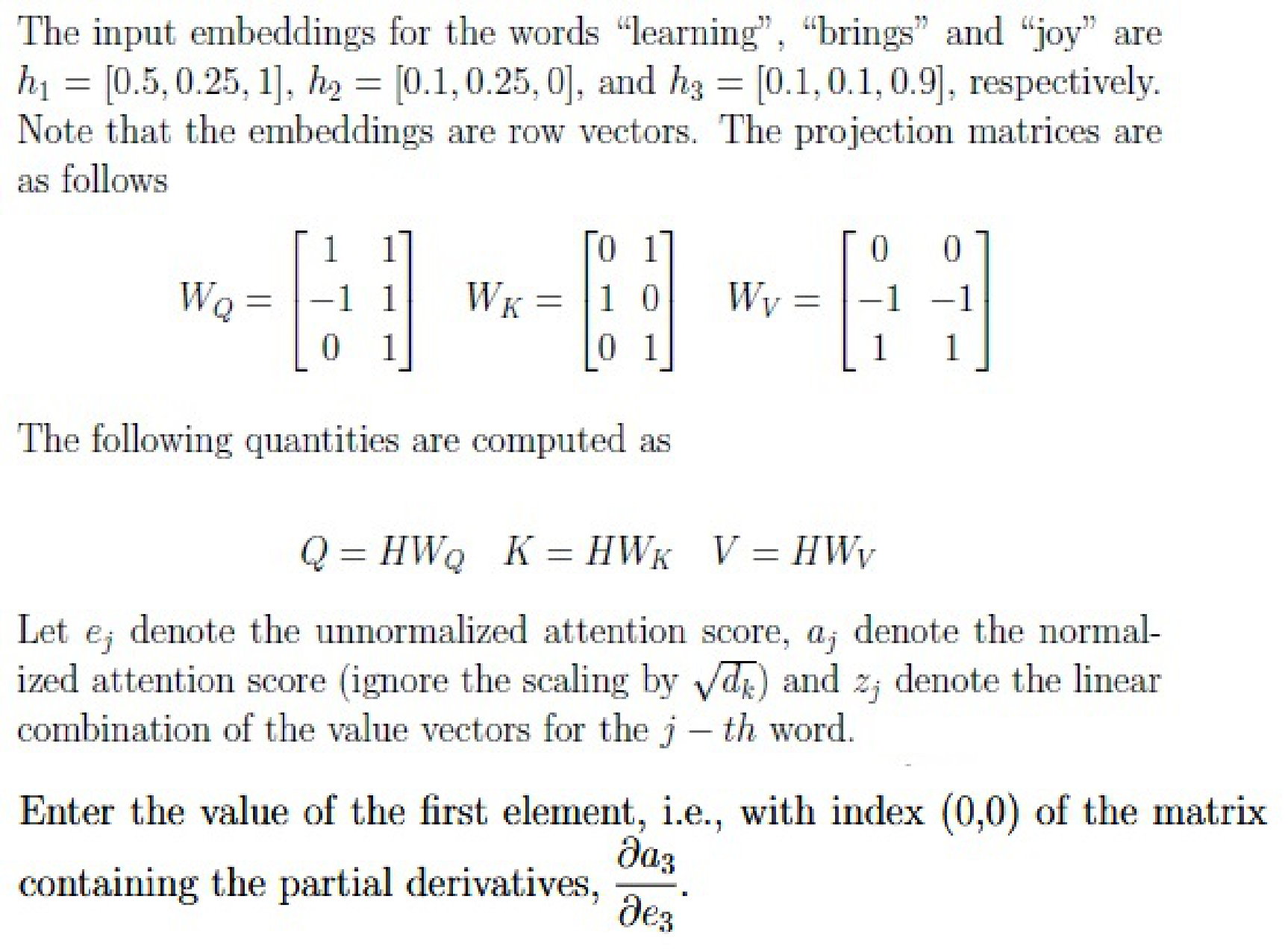
Figure 1. Input word embeddings, projection matrices W_Q, W_K, W_V, and partial derivative prompt for words learning, brings, and joy
Correct answer: 0.2 to 0.3
Source evidence: [{"page": 3, "bbox": [22.87, 70.0, 150.0, 100.0], "type": "explicit field", "detail": "Official source Range answer: 0.2 to 0.3"}]
Question 190
Question ID: 6406531040922
Type: MSQ · Marks: 2
PDF pages: 3
Shared context: ctx-188
Choose the correct statements regarding an encoder-decoder transformer model:
Options
A.
A self attention block makes use of a mask matrix.
Source option ID: 6406533516331
Label added for presentation.
B.
Multi head self attention block is part of the encoder.
Source option ID: 6406533516332
Label added for presentation.
C.
Teacher forcing can help speed up the training process for tasks such as machine translation.
Source option ID: 6406533516333
Label added for presentation.
D.
None of these.
Source option ID: 6406533516334
Label added for presentation.
Correct answer: Multi head self attention block is part of the encoder.; Teacher forcing can help speed up the training process for tasks such as machine translation.
Source evidence: [{"page": 3, "bbox": [23.62, 276.7, 119.02, 293.02], "type": "green source option", "detail": "Green marked option 6406533516332 (B)"}, {"page": 3, "bbox": [23.62, 297.52, 119.02, 313.84], "type": "green source option", "detail": "Green marked option 6406533516333 (C)"}]
Question 191
Question ID: 6406531040925
Type: MSQ · Marks: 2
PDF pages: 3
Shared context: ctx-188
Consider the following statements about increasing the size of the vocabulary
Options
A.
It reduces number of tokens required to represent a sentence
Source option ID: 6406533516344
Label added for presentation.
B.
It Increases the computational complexity as embedding matrix size increases
Source option ID: 6406533516345
Label added for presentation.
C.
It increases the context length T
Source option ID: 6406533516346
Label added for presentation.
D.
None of these
Source option ID: 6406533516347
Label added for presentation.
Correct answer: It reduces number of tokens required to represent a sentence; It Increases the computational complexity as embedding matrix size increases
Source evidence: [{"page": 3, "bbox": [23.62, 475.9, 119.02, 492.22], "type": "green source option", "detail": "Green marked option 6406533516344 (A)"}, {"page": 3, "bbox": [23.62, 496.72, 119.02, 513.04], "type": "green source option", "detail": "Green marked option 6406533516345 (B)"}]
Question 192
Question ID: 6406531040934
Type: MSQ · Marks: 2
PDF pages: 3, 4
Shared context: ctx-188
Consider the C4 pipeline. Which of the following will NOT pass through it as it is?
Options
A.
Zur Schule zu gehen ist eine gute Angewohnheit.
(Above sentence is german translation of “Going to school is a good habit” )
Source option ID: 6406533516369
Label added for presentation.
B.
Following function computes n — th Fibonacci number:
public static int fibo(int n):
if( n <= 1){
return n
}
return fibo(n - 1) + fibo(n - 2)
Source option ID: 6406533516370
Label added for presentation.
C.
Lorem ipsum dolor sit amet...
Source option ID: 6406533516371
Label added for presentation.
D.
Please enable JavaScript to use our site.
Home
Products
Shipping
Contact
FAQ
Source option ID: 6406533516372
Label added for presentation.
E.
D Gukesh defeated defending champion Ding Liren at the World Chess Championship. D Gukesh defeated defending champion Ding Liren at the World Chess Championship.
Source option ID: 6406533516373
Label added for presentation.
F.
Jawaharlal Nehru was the first prime minister of indipendent India.
Source option ID: 6406533516374
Label added for presentation.
G.
None of these.
Source option ID: 6406533516375
Label added for presentation.
Correct answer: Zur Schule zu gehen ist eine gute Angewohnheit.
(Above sentence is german translation of “Going to school is a good habit” ); Following function computes n — th Fibonacci number:
java
public static int fibo(int n):
if( n <= 1){
return n
}
return fibo(n - 1) + fibo(n - 2)
; Lorem ipsum dolor sit amet...; Please enable JavaScript to use our site.
Home
Products
Shipping
Contact
FAQ; D Gukesh defeated defending champion Ding Liren at the World Chess Championship. D Gukesh defeated defending champion Ding Liren at the World Chess Championship.
Source evidence: [{"page": 3, "bbox": [23.62, 727.53, 119.02, 743.85], "type": "green source option", "detail": "Green marked option 6406533516369 (A)"}, {"page": 3, "bbox": [23.62, 764.67, 119.02, 780.99], "type": "green source option", "detail": "Green marked option 6406533516370 (B)"}, {"page": 4, "bbox": [23.62, 144.5, 119.02, 160.82], "type": "green source option", "detail": "Green marked option 6406533516371 (C)"}, {"page": 4, "bbox": [23.62, 291.83, 119.02, 308.15], "type": "green source option", "detail": "Green marked option 6406533516372 (D)"}, {"page": 4, "bbox": [23.62, 370.15, 119.02, 386.47], "type": "green source option", "detail": "Green marked option 6406533516373 (E)"}]
Question 193
Question ID: 6406531040935
Type: MSQ · Marks: 2
PDF pages: 4
Shared context: ctx-188
Which of the following are correct about GPT-3 model with 175B parameters:
Options
A.
It is an encoder-decoder only model.
Source option ID: 6406533516376
Label added for presentation.
B.
It uses absolute postional encoding.
Source option ID: 6406533516377
Label added for presentation.
C.
It uses a composite dataset for pre-training.
Source option ID: 6406533516378
Label added for presentation.
D.
None of these.
Source option ID: 6406533516379
Label added for presentation.
Correct answer: It uses absolute postional encoding.; It uses a composite dataset for pre-training.
Source evidence: [{"page": 4, "bbox": [23.62, 651.93, 119.02, 668.25], "type": "green source option", "detail": "Green marked option 6406533516377 (B)"}, {"page": 4, "bbox": [23.62, 672.75, 119.02, 689.07], "type": "green source option", "detail": "Green marked option 6406533516378 (C)"}]
Question 194
Question ID: 6406531040923
Type: MSQ · Marks: 3
PDF pages: 4, 5
Shared context: ctx-188
Choose all the correct statements about the GPT model:
Options
A.
All the parameters of are randomly initialized during pre-training
Source option ID: 6406533516335
Label added for presentation.
B.
The model minimizes the CLM objective during fine-tuning for downstream tasks like sentiment classification to improve the performance
Source option ID: 6406533516336
Label added for presentation.
C.
All parameters are randomly initialized during fine-tuning
Source option ID: 6406533516337
Label added for presentation.
D.
In general, fine-tuning requires a dataset with labels
Source option ID: 6406533516338
Label added for presentation.
E.
None of these
Source option ID: 6406533516339
Label added for presentation.
Correct answer: All the parameters of are randomly initialized during pre-training; In general, fine-tuning requires a dataset with labels
Source evidence: [{"page": 5, "bbox": [23.62, 95.59, 119.02, 111.91], "type": "green source option", "detail": "Green marked option 6406533516335 (A)"}, {"page": 5, "bbox": [23.62, 174.37, 119.02, 190.69], "type": "green source option", "detail": "Green marked option 6406533516338 (D)"}]
Question 195
Question ID: 6406531040932
Type: MSQ · Marks: 3
PDF pages: 5
Shared context: ctx-188
Consider fine-tuning the T5 model on a sentiment classification task. The T5 model was pre-trained using the C4 dataset. Suppose, in the original dataset, the positive samples are denoted by integer 1 and the negative samples are denoted by integer 0. Choose the necessary modifications that one needs to perform to use the T5 model for fine-tuning:
Options
A.
Map the label 0 to “negative” and 1 to “positive” in the dataset
Source option ID: 6406533516361
Label added for presentation.
B.
Map the label 0 to “0” and 1 to “1” in the dataset
Source option ID: 6406533516362
Label added for presentation.
C.
Update the vocabulary of T5 with the modified labels
Source option ID: 6406533516363
Label added for presentation.
D.
Add at least one linear layer on top of the decoder for final classification
Source option ID: 6406533516364
Label added for presentation.
Correct answer: Map the label 0 to “negative” and 1 to “positive” in the dataset; Map the label 0 to “0” and 1 to “1” in the dataset
Source evidence: [{"page": 5, "bbox": [23.62, 385.39, 119.02, 401.71], "type": "green source option", "detail": "Green marked option 6406533516361 (A)"}, {"page": 5, "bbox": [23.62, 406.21, 119.02, 422.53], "type": "green source option", "detail": "Green marked option 6406533516362 (B)"}]
Question 196
Question ID: 6406531040924
Type: MCQ · Marks: 3
PDF pages: 5, 6
Shared context: ctx-188
Suppose we use a pre-trained model for text generation with the given prompt “I am going to”. Which of the following decoding strategies can be used such that the pre-trained model generates different text completion each time it is executed
Options
A.
Beam search with beam size 1
Source option ID: 6406533516340
Label added for presentation.
B.
Greedy approach
Source option ID: 6406533516341
Label added for presentation.
C.
Top-K with k = 2
Source option ID: 6406533516342
Label added for presentation.
D.
None of these
Source option ID: 6406533516343
Label added for presentation.
Correct answer: Top-K with k = 2
Source evidence: [{"page": 5, "bbox": [23.62, 767.28, 119.02, 787.53], "type": "green source option", "detail": "Green marked option 6406533516342 (C)"}]
Question 197
Question ID: 6406531040933
Type: MCQ · Marks: 2
PDF pages: 6
Shared context: ctx-188
What is the order of the language modeling pipeline?
Options
A.
First, the model, which handles text and returns raw predictions. The tokenizer then makes sense of these predictions and converts them back to text when needed.
Source option ID: 6406533516365
Label added for presentation.
B.
First, the tokenizer, which handles text and returns IDs. The model handles these IDs and outputs a prediction, which can be some text.
Source option ID: 6406533516366
Label added for presentation.
C.
The tokenizer handles text and returns IDs. The model handles these IDs and outputs a prediction. The tokenizer can then be used once again to convert these predictions back to some text.
Source option ID: 6406533516367
Label added for presentation.
D.
None of these
Source option ID: 6406533516368
Label added for presentation.
Correct answer: The tokenizer handles text and returns IDs. The model handles these IDs and outputs a prediction. The tokenizer can then be used once again to convert these predictions back to some text.
Source evidence: [{"page": 6, "bbox": [23.62, 313.23, 119.02, 359.31], "type": "green source option", "detail": "Green marked option 6406533516367 (C)"}]
Question 198
Question ID: 6406531040936
Type: MCQ · Marks: 2
PDF pages: 6
Shared context: ctx-188
Consider following statment and mark true or false:
Repeating examples in the pre-training datasets are completely harmless for downstream performance.
Options
A.
TRUE
Source option ID: 6406533516380
Label added for presentation.
B.
FALSE
Source option ID: 6406533516381
Label added for presentation.
Correct answer: FALSE
Source evidence: [{"page": 6, "bbox": [23.62, 577.71, 119.02, 594.03], "type": "green source option", "detail": "Green marked option 6406533516381 (B)"}]
Question 199
Question ID: 6406531040937
Type: MCQ · Marks: 2
PDF pages: 6, 7
Shared context: ctx-188
What is the time complexity of the computing attention score matrix A with a batch size of one? The symbols have usual meaning.
Options
A.
\(O(T^2 d)\)
Source option ID: 6406533516382
Label added for presentation.
B.
\(O(T d^2)\)
Source option ID: 6406533516383
Label added for presentation.
C.
\(O(T d)\)
Source option ID: 6406533516384
Label added for presentation.
D.
\(O(T + d)\)
Source option ID: 6406533516385
Label added for presentation.
E.
None of these.
Source option ID: 6406533516386
Label added for presentation.
Correct answer: \(O(T^2 d)\)
Source evidence: [{"page": 6, "bbox": [23.62, 744.2, 119.02, 760.52], "type": "green source option", "detail": "Green marked option 6406533516382 (A)"}]
Question 200
Question ID: 6406531040942
Type: MCQ · Marks: 2
PDF pages: 7
Shared context: ctx-188
Suppose we take a pre-trained model GPT-2 model and use it for grammatical acceptance test (based on perplexity score). Say the starting position of the input is shifted \(k\) units to the right where \(k \ge 0\) is some integer, i.e. if the index of a token in the input is 1 (0-based indexing) then its new position is \(1+k\). In general token at \(i\) index is shifted to \(i+k\).
Choose the correct statement:
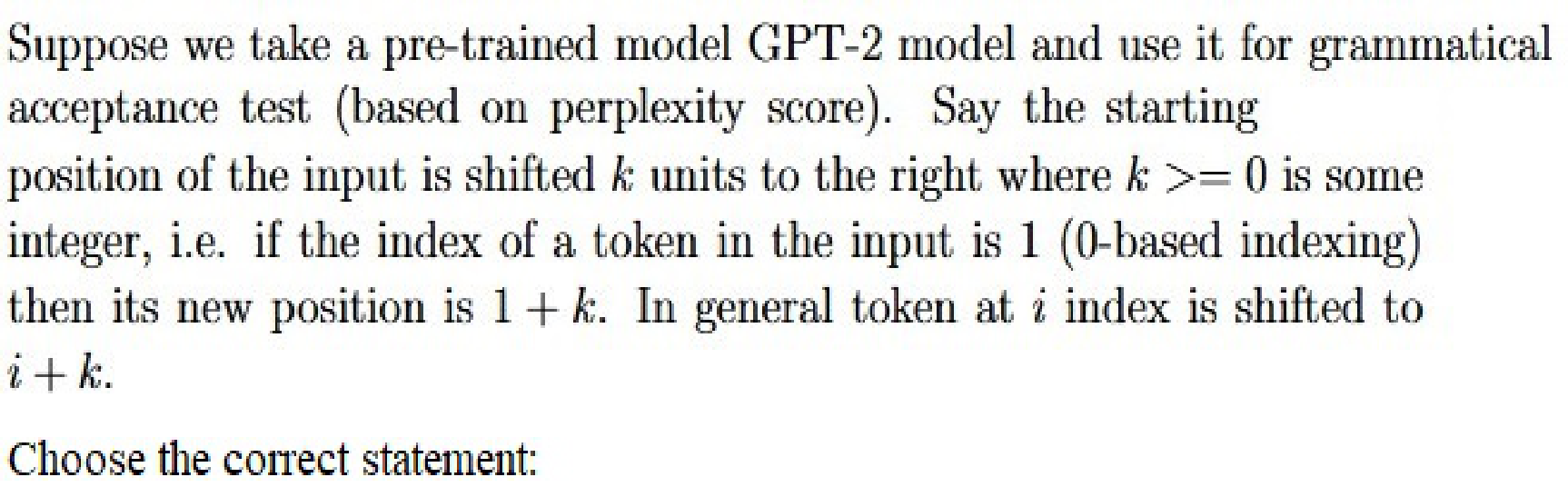
Figure 2. GPT-2 model grammatical acceptance test perplexity evaluation prompt under input shift by k units
Options
A.
\(k = 0\) will perform same as compared to \(k = 400\)
Source option ID: 6406533516390
Label added for presentation.
B.
\(k = 0\) will perform worse compared to \(k = 400\)
Source option ID: 6406533516391
Label added for presentation.
C.
\(k = 0\) will perform better compared to \(k = 400\)
Source option ID: 6406533516392
Label added for presentation.
D.
Value of \(k\) is irrelevant as the difference between position embeddings of two consecutive tokens remain the same.
Source option ID: 6406533516393
Label added for presentation.
Correct answer: \(k = 0\) will perform better compared to \(k = 400\)
Source evidence: [{"page": 7, "bbox": [23.62, 514.22, 119.02, 530.54], "type": "green source option", "detail": "Green marked option 6406533516392 (C)"}]
Question 201
Question ID: 6406531040943
Type: MCQ · Marks: 2
PDF pages: 7, 8
Shared context: ctx-188
Which of the following is the correct expression for \(e_{ij}\) for Transformer-XL model? The symbols have the usual meaning.

Figure 3. Transformer-XL relative positional attention score expression e_ij question stem
Options
A.
\(E_{x_i}^T W_q^T W_{k,E} E_{x_j} + E_{x_i}^T W_q^T W_{k,R} R_{i-j} + u^T W_{k,E} E_{x_j} + v^T W_{k,R} R_{i-j}\)

Figure 4. Option A relative positional attention score expression
Source option ID: 6406533516394
Label added for presentation.
B.
\(E_{x_i}^T W_q^T W_{k,E} E_{x_j} + E_{x_i}^T W_q^T W_{k,R} R_{i-j} + u^T W_{k,E} R_{i-j} + v^T W_{k,R} E_{x_j}\)

Figure 5. Option B relative positional attention score expression
Source option ID: 6406533516395
Label added for presentation.
C.
\(E_{x_i}^T W_q^T W_{k,E} E_{x_j} + E_{x_i}^T W_q^T W_{k,R} R_{i-j} + u^T W_{k,E} E_{x_i} + v^T W_{k,R} R_{i-j}\)

Figure 6. Option C relative positional attention score expression
Source option ID: 6406533516396
Label added for presentation.
D.
\(u^T W_{k,E} E_{x_j} + v^T W_{k,R} R_{i-j} + E_{x_i}^T W_q^T W_{k,E} E_{x_j} + E_{x_i}^T W_q^T W_{k,R} R_{i-j}\)

Figure 7. Option D relative positional attention score expression
Source option ID: 6406533516397
Label added for presentation.
E.
None of these
Source option ID: 6406533516398
Label added for presentation.
Correct answer: \(E_{x_i}^T W_q^T W_{k,E} E_{x_j} + E_{x_i}^T W_q^T W_{k,R} R_{i-j} + u^T W_{k,E} E_{x_j} + v^T W_{k,R} R_{i-j}\)
Source evidence: [{"page": 7, "bbox": [23.62, 774.73, 119.02, 791.05], "type": "green source option", "detail": "Green marked option 6406533516394 (A)"}]
Shared context 202-206
Question ID: 6406531040926
Type: Comprehension
PDF pages: 8
Consider the following dictionary with the number of word occurrences in a corpus:
Note: Append </w> to each word at the end.
You will be working with word piece algorithm, answer the given subquestions in that context:
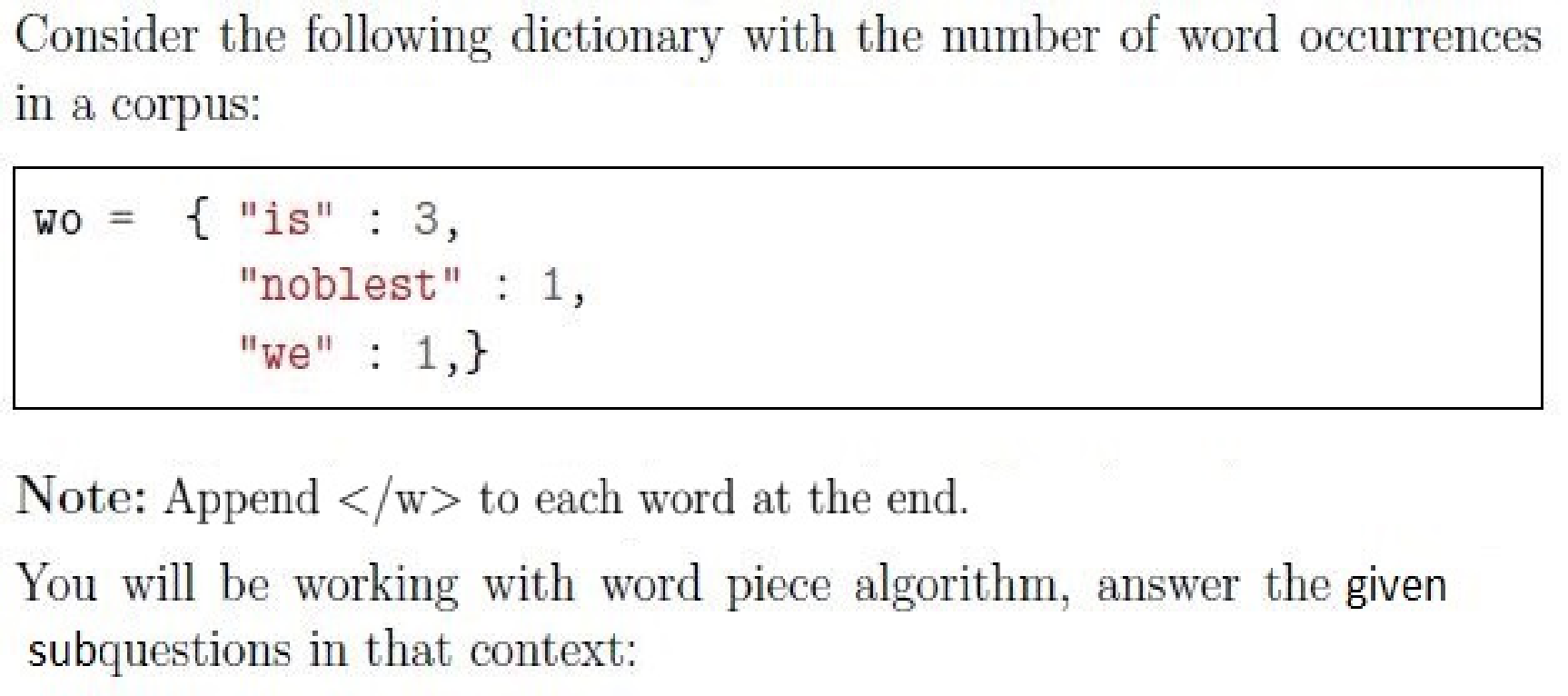
Figure 8. WordPiece algorithm comprehension passage containing corpus vocabulary dictionary w_c
Question 202
Question ID: 6406531040927
Type: SA · Marks: 2
PDF pages: 8
Shared context: ctx-188, ctx-202-206
How many tokens are there in the initial vocabulary?
Correct answer: 10
Source evidence: [{"page": 8, "bbox": [22.87, 735.0, 50.0, 755.0], "type": "explicit field", "detail": "Official source Equal answer: 10"}]
Question 203
Question ID: 6406531040928
Type: MCQ · Marks: 3
PDF pages: 9
Shared context: ctx-188, ctx-202-206
Which of the following pairs has the least score before any merge?
Options
A.
('e', '')
Source option ID: 6406533516349
Label added for presentation.
B.
('s', 't')
Source option ID: 6406533516350
Label added for presentation.
C.
('o', 'b')
Source option ID: 6406533516351
Label added for presentation.
D.
('l', 'e')
Source option ID: 6406533516352
Label added for presentation.
E.
('w', 'e')
Source option ID: 6406533516353
Label added for presentation.
Correct answer: ('e', '')
Source evidence: [{"page": 9, "bbox": [23.62, 141.6, 119.02, 157.92], "type": "green source option", "detail": "Green marked option 6406533516349 (A)"}]
Question 204
Question ID: 6406531040929
Type: SA · Marks: 3
PDF pages: 9
Shared context: ctx-188, ctx-202-206
Which pair will be merged the very first merge? Say the pair is (‘a’,‘b’), then enter “ab” (without quotes and white spaces). If there is a tie between two or more candidates, enter the one that occurs first in the original vocabulary.
NOTE: Enter the exact answer without any space in the beginning or at the end.
Correct answer: no
Source evidence: [{"page": 9, "bbox": [22.87, 580.0, 50.0, 600.0], "type": "explicit field", "detail": "Official source Equal answer: no"}]
Question 205
Question ID: 6406531040930
Type: SA · Marks: 3
PDF pages: 9, 10
Shared context: ctx-188, ctx-202-206
What is the score of the pair merged in the very first merge?
Correct answer: 1.0
Source evidence: [{"page": 10, "bbox": [22.87, 90.0, 50.0, 110.0], "type": "explicit field", "detail": "Official source Equal answer: 1.0"}]
Question 206
Question ID: 6406531040931
Type: MCQ · Marks: 3
PDF pages: 10
Shared context: ctx-188, ctx-202-206
Assuming that the algorithm was stopped after one merge only, how will the word “nose” be tokenized with the given vocabulary?
Please note that </w> is already appended to the word.
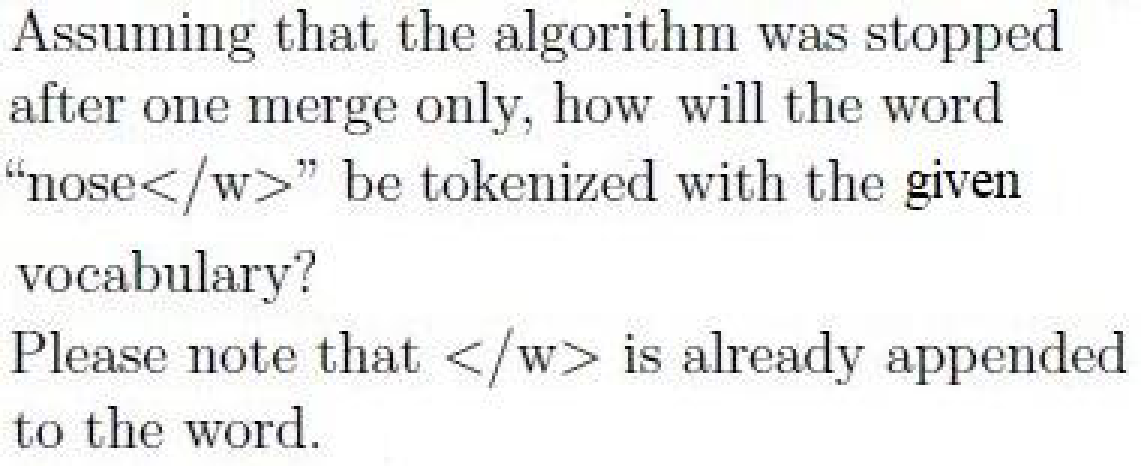
Figure 9. WordPiece tokenization question stem for nose after one merge
Options
A.
n, os, e,
Source option ID: 6406533516356
Label added for presentation.
B.
no, s, e,
Source option ID: 6406533516357
Label added for presentation.
C.
n, o, s, e,
Source option ID: 6406533516358
Label added for presentation.
D.
n, o, se,
Source option ID: 6406533516359
Label added for presentation.
E.
None of these
Source option ID: 6406533516360
Label added for presentation.
Correct answer: no, s, e,
Source evidence: [{"page": 10, "bbox": [23.62, 383.75, 119.02, 400.07], "type": "green source option", "detail": "Green marked option 6406533516357 (B)"}]
Shared context 207-208
Question ID: 6406531040939
Type: Comprehension
PDF pages: 10
Assume that you are using block attention model. Sequence length \(T = 32\), number of blocks \(n = 4\), identity permutation for \(Q\) matrix and \(\pi = (2,0,3,1)\) for \(K^T\) matrix. The mask matrix is denoted by \(M\).
Answer the given subquestions:

Figure 10. Block attention model comprehension passage with sequence length T=32 and permutation vector pi=(2,0,3,1)
Question 207
Question ID: 6406531040940
Type: SA · Marks: 2
PDF pages: 11
Shared context: ctx-188, ctx-207-208
How many non zero entries will be there in the mask matrix M?
Correct answer: 256
Source evidence: [{"page": 11, "bbox": [22.87, 210.0, 50.0, 230.0], "type": "explicit field", "detail": "Official source Equal answer: 256"}]
Question 208
Question ID: 6406531040941
Type: SA · Marks: 2
PDF pages: 11
Shared context: ctx-188, ctx-207-208
What will be the value of following expression?
Correct answer: 3
Source evidence: [{"page": 11, "bbox": [22.87, 476.5, 50.0, 495.0], "type": "explicit field", "detail": "Official source Equal answer: 3"}]
Question 209
Question ID: 6406531040938
Type: SA · Marks: 2
PDF pages: 11, 12
Shared context: ctx-188
How many entries of the unnormalized attention matrix \(QK^T\) will be calculated with strided attention mechanism with \(s = 5\). The sequence length is \(T = 16\)

Figure 11. Strided attention mechanism unnormalized matrix computation entries question stem for s=5, T=16
Correct answer: 74
Source evidence: [{"page": 12, "bbox": [22.87, 16.75, 38.29, 35.11], "type": "explicit field", "detail": "Official source Equal answer: 74"}]
Answer key
| Source question | Source identity | Correct answer | PDF pages |
|---|---|---|---|
| 189 | 6406531040921 | 0.2 to 0.3 | 2, 3 |
| 190 | 6406531040922 | Multi head self attention block is part of the encoder.; Teacher forcing can help speed up the training process for tasks such as machine translation. | 3 |
| 191 | 6406531040925 | It reduces number of tokens required to represent a sentence; It Increases the computational complexity as embedding matrix size increases | 3 |
| 192 | 6406531040934 | Zur Schule zu gehen ist eine gute Angewohnheit. (Above sentence is german translation of “Going to school is a good habit” ); Following function computes n — th Fibonacci number: java public static int fibo(int n): if( n <= 1){ return n } return fibo(n - 1) + fibo(n - 2); Lorem ipsum dolor sit amet...; Please enable JavaScript to use our site. Home Products Shipping Contact FAQ; D Gukesh defeated defending champion Ding Liren at the World Chess Championship. D Gukesh defeated defending champion Ding Liren at the World Chess Championship. |
3, 4 |
| 193 | 6406531040935 | It uses absolute postional encoding.; It uses a composite dataset for pre-training. | 4 |
| 194 | 6406531040923 | All the parameters of are randomly initialized during pre-training; In general, fine-tuning requires a dataset with labels | 4, 5 |
| 195 | 6406531040932 | Map the label 0 to “negative” and 1 to “positive” in the dataset; Map the label 0 to “0” and 1 to “1” in the dataset | 5 |
| 196 | 6406531040924 | Top-K with k = 2 | 5, 6 |
| 197 | 6406531040933 | The tokenizer handles text and returns IDs. The model handles these IDs and outputs a prediction. The tokenizer can then be used once again to convert these predictions back to some text. | 6 |
| 198 | 6406531040936 | FALSE | 6 |
| 199 | 6406531040937 | \(O(T^2 d)\) | 6, 7 |
| 200 | 6406531040942 | \(k = 0\) will perform better compared to \(k = 400\) | 7 |
| 201 | 6406531040943 | \(E_{x_i}^T W_q^T W_{k,E} E_{x_j} + E_{x_i}^T W_q^T W_{k,R} R_{i-j} + u^T W_{k,E} E_{x_j} + v^T W_{k,R} R_{i-j}\) | 7, 8 |
| 202 | 6406531040927 | 10 | 8 |
| 203 | 6406531040928 | ('e', '') | 9 |
| 204 | 6406531040929 | no | 9 |
| 205 | 6406531040930 | 1.0 | 9, 10 |
| 206 | 6406531040931 | no, s, e, | 10 |
| 207 | 6406531040940 | 256 | 11 |
| 208 | 6406531040941 | 3 | 11 |
| 209 | 6406531040938 | 74 | 11, 12 |
Extraction notes
Status: verified
Count reconciliation: The portal declared 18 questions and 50 marks for Section 8 (LLM). The 50 marks reconcile exactly across the 21 academic questions: Q189 (3) + Q190 (2) + Q191 (2) + Q192 (2) + Q193 (2) + Q194 (3) + Q195 (3) + Q196 (3) + Q197 (2) + Q198 (2) + Q199 (2) + Q200 (2) + Q201 (2) + Q202 (2) + Q203 (3) + Q204 (3) + Q205 (3) + Q206 (3) + Q207 (2) + Q208 (2) + Q209 (2) = 50 marks. The source PDF contains 9 portal sub-sections for Section 8, 1 administrative confirmation entry (Q187, 0 marks), 1 shared-context calculation general note (Q188, 0 marks), 2 multi-question comprehension passages (Q202-206 with 5 sub-questions, and Q207-208 with 2 sub-questions), and 21 academic questions (Q189-Q209). In the portal declared count of 18 items, each multi-question comprehension passage was counted as 1 container (16 individual items + 2 comprehension containers = 18 items). The observed academic question count is 21.
- Section 8 (LLM) is preceded on page 1 by Section 7 tail options (True/False) and succeeded on page 12 by Section 9 (i-NLP) starting at Question 210, both excluded as outside course boundary.
- Question 188 general calculation instructions preserved as shared-context entry ctx-188 with acknowledgment options excluded.
- Comprehension passage for Q202-206 preserved as shared-context entry ctx-202-206.
- Comprehension passage for Q207-208 preserved as shared-context entry ctx-207-208.
Excluded source entries:
- {"classification": "subject-confirmation", "page": 1, "bbox": [22.87, 725.0, 569.0, 840.0], "reason": "Administrative subject confirmation asking candidate to confirm subject and cross check hall ticket", "identity": "187"}
- {"classification": "administrative-acknowledgment-options", "page": 2, "bbox": [22.87, 220.0, 485.73, 277.48], "reason": "Administrative acknowledgment options (Instructions has been mentioned above / This Instructions is just for a reference & not for an evaluation) excluded semantically while preserving calculation note as shared context", "identity": "188"}