Week 4: Exam Questions and Worked Answers
Read the Week 4 plain-language (ELI12) note first, then come back here.
Navigation: Previous bank · Week 4 notes · Knowledge Map · Knowledge Map · Previous notes · Next notes
Coverage: 67 routed occurrences; 61 distinct stems; by type MCQ 28, MSQ 20, SA 19; by exam Q1 26, Q2 6, ET 35.
Answer provenance: Answers were derived by the study team (Terra/Luna agents); they are not official keys. verified_by_code: true means a numerical/code-based check was run for that answer; false means no such code verification is claimed. Status and any source ambiguity are stated with each solution.
Topic checklist
The checklist includes every topic named for this week in sources/topics.json. A topic without a directly routed question still links to the study notes.
Topic: Exhaustive and greedy search
Topic: Beam search and length normalisation
Topic: Top-k sampling and temperature
Topic: Top-p (nucleus) sampling and repetition issues
Topic: BERT masked language modelling (80/10/10)
Topic: NSP, [CLS]/[SEP] and the three input embeddings
Topic: BERT sizes and parameter counts
Topic: BERT fine-tuning heads and GPT vs BERT
Question navigator
| Paper | Question link | Topic | Answer status |
|---|---|---|---|
| 2024T1_ET_AN | 2024 T1 End Term AN, Q148 | w4-exhaustive-greedy | derived |
| 2024T1_ET_AN | 2024 T1 End Term AN, Q150 | w4-exhaustive-greedy, w4-beam-search, w4-topk-temperature, w4-topp-nucleus | derived |
| 2024T1_ET_FN | 2024 T1 End Term FN, Q198 | w4-bert-architecture-params | derived |
| 2024T1_ET_FN | 2024 T1 End Term FN, Q201 | w4-exhaustive-greedy | derived |
| 2024T1_ET_FN | 2024 T1 End Term FN, Q203 | w4-exhaustive-greedy, w4-beam-search, w4-topk-temperature, w4-topp-nucleus | derived |
| 2024T1_Q1_NA | 2024 T1 Quiz 1 NA, Q195 | w4-exhaustive-greedy, w4-beam-search, w4-topk-temperature, w4-topp-nucleus | ambiguous |
| 2024T1_Q1_NA | 2024 T1 Quiz 1 NA, Q198 | w4-bert-nsp-inputs | derived |
| 2024T3_ET_AN | 2024 T3 End Term AN, Q178 | w4-exhaustive-greedy, w4-beam-search, w4-topk-temperature | ambiguous |
| 2024T3_ET_FN | 2024 T3 End Term FN, Q196 | w4-topk-temperature | derived |
| 2024T3_Q1_NA | 2024 T3 Quiz 1 NA, Q288 | w4-topk-temperature | derived |
| 2025T1_Q1_NA | 2025 T1 Quiz 1 NA, Q106 | w4-topk-temperature | derived |
| 2025T1_Q1_NA | 2025 T1 Quiz 1 NA, Q109 | w4-exhaustive-greedy | derived |
| 2025T1_Q1_NA | 2025 T1 Quiz 1 NA, Q110 | w4-beam-search, w4-topk-temperature, w4-topp-nucleus, w4-exhaustive-greedy | ambiguous |
| 2025T2_ET_AN | 2025 T2 End Term AN, Q198 | w4-topp-nucleus | derived |
| 2025T2_ET_FN | 2025 T2 End Term FN, Q141 | w4-exhaustive-greedy, w4-beam-search, w4-topk-temperature, w4-topp-nucleus | ambiguous |
| 2025T2_ET_FN | 2025 T2 End Term FN, Q143 | w4-topk-temperature, w4-topp-nucleus | derived |
| 2025T2_ET_FN | 2025 T2 End Term FN, Q145 | w4-topk-temperature | derived |
| 2025T2_Q1_NA | 2025 T2 Quiz 1 NA, Q137 | w4-bert-finetuning, w4-bert-mlm | derived |
| 2025T2_Q1_NA | 2025 T2 Quiz 1 NA, Q138 | w4-topk-temperature | derived |
| 2025T2_Q1_NA | 2025 T2 Quiz 1 NA, Q142 | w4-bert-nsp-inputs | derived |
| 2025T2_Q1_NA | 2025 T2 Quiz 1 NA, Q143 | w4-topp-nucleus, w4-topk-temperature | derived |
| 2025T2_Q1_NA | 2025 T2 Quiz 1 NA, Q145 | w4-topk-temperature | derived |
| 2025T2_Q1_NA | 2025 T2 Quiz 1 NA, Q153 | w4-exhaustive-greedy | derived |
| 2025T2_Q1_NA | 2025 T2 Quiz 1 NA, Q154 | w4-exhaustive-greedy | derived |
| 2025T2_Q1_NA | 2025 T2 Quiz 1 NA, Q155 | w4-topk-temperature | derived |
| 2025T3_ET_AN | 2025 T3 End Term AN, Q2 | w4-topk-temperature | derived |
| 2025T3_ET_AN | 2025 T3 End Term AN, Q5 | w4-bert-finetuning | derived |
| 2025T3_ET_AN | 2025 T3 End Term AN, Q6 | w4-bert-finetuning | derived |
| 2025T3_ET_AN | 2025 T3 End Term AN, Q15 | w4-topp-nucleus | derived |
| 2025T3_ET_FN | 2025 T3 End Term FN, Q3 | w4-topk-temperature | derived |
| 2025T3_ET_FN | 2025 T3 End Term FN, Q4 | w4-topp-nucleus | derived |
| 2025T3_ET_FN | 2025 T3 End Term FN, Q6 | w4-bert-finetuning | derived |
| 2025T3_ET_FN | 2025 T3 End Term FN, Q24 | w4-topk-temperature | derived |
| 2025T3_Q1_NA | 2025 T3 Quiz 1 NA, Q178 | w4-exhaustive-greedy | derived |
| 2025T3_Q1_NA | 2025 T3 Quiz 1 NA, Q180 | w4-exhaustive-greedy | derived |
| 2025T3_Q1_NA | 2025 T3 Quiz 1 NA, Q181 | w4-beam-search | derived |
| 2025T3_Q1_NA | 2025 T3 Quiz 1 NA, Q182 | w4-topp-nucleus | derived |
| 2025T3_Q1_NA | 2025 T3 Quiz 1 NA, Q185 | w4-beam-search | derived |
| 2025T3_Q2_NA | 2025 T3 Quiz 2 NA, Q115 | w4-beam-search | derived |
| 2026T1_ET_AN | 2026 T1 End Term AN, Q8 | w4-topp-nucleus | derived |
| 2026T1_ET_AN | 2026 T1 End Term AN, Q11 | w4-topk-temperature | derived |
| 2026T1_ET_FN | 2026 T1 End Term FN, Q6 | w4-bert-nsp-inputs | derived |
| 2026T1_ET_FN | 2026 T1 End Term FN, Q12 | w4-bert-finetuning | derived |
| 2026T1_ET_FN | 2026 T1 End Term FN, Q15 | w4-beam-search | derived |
| 2026T1_ET_FN | 2026 T1 End Term FN, Q16 | w4-bert-finetuning | derived |
| 2026T1_ET_FN | 2026 T1 End Term FN, Q17 | w4-bert-finetuning | derived |
| 2026T1_Q1_NA | 2026 T1 Quiz 1 NA, Q6 | w4-bert-nsp-inputs | derived |
| 2026T1_Q1_NA | 2026 T1 Quiz 1 NA, Q7 | w4-topk-temperature | derived |
| 2026T1_Q1_NA | 2026 T1 Quiz 1 NA, Q8 | w4-bert-finetuning | derived |
| 2026T1_Q2_NA | 2026 T1 Quiz 2 NA, Q3 | w4-bert-mlm | derived |
| 2026T1_Q2_NA | 2026 T1 Quiz 2 NA, Q4 | w4-bert-mlm | derived |
| 2026T1_Q2_NA | 2026 T1 Quiz 2 NA, Q17 | w4-topk-temperature | derived |
| 2026T1_Q2_NA | 2026 T1 Quiz 2 NA, Q18 | w4-bert-architecture-params | derived |
| 2026T2_ET_AN | 2026 T2 End Term AN, Q4 | w4-beam-search | derived |
| 2026T2_ET_AN | 2026 T2 End Term AN, Q5 | w4-bert-nsp-inputs | derived |
| 2026T2_ET_AN | 2026 T2 End Term AN, Q9 | w4-topp-nucleus | derived |
| 2026T2_ET_AN | 2026 T2 End Term AN, Q10 | w4-topp-nucleus | derived |
| 2026T2_ET_FN | 2026 T2 End Term FN, Q6 | w4-bert-nsp-inputs | derived |
| 2026T2_ET_FN | 2026 T2 End Term FN, Q12 | w4-bert-finetuning | derived |
| 2026T2_ET_FN | 2026 T2 End Term FN, Q15 | w4-beam-search | derived |
| 2026T2_ET_FN | 2026 T2 End Term FN, Q16 | w4-bert-finetuning | derived |
| 2026T2_ET_FN | 2026 T2 End Term FN, Q17 | w4-bert-finetuning | derived |
| 2026T2_Q1_NA | 2026 T2 Quiz 1 NA, Q14 | w4-exhaustive-greedy | derived |
| 2026T2_Q1_NA | 2026 T2 Quiz 1 NA, Q15 | w4-exhaustive-greedy | ambiguous |
| 2026T2_Q1_NA | 2026 T2 Quiz 1 NA, Q16 | w4-topk-temperature | derived |
| 2026T2_Q1_NA | 2026 T2 Quiz 1 NA, Q17 | w4-beam-search | derived |
| 2026T2_Q2_NA | 2026 T2 Quiz 2 NA, Q10 | w4-topp-nucleus | derived |
Quiz 1 questions
2024 T1 Quiz 1 NA, Q195
Paper: 2024T1_Q1_NA · Type: MSQ · Marks: 4 · Topic(s): w4-exhaustive-greedy, w4-beam-search, w4-topk-temperature, w4-topp-nucleus
Which of the following decoding strategies is (are) appropriate for machine translation tasks? Assume we have infinite compute and the values for \(k \ge 3, p > 0.35\) where required.

A. Top-k sampling
Label added for presentation.
B. Beam search with the beam size K = 2
Label added for presentation.
C. Top-p sampling
Label added for presentation.
D. Exhaustive search
Label added for presentation.
E. None of these
Label added for presentation.
Editorial correction: the extracted text differed from the scan (extraction_error); see evidence
LLM/sources/exam-papers/assets/da5004_2024T1_Q1_NA/q195-q195-stem-01-p012.png shows k ≥ 3..
Worked answer
Final answer: A–D are usable; B and D are the conventional mode-seeking choices
Steps: Top-k, top-p, beam and exhaustive search can all generate translations. If appropriate means the conventional mode-seeking objective, B and D are the course key; if it means usable, A–D qualify. No criterion for appropriateness is given, so a unique set cannot be established.
Status: ambiguous
Ambiguity note: Top-k, top-p, beam and exhaustive search can all generate translations. If appropriate means the conventional mode-seeking objective, B and D are the course key; if it means usable, A–D qualify. No criterion for appropriateness is given, so a unique set cannot be established.
verified_by_code: false — No numeric checker path; answer remains explicitly ambiguous.
2024 T1 Quiz 1 NA, Q198
Paper: 2024T1_Q1_NA · Type: MCQ · Marks: 3 · Topic(s): w4-bert-nsp-inputs
The statement that “the Next Sentence Prediction (NSP) task requires the BERT model to run autoregressively given the first sentence( or segment)” is
A. TRUE
Label added for presentation.
B. FALSE
Label added for presentation.
Worked answer
Final answer: B: false.
Steps: BERT NSP classifies a jointly encoded sentence pair, not autoregressively generates the second sentence. A asserts that incorrect mechanism.
Status: derived
verified_by_code: false — Non-numeric response; no numeric checker path applies.
Shared context
Question ID: 640653993611
Type: Comprehension
PDF pages: 8
Consider a vocabulary \(V\),
\(V = (\text{[start]}, \text{breaking}, \text{ground}, \text{a}, \text{is}, \text{seismology}, \text{study}, \text{experience}, \text{earth quake}, \text{[end]})\).
Assume that we have a pre-trained GPT model for text generation and the first input token to the model is always the special token [start]. The prediction probabilities outputted by the model are given below.
The columns of the matrix are in the same order as the words listed in the vocabulary set above.
The zeroth row of the matrix is the output probability distribution by the model given the special [Start] token as input.
Following the Greedy Search decoding strategy, the subsequent rows give the conditional probability distribution conditioned over the previous tokens. If you think the given information is insufficient for any sub-questions, then enter -1 as your answer.
!Pre-trained GPT vocabulary and prediction probability distribution matrix for greedy decoding
Figure 6. Pre-trained GPT vocabulary and prediction probability distribution matrix for greedy decoding
Based on the above data, answer the given subquestions.
Question 285
Corrected shared-context text: Vocabulary V=([start], breaking, ground, a, is, seismology, study, experience, earth quake, [end]). Rows of the probability matrix correspond to greedy prefixes, beginning with [start]; columns follow V. Matrix: [[.04,.01,.14,.07,.09,.41,.08,.05,.08,.01],[.10,.03,.06,.16,.43,.01,.06,.09,.01,.04],[.06,.08,.28,.29,.03,.08,.04,.08,.04,.04],[.11,.03,.48,.02,.01,.07,.06,.14,.07,.01],[.09,.29,.04,.01,.04,.03,.25,.05,.15,.06],[.14,.22,.13,.08,.01,.03,.06,.23,.08,.03]]. Enter -1 if information is insufficient.
Dependent question
2024 T3 Quiz 1 NA, Q288
Paper: 2024T3_Q1_NA · Type: SA · Marks: 2 · Topic(s): w4-topk-temperature
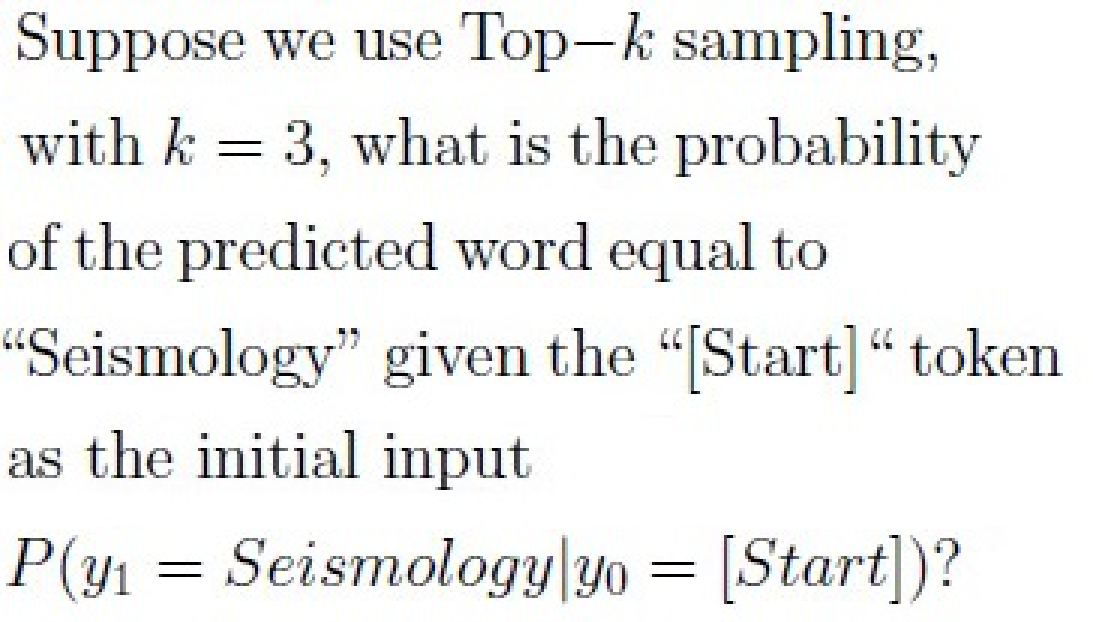
Suppose we use Top—k sampling, with k = 3, what is the probability of the predicted word equal to “Seismology” given the “[Start]” token as the initial input \(P(y_1 = \text{Seismology} \mid y_0 = \text{[Start]})\)?
Editorial correction: the extracted text differed from the scan (shared_context); see evidence
LLM/sources/exam-papers/assets/da5004_2024T3_Q1_NA/ctx-285-288-passage-01-p008.png shows vocabulary, probability matrix, greedy-prefix conditioning and insufficient-data instruction..
Worked answer
Final answer: 0.41/0.64 ≈ 0.640625.
Steps: The three largest first-row entries are 0.41, 0.14 and 0.09; renormalize 0.41/(0.41+0.14+0.09).
Status: derived
verified_by_code: false — depends on figure, no code path
2025 T1 Quiz 1 NA, Q106
Paper: 2025T1_Q1_NA · Type: MCQ · Marks: 3 · Topic(s): w4-topk-temperature
Suppose we use a pre-trained model for text generation with the given prompt “I am going to”.
Which of the following decoding strategies can be used such that the pre-trained model generates
different text completion each time it is executed
A. Beam search with beam size 1
B. Greedy approach
C. Top-K with k = 2
D. None of these
Worked answer
Final answer: C
Steps: Top-k sampling with k=2 is the only listed stochastic method and can yield different continuations; width-one beam search and greedy search are deterministic with fixed ties. A sample need not differ on every run, but the standard contrast asks which can produce variation.
Status: derived
verified_by_code: false — Non-numeric response; no numeric checker path applies.
2025 T1 Quiz 1 NA, Q109
Paper: 2025T1_Q1_NA · Type: MSQ · Marks: 3 · Topic(s): w4-exhaustive-greedy
Which of the following are correct statements regarding exhaustive decoding strategy? Note: \(V\) represents the vocabulary.

A. To generate a 10 token output, \(|V|^{10}\) possibilities will be considered.

B. To generate a 10 token output, \(|V|^{12}\) possibilities will be considered.

C. It is a deterministic approach.

D. It is a stochastic approach

Worked answer
Final answer: A and C.
Steps: There are |V| choices at each of 10 positions, giving |V|^10 complete sequences; exhaustive maximization is deterministic with fixed tie-breaking. B uses the wrong exponent and D confuses search with sampling.
Status: derived
verified_by_code: false — Non-numeric response; no numeric checker path applies.
2025 T1 Quiz 1 NA, Q110
Paper: 2025T1_Q1_NA · Type: MSQ · Marks: 3 · Topic(s): w4-beam-search, w4-topk-temperature, w4-topp-nucleus, w4-exhaustive-greedy
Which of the following decoding strategies is (are) appropriate for machine translation tasks?
Assume we have infinite compute and the values for k ≥ 3, p > 0.35 where required.
A. Top-k sampling
B. Beam search with the beam size K = 2
C. Top-p sampling
D. Exhaustive search
E. None of these
Worked answer
Final answer: A–D are usable; B and D are the conventional mode-seeking choices
Steps: Top-k, top-p, beam and exhaustive search can all generate translations. If appropriate means the conventional mode-seeking objective, B and D are the course key; if it means usable, A–D qualify. No criterion for appropriateness is given, so a unique set cannot be established.
Status: ambiguous
Ambiguity note: Top-k, top-p, beam and exhaustive search can all generate translations. If appropriate means the conventional mode-seeking objective, B and D are the course key; if it means usable, A–D qualify. No criterion for appropriateness is given, so a unique set cannot be established.
verified_by_code: false — No numeric checker path; answer remains explicitly ambiguous.
2025 T2 Quiz 1 NA, Q137
Paper: 2025T2_Q1_NA · Type: MCQ · Marks: 2 · Topic(s): w4-bert-finetuning, w4-bert-mlm
What is the main difference between GPT and BERT pre-training objectives?
A. GPT uses Masked Language Modeling, BERT uses Causal Language Modeling
B. GPT uses Causal Language Modeling, BERT uses Masked Language Modeling
C. Both use Masked Language Modeling
D. Both use Causal Language Modeling
Worked answer
Final answer: B.
Steps: GPT predicts next tokens causally; BERT uses masked-token prediction (plus NSP in original pretraining). A reverses them; C and D make both objectives identical.
Status: derived
verified_by_code: false — Non-numeric response; no numeric checker path applies.
2025 T2 Quiz 1 NA, Q138
Paper: 2025T2_Q1_NA · Type: MCQ · Marks: 2 · Topic(s): w4-topk-temperature
In Top-K sampling for language generation, increasing the value of K typically has which of the following effects?
A. It makes the output more deterministic and repetitive.
B. It reduces the probability of selecting high-frequency words.
C. It increases the diversity of the generated text but may reduce coherence if K is too large.
D. It guarantees grammatical correctness by focusing on top-ranked tokens only.
Worked answer
Final answer: C.
Steps: Increasing k allows more low-ranked options and potentially greater diversity and incoherence. A reverses the trend, B is not guaranteed, and D is an unsupported guarantee.
Status: derived
verified_by_code: false — Non-numeric response; no numeric checker path applies.
2025 T2 Quiz 1 NA, Q142
Paper: 2025T2_Q1_NA · Type: MSQ · Marks: 3 · Topic(s): w4-bert-nsp-inputs
Which elements are included in BERT’s input representation for Next Sentence Prediction?
A. [CLS] token at the beginning of input.

B. [SEP] token to separate sentence A and sentence B.

C. Segment embeddings to distinguish sentence A and sentence B.

D. Position embeddings are not required for Next Sentence Prediction.

Worked answer
Final answer: A, B, C.
Steps: BERT’s paired input begins with [CLS], separates sentences with [SEP], and adds segment embeddings. D is false: position embeddings are part of the input representation.
Status: derived
verified_by_code: false — Non-numeric response; no numeric checker path applies.
2025 T2 Quiz 1 NA, Q143
Paper: 2025T2_Q1_NA · Type: MSQ · Marks: 3 · Topic(s): w4-topp-nucleus, w4-topk-temperature
How does Top-p (nucleus) sampling differ from Top-K sampling in language generation?
A. It samples only from a fixed number of tokens at each step.
B. It samples from the smallest set of tokens whose cumulative probability exceeds p.
C. It always selects the top-p tokens with equal probability.
D. It guarantees diversity by selecting all low-probability tokens.
Worked answer
Final answer: B.
Steps: Top-p retains the smallest high-probability prefix reaching p. A describes top-k, C incorrectly makes probabilities uniform, and D does not ensure diversity or include all tail tokens.
Status: derived
verified_by_code: false — Non-numeric response; no numeric checker path applies.
2025 T2 Quiz 1 NA, Q145
Paper: 2025T2_Q1_NA · Type: SA · Marks: 3 · Topic(s): w4-topk-temperature
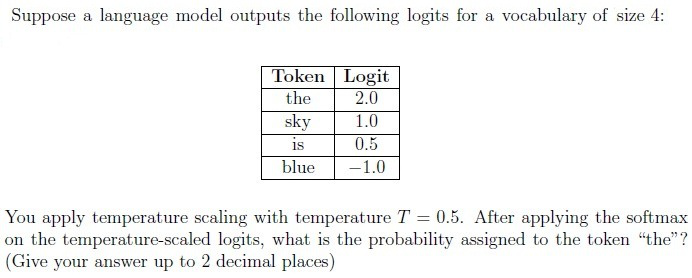
Suppose a language model outputs the following logits for a vocabulary of size 4:
| Token | Logit |
|---|---|
| the | 2.0 |
| sky | 1.0 |
| is | 0.5 |
| blue | -1.0 |
You apply temperature scaling with temperature \(T = 0.5\). After applying the softmax on the temperature-scaled logits, what is the probability assigned to the token “the”? (Give your answer up to 2 decimal places)
Worked answer
Final answer: Approximately 0.84.
Steps: Scale logits by 1/0.5, yielding [4,2,1,−2]; exp(4)/sum(exp([4,2,1,−2])) ≈ 0.842.
Status: derived
verified_by_code: false — depends on figure, no code path
2025 T2 Quiz 1 NA, Q153
Paper: 2025T2_Q1_NA · Type: SA · Marks: 2 · Topic(s): w4-exhaustive-greedy
In exhaustive search, at timestep t=1, we run the decoder once to obtain probability distributions over all tokens in the vocabulary. Given the 6 tokens available in the table in the main question, how many times must we run the decoder at timestep t=4?
Worked answer
Final answer: 216 decoder evaluations.
Steps: At t=4 exhaustive search expands 6^3=216 distinct length-3 prefixes, requiring one evaluation each absent batching.
Status: derived
verified_by_code: true — solve_numeric.py recomputed adjudicated inputs/conventions; all recorded values and adjudication checks MATCH.
2025 T2 Quiz 1 NA, Q154
Paper: 2025T2_Q1_NA · Type: SA · Marks: 1 · Topic(s): w4-exhaustive-greedy
How many total sequences of exactly length 5 are possible according to exhaustive search?
Worked answer
Final answer: 7776 sequences.
Steps: Six possible tokens at each of five positions give 6^5=7776 length-5 sequences.
Status: derived
verified_by_code: true — solve_numeric.py recomputed adjudicated inputs/conventions; all recorded values and adjudication checks MATCH.
2025 T2 Quiz 1 NA, Q155
Paper: 2025T2_Q1_NA · Type: SA · Marks: 2 · Topic(s): w4-topk-temperature
If we use top-k sampling with k=2 at timestep 1, what is the normalized probability of selecting token “sky” at the timestep=1?
Answer key
| Source question | Source identity | Correct answer | PDF pages |
|---|---|---|---|
| 135 | 6406531279474 | All at once (in parallel) | 2 |
| 136 | 6406531279475 | Normalize attention scores to a probability distribution | 3 |
| 137 | 6406531279476 | GPT uses Causal Language Modeling, BERT uses Masked Language Modeling | 3 |
| 138 | 6406531279477 | It increases the diversity of the generated text but may reduce coherence if K is too large. | 3 |
| 139 | 6406531279478 | They help in training deep networks by enabling gradient flow. | 4 |
| 140 | 6406531279479 | The model only attends to past and current tokens during training.; The model is trained by predicting the next token in a sequence. | 4 |
| 141 | 6406531279480 | Transformers process input sequences in parallel, enabling faster training.; Large transformer models can be fine-tuned for various NLP tasks using a single pre-trained model. | 4 |
| 142 | 6406531279481 | [CLS] token at the beginning of input.; [SEP] token to separate sentence A and sentence B.; Segment embeddings to distinguish sentence A and sentence B. | 5 |
| 143 | 6406531279482 | It samples from the smallest set of tokens whose cumulative probability exceeds p. | 5 |
| 144 | 6406531279483 | 1.98 to 2.08 | 6 |
| 145 | 6406531279484 | 0.81 to 0.87 | 7 |
| 146 | 6406531279485 | 0.9 to 1.1 | 7 |
| 147 | 6406531279487 | $\(\begin{bmatrix} 0 & 0 \\ 6 & 12 \end{bmatrix}\)$ | 9, 10 |
| 148 | 6406531279488 | $\(\begin{bmatrix} 1.34 & 2.23 \\ 0.66 & 4.77 \end{bmatrix}\)$ | 10 |
| 149 | 6406531279489 | $\(\begin{bmatrix} 0.00 & 0.00 \\ 3.00 & 6.00 \\ 1.34 & 2.23 \\ 0.66 & 4.77 \end{bmatrix}\)$ | 10, 11 |
| 150 | 6406531279491 | 36 | 12, 13 |
| 151 | 6406531279492 | 8 | 13 |
| 152 | 6406531279493 | 8 | 13 |
| 153 | 6406531279495 | 216 | 14 |
| 154 | 6406531279496 | 7776 | 14, 15 |
| 155 | 6406531279497 | 0.41 | 15 |
Extraction notes
Status: verified
Count reconciliation: Section 8 declares 16 questions and 50 marks. The 16 portal question units correspond to 1 administrative subject-confirmation question (Question 134, 0 marks), 12 standalone academic questions (Questions 135-139 [5 MCQs x 2 = 10 marks], Questions 140-143 [4 MSQs x 3 = 12 marks], Questions 144-146 [3 SAs x 3 = 9 marks]), and 3 comprehension blocks (Questions 147-149 [3+3+2 = 8 marks], Questions 150-152 [1+2+3 = 6 marks], and Questions 153-155 [2+1+2 = 5 marks]). Total academic questions reconcile to exactly 21 (12 standalone + 9 comprehension subquestions). Marks sum to 10 + 12 + 9 + 8 + 6 + 5 = 50, matching the declared Section Marks of 50.
Excluded source entries:
- {"classification": "out-of-scope-section", "page": 1, "bbox": [0.0, 0.0, 595.3, 491.39], "reason": "Preceding section exam content (options 6406534313773 to 6406534313775, and Question 133) prior to Section 8 LLM header", "identity": "preceding-section"}
- {"classification": "subject-confirmation", "page": 2, "bbox": [22.87, 80.0, 580.0, 280.0], "reason": "Administrative subject confirmation asking candidate to confirm subject and cross check hall ticket", "identity": "134"}
- {"classification": "out-of-scope-section", "page": 15, "bbox": [0.0, 406.5, 595.3, 841.9], "reason": "Subsequent Section 9 DL(CV) exam header terminating LLM section", "identity": "following-section-9"}
Worked answer
Final answer: 0.23/(0.33+0.23) ≈ 0.411.
Steps: The first column gives blue 0.33 and sky 0.23 as the top two; sky renormalizes to 0.23/(0.33+0.23)=0.410714. The column totals 0.92, but any omitted mass totals only 0.08 and cannot displace either token.
Status: derived
verified_by_code: true — solve_numeric.py recomputed adjudicated inputs/conventions; all recorded values and adjudication checks MATCH.
2025 T3 Quiz 1 NA, Q178
Paper: 2025T3_Q1_NA · Type: MCQ · Marks: 2 · Topic(s): w4-exhaustive-greedy
Given a vocabulary of size \(|V|\), how many sequences of maximum length 5 are possible?

A. \(|V|^5\)
Label added for presentation.

B. \(5 \cdot |V|\)
Label added for presentation.

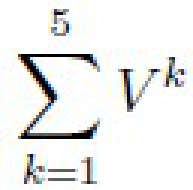
C. \(\sum_{k=1}^5 |V|^k\)
Label added for presentation.
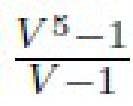
D. \(\frac{|V|^5 - 1}{|V| - 1}\)
Label added for presentation.
Worked answer
Final answer: C: Σ(k=1..5) |V|^k.
Steps: Count all nonempty lengths 1 through 5. A counts only length 5; B is linear instead of exponential; D sums lengths 0 through 4.
Status: derived
verified_by_code: false — Non-numeric response; no numeric checker path applies.
2025 T3 Quiz 1 NA, Q180
Paper: 2025T3_Q1_NA · Type: MCQ · Marks: 3 · Topic(s): w4-exhaustive-greedy
For a vocabulary of size \(V\) and a fixed sequence length \(L\), exhaustive decoding evaluates all possible sequences of length \(L\). If we increase the sequence length to \(L + 1\), how many additional sequences will need to be evaluated?

A. Same, no change
Label added for presentation.

B. \(V^L\) more sequences
Label added for presentation.

C. \((V - 1) \cdot V^L\) more sequences
Label added for presentation.

D. \(V\) more sequences
Label added for presentation.

E. One more sequence
Label added for presentation.

Worked answer
Final answer: C: (V−1)V^L
Steps: Exhaustive search over length L has V^L candidates; over length L+1 it has V^(L+1). The increase in candidate count is V^(L+1)−V^L=(V−1)V^L. “Additional” naturally asks for the increase, rather than a count of the identities of new strings.
Status: derived
verified_by_code: false — Non-numeric response; no numeric checker path applies.
2025 T3 Quiz 1 NA, Q181
Paper: 2025T3_Q1_NA · Type: MCQ · Marks: 3 · Topic(s): w4-beam-search
For a vocabulary size of 10, how many beams will there be in greedy search, beam search with beam size 3, and exhaustive search at step 1 and step 3, respectively?
A. Step 1:
Greedy: 1, Beam: 1, Exhaustive: 1
Step 3:
Greedy: 1, Beam: 1, Exhaustive: 1
Label added for presentation.
B. Step 1:
Greedy: 1, Beam: 3, Exhaustive: 10
Step 3:
Greedy: 1, Beam: 3, Exhaustive: 10
Label added for presentation.
C. Step 1:
Greedy: 1, Beam: 3, Exhaustive: 1
Step 3:
Greedy: 1, Beam: 3, Exhaustive: 100
Label added for presentation.
D. Step 1:
Greedy: 1, Beam: 3, Exhaustive: 10
Step 3:
Greedy: 1, Beam: 3, Exhaustive: 1000
Label added for presentation.
Worked answer
Final answer: D.
Steps: After one token the retained counts are 1, 3, 10; after three, 1, 3, 10^3. A, B and C incorrectly count beam or exhaustive prefixes.
Status: derived
verified_by_code: true — solve_numeric.py recomputed adjudicated inputs/conventions; all recorded values and adjudication checks MATCH.
2025 T3 Quiz 1 NA, Q182
Paper: 2025T3_Q1_NA · Type: MSQ · Marks: 2 · Topic(s): w4-topp-nucleus
Which of the following decoding strategies is/are inherently non-deterministic?
A. Beam
Label added for presentation.
B. Greedy
Label added for presentation.
C. Nucleus
Label added for presentation.
D. Exhaustive
Label added for presentation.
Worked answer
Final answer: C: nucleus sampling.
Steps: Sampling draws randomly from the nucleus. A beam, B greedy, and D exhaustive search are deterministic under fixed tie-breaking.
Status: derived
verified_by_code: false — Non-numeric response; no numeric checker path applies.
2025 T3 Quiz 1 NA, Q185
Paper: 2025T3_Q1_NA · Type: MSQ · Marks: 4 · Topic(s): w4-beam-search
A transformer decoder uses a vocabulary of size 5. At step 1, the predicted token probabilities are:
| Token | Probability |
|---|---|
| A | 0.40 |
| B | 0.30 |
| C | 0.20 |
| D | 0.05 |
| E | 0.05 |
Which statement(s) is/are correct?
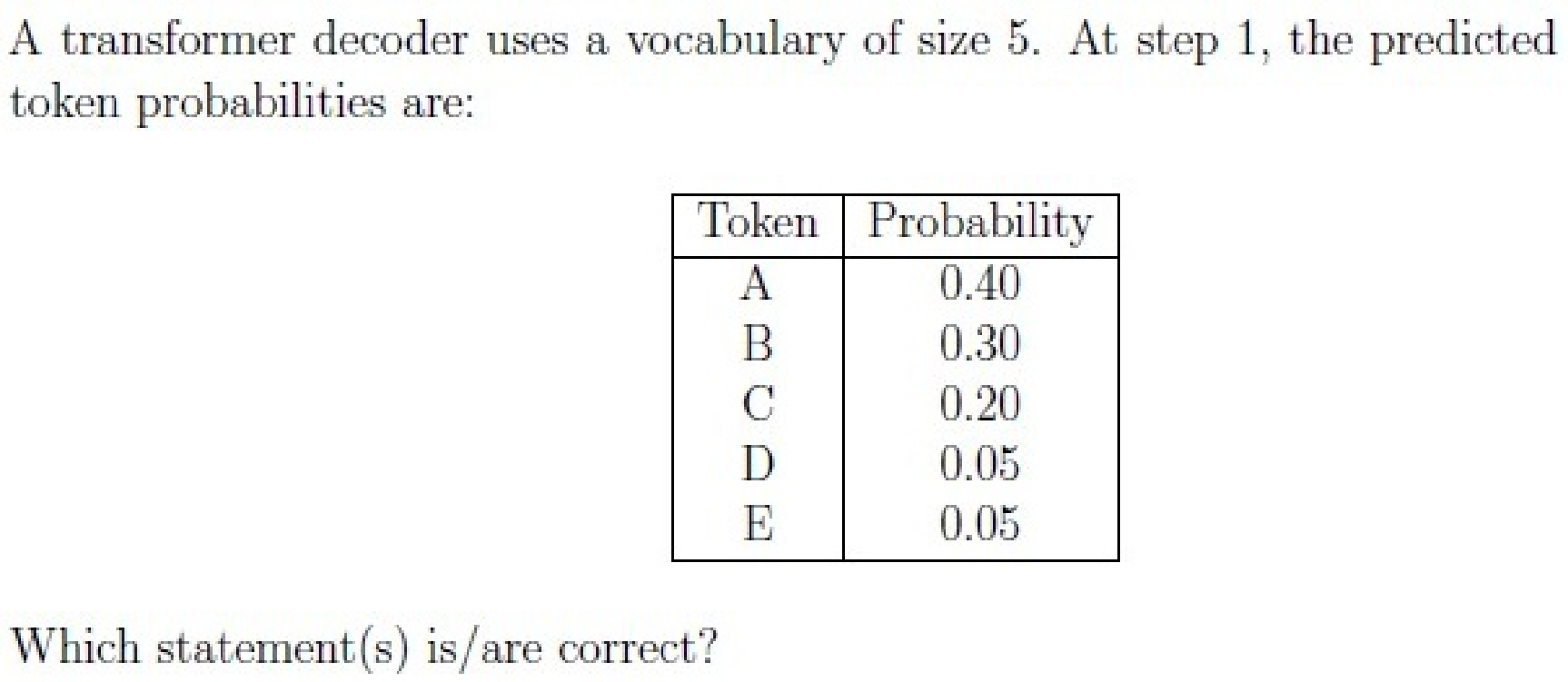
A. Beam search with beam size 2 will keep either A or B as per probability whereas Top-2 sampling will keep both A and B.
Label added for presentation.
B. Beam search with beam size 2 will keep both A and B whereas Top-2 sampling will keep either A or B.
Label added for presentation.
C. Beam search with beam size 2 will randomly choose any two tokens, whereas Top-2 sampling will always pick the two least probable tokens.
Label added for presentation.
D. Beam search with beam size 2 will always keep the top-2 most probable tokens, whereas Top-2 sampling will restrict choices to top-2 tokens and then sample one probabilistically.
Label added for presentation.
Worked answer
Final answer: B and D.
Steps: Beam width 2 retains both A and B; top-2 filters to both then draws one. A reverses the two roles; C claims random beam selection and least-probable filtering.
Status: derived
verified_by_code: false — Non-numeric response; no numeric checker path applies.
2026 T1 Quiz 1 NA, Q6
Paper: 2026T1_Q1_NA · Type: MCQ · Marks: 2 · Topic(s): w4-bert-nsp-inputs
Consider the BERT architecture. During pre-training, it uses segment embeddings (\(E_A, E_B\)) to distinguish between sentences. However, during fine-tuning for a single-sentence classification task (e.g., Sentiment Analysis), how are these segment embeddings typically utilized?
A. Segment embeddings are not used; the embedding layer is disabled for single-sentence tasks.
B. All tokens in the input sequence are assigned the same segment embedding (e.g., \(E_A\)).
C. The first half of the sentence gets \(E_A\) and the second half gets \(E_B\) to maintain symmetry.
D. Segment embeddings are randomly initialized for every new single-sentence input.
Worked answer
Final answer: B.
Steps: Single-sentence input normally assigns the same learned segment-A embedding to every token. A disables an active embedding, C invents a split, and D incorrectly reinitializes parameters.
Status: derived
verified_by_code: false — Non-numeric response; no numeric checker path applies.
2026 T1 Quiz 1 NA, Q7
Paper: 2026T1_Q1_NA · Type: MCQ · Marks: 2 · Topic(s): w4-topk-temperature
Consider a decoding step in a language model where the logits for the next token are \(z = [2.0, 1.0, 0.5]\). We apply a temperature scaling \(z/T\) before the softmax. As \(T \to 0\) (approaches zero), what does the resulting probability distribution \(P(x)\) look like?
A. It approaches a uniform distribution where all tokens have equal probability.
B. It approaches a "one-hot" distribution where the token with the highest logit has probability 1.0 (Greedy Search).
C. It remains unchanged from the original softmax distribution.
D. It causes numerical instability and results in NaNs.
Worked answer
Final answer: B.
Steps: For a unique maximum, softmax(z/T) converges to [1,0,0] as T→0+. A is the high-temperature limit, C is false, D confuses numerical implementation with the mathematical limit.
Status: derived
verified_by_code: false — Non-numeric response; no numeric checker path applies.
2026 T1 Quiz 1 NA, Q8
Paper: 2026T1_Q1_NA · Type: MCQ · Marks: 2 · Topic(s): w4-bert-finetuning
You are fine-tuning a pre-trained BERT model for a spam classification task. The input sequence is: [CLS] Win a free iPhone now [SEP]. Which vector from the final layer output is typically passed to the classification head (\(W_v\))?
A. The average pooling of all token vectors.
B. The final hidden state vector corresponding to the [SEP] token (\(h_{sep}\)).
C. The final hidden state vector corresponding to the [CLS] token (\(h_{cls}\)).
D. The concatenation of all hidden state vectors.
Worked answer
Final answer: C: final [CLS] hidden state.
Steps: BERT’s standard sequence classification head uses [CLS]. A is alternative pooling, B uses [SEP], D concatenates variable numbers of vectors.
Status: derived
verified_by_code: false — Non-numeric response; no numeric checker path applies.
2026 T2 Quiz 1 NA, Q14
Paper: 2026T2_Q1_NA · Type: SA · Marks: 2 · Topic(s): w4-exhaustive-greedy
Use greedy decoding to determine the most likely sequence of 6 tokens and compute the probability of generating that sequence. Enter the value rounded off to 3 decimal places
Worked answer
Final answer: historic castle was majestic but abandoned; probability 0.005.
Steps: Select column maxima 0.38, 0.40, 0.50, 0.35, 0.45, 0.40; their product is 0.004788, rounded to 0.005.
Status: derived
verified_by_code: true — solve_numeric.py recomputed adjudicated inputs/conventions; all recorded values and adjudication checks MATCH.
2026 T2 Quiz 1 NA, Q15
Paper: 2026T2_Q1_NA · Type: SA · Marks: 2 · Topic(s): w4-exhaustive-greedy
Use exhaustive search strategy to identify the most probable sequence consisting of 4 tokens. How many decoder runs are required in total to identify the most probable sequence containing 4 tokens?
Worked answer
Final answer: 400 unbatched prefix evaluations; 4 batched depth-wise forward passes
Steps: General exhaustive decoding evaluates 1+7+7²+7³=400 prefixes to assign probabilities to four tokens. If “decoder run” means batched forward pass, four depth-wise calls suffice; if the supplied table is reusable and prefix-invariant, the computation needs no additional model calls. The usual course search-tree convention implies 400 but the unit is not defined.
Status: ambiguous
Ambiguity note: Implied course/exam convention: 400 unbatched prefix evaluations; 4 batched depth-wise forward passes. General exhaustive decoding evaluates 1+7+7²+7³=400 prefixes to assign probabilities to four tokens. If “decoder run” means batched forward pass, four depth-wise calls suffice; if the supplied table is reusable and prefix-invariant, the computation needs no additional model calls. The usual course search-tree convention implies 400 but the unit is not defined.
verified_by_code: true — solve_numeric.py recomputed adjudicated inputs/conventions; all recorded values and adjudication checks MATCH.
2026 T2 Quiz 1 NA, Q16
Paper: 2026T2_Q1_NA · Type: SA · Marks: 3 · Topic(s): w4-topk-temperature
Use Top-k sampling at timestep t = 4 and k = 3. Compute the renormalized probability of the most probable token from the candidate tokens and enter the value rounded off to three decimal places
Worked answer
Final answer: 0.412.
Steps: At t=4 the top three are 0.35, 0.30, 0.20; normalize 0.35/0.85≈0.411765.
Status: derived
verified_by_code: true — solve_numeric.py recomputed adjudicated inputs/conventions; all recorded values and adjudication checks MATCH.
2026 T2 Quiz 1 NA, Q17
Paper: 2026T2_Q1_NA · Type: SA · Marks: 2 · Topic(s): w4-beam-search
Consider the sequence "the castle was abandoned". What is the minimum beam width required to guarantee that this sequence is retained during beam search at timestep t = 4 ?
Answer key
| Source question | Source identity | Correct answer | PDF pages |
|---|---|---|---|
| 2 | 6406532166233 | A, C | 2 |
| 3 | 6406532166235 | 4 | 3 |
| 4 | 6406532166236 | A | 3 |
| 5 | 6406532166237 | 144 | 4 |
| 6 | 6406532166238 | 32768 | 4 |
| 7 | 6406532166239 | 8128 | 4, 5 |
| 8 | 6406532166240 | 256 | 5 |
| 9 | 6406532166241 | B | 5, 6 |
| 10 | 6406532166243 | 0.17 to 0.19 | 6, 7 |
| 11 | 6406532166244 | C | 7 |
| 12 | 6406532166245 | -1 | 7 |
| 13 | 6406532166246 | A, B, E | 7, 8 |
| 14 | 6406532166248 | 0.004 to 0.0055 | 8, 9 |
| 15 | 6406532166249 | 400 | 9 |
| 16 | 6406532166250 | 0.410 to 0.414 | 9 |
| 17 | 6406532166251 | 5 | 9, 10 |
Extraction notes
Status: verified
Count reconciliation: Section 1 (LLM) declares 11 questions and 50 marks. The 11 portal containers comprise 1 administrative subject-confirmation entry (Question 1, 0 marks, excluded), 7 standalone academic questions (Question 2: 4 marks, Question 5: 4 marks, Question 6: 4 marks, Question 7: 4 marks, Question 8: 4 marks, Question 9: 4 marks, Question 13: 3 marks; total standalone = 27 marks), and 3 comprehension portal containers (Comprehension 6406532166234 covering Q3: 3 marks, Q4: 3 marks; Comprehension 6406532166242 covering Q10: 3 marks, Q11: 3 marks, Q12: 2 marks; Comprehension 6406532166247 covering Q14: 2 marks, Q15: 2 marks, Q16: 3 marks, Q17: 2 marks; total comprehension = 6 + 8 + 9 = 23 marks). The total academic questions reconcile to exactly 16 (7 standalone + 9 comprehension subquestions). The marks sum to 27 + 23 = 50 marks, exactly reconciling the declared Section Marks of 50. The 11 declared questions correspond exactly to the 11 portal containers (1 confirmation + 7 standalone + 3 comprehension blocks).
- Exam section 1 LLM runs from physical page 1 to page 10.
- Comprehension passages ctx-3-4, ctx-10-12, and ctx-14-17 provide shared context for subquestions (3 to 4), (10 to 12), and (14 to 17) respectively.
- All formulas, projection matrices, probability tree diagrams, and vocabulary decoding tables were verified against source rasters with high-resolution crops at 288 DPI.
Excluded source entries:
- {"classification": "subject-confirmation", "page": 1, "bbox": [22.87, 750.0, 580.0, 841.9], "reason": "Administrative subject confirmation asking candidate to confirm subject and cross check hall ticket", "identity": "1"}
Worked answer
Final answer: 5 beams.
Steps: The target prefix products through t=4 are 0.30, 0.12, 0.06, 0.018. Under the given prefix-invariant table, its global ranks are 2, 2, 2, 5, so width 5 retains it at each step.
Status: derived
verified_by_code: true — solve_numeric.py recomputed adjudicated inputs/conventions; all recorded values and adjudication checks MATCH.
Quiz 2 questions
2025 T3 Quiz 2 NA, Q115
Paper: 2025T3_Q2_NA · Type: MSQ · Marks: 2 · Topic(s): w4-beam-search
Which decoding method ensures the same response every time for a given prompt (assuming no randomness in model weights)? Select all that apply.
A. Top-k with k = 3, temperature > 1
B. Top-k with k = 3, temperature = 1
C. Top-p with p = 0.2, Temperature > 1
D. Top-p with p = 0.2, Temperature = 1
E. Beam Search with beam-size = 5
F. Beam Search with beam-size = 1
Worked answer
Final answer: E and F.
Steps: Ordinary beam search is deterministic with fixed tie-breaking; width one reduces to greedy. A–D sample and need not repeat when the candidate set has multiple tokens.
Status: derived
verified_by_code: false — Non-numeric response; no numeric checker path applies.
2026 T1 Quiz 2 NA, Q3
Paper: 2026T1_Q2_NA · Type: MCQ · Marks: 2 · Topic(s): w4-bert-mlm
In the Masked Language Modeling (MLM) objective of BERT, 15% of tokens are chosen for prediction. Of these chosen tokens, 80% are replaced with [MASK], 10% are replaced with a random word, and 10% are left unchanged. What is the primary theoretical motivation for keeping 10% of the tokens unchanged?
A. To reduce the computational cost of the softmax layer during training.
B. To prevent the network from overfitting to the [MASK] token.
C. To mitigate the mismatch between pre-training (where [MASK] appears) and fine-tuning (where [MASK] does not appear), ensuring the model creates meaningful representations for non-masked words.
D. To act as a regularizer similar to Dropout.
Worked answer
Final answer: C.
Steps: Unchanged selected tokens reduce pretraining/fine-tuning input mismatch and encourage contextual representations of ordinary tokens. A has no softmax saving; B is related but less complete; D is not the stated motivation.
Status: derived
verified_by_code: false — Non-numeric response; no numeric checker path applies.
2026 T1 Quiz 2 NA, Q4
Paper: 2026T1_Q2_NA · Type: MCQ · Marks: 2 · Topic(s): w4-bert-mlm
Why is the standard GPT architecture (Decoder-only with causal masking) generally unsuitable for the Masked Language Modeling (MLM) objective as implemented in BERT?
A. GPT models are too small to learn bidirectional contexts.
B. The causal mask in GPT prevents the model from attending to future tokens, making it impossible to use right-side context to predict a masked token.
C. GPT does not have positional embeddings, which are required for MLM.
D. GPT uses ReLU activation, while BERT uses GELU, which is required for MLM.
Worked answer
Final answer: B.
Steps: GPT’s causal mask blocks right-hand context, unlike BERT MLM. A cites size, C incorrectly denies positional embeddings, and D incorrectly makes activation choice decisive.
Status: derived
verified_by_code: false — Non-numeric response; no numeric checker path applies.
2026 T1 Quiz 2 NA, Q17
Paper: 2026T1_Q2_NA · Type: SA · Marks: 3 · Topic(s): w4-topk-temperature
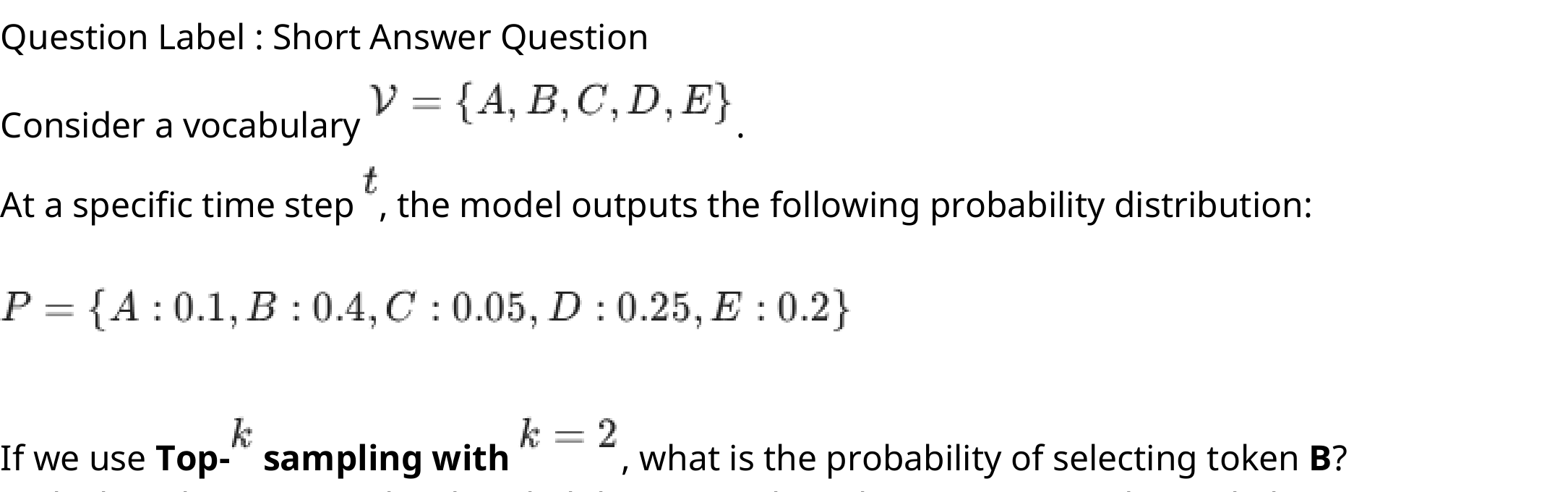
Consider a vocabulary \(\mathcal{V} = \{A, B, C, D, E\}\).
At a specific time step \(t\), the model outputs the following probability distribution:
$\(P = \{A : 0.1, B : 0.4, C : 0.05, D : 0.25, E : 0.2\}\)$
If we use Top-\(k\) sampling with \(k = 2\), what is the probability of selecting token B?
(Calculate the re-normalized probability. Enter the value correct to 2 decimal places).
Worked answer
Final answer: 0.62.
Steps: Top two are B=0.4 and D=0.25; normalize P(B)=0.4/0.65≈0.61538.
Status: derived
verified_by_code: false — depends on figure, no code path
2026 T1 Quiz 2 NA, Q18
Paper: 2026T1_Q2_NA · Type: SA · Marks: 3 · Topic(s): w4-bert-architecture-params
Consider a small BERT-like model with the following configuration:
• Embedding dimension (\(d_{model}\)) = 128
• Vocabulary size (\(|V|\)) = 5000
• Maximum sequence length (\(T\)) = 64
• Number of segment types = 2
Calculate the total number of parameters in the Embedding Layer (sum of Token embeddings, Position embeddings, and Segment embeddings).
Enter the exact integer value.
Worked answer
Final answer: 648448 parameters.
Steps: Token, position and segment tables contribute 5000×128 + 64×128 + 2×128 = 640000+8192+256=648448.
Status: derived
verified_by_code: true — solve_numeric.py recomputed adjudicated inputs/conventions; all recorded values and adjudication checks MATCH.
2026 T2 Quiz 2 NA, Q10
Paper: 2026T2_Q2_NA · Type: MCQ · Marks: 3 · Topic(s): w4-topp-nucleus
In the decoding phase of a Language model, temperature scaling with \(T = 5\) is applied to the output logits before performing top-\(p\) (nucleus) sampling. Which of the following options best describes the impact of the temperature scaling on the subsequent sampling step?

A. Increases the required number of candidate tokens thus expanding the
nucleus.
B. Decreases the required number of candidate tokens thus shrinking the
nucleus.
C. Truncates the tail of the distribution causing the sampling to behave similar to top-\(k\) sampling.
D. Size of the nucleus remains unaffected by the temperature scaling as it only
depends on order of the tokens.
Worked answer
Final answer: A
Steps: At T=5 versus T=1, softmax is flatter and the cumulative mass of any fixed top-k prefix cannot increase, so the nucleus size cannot decrease. It can stay equal for some logits and p, but A best describes the trend among the choices; the question asks for the best description, not a universal strict inequality.
Status: derived
verified_by_code: false — Non-numeric response; no numeric checker path applies.
End Term questions
2024 T1 End Term AN, Q148
Paper: 2024T1_ET_AN · Type: SA · Marks: 4 · Topic(s): w4-exhaustive-greedy
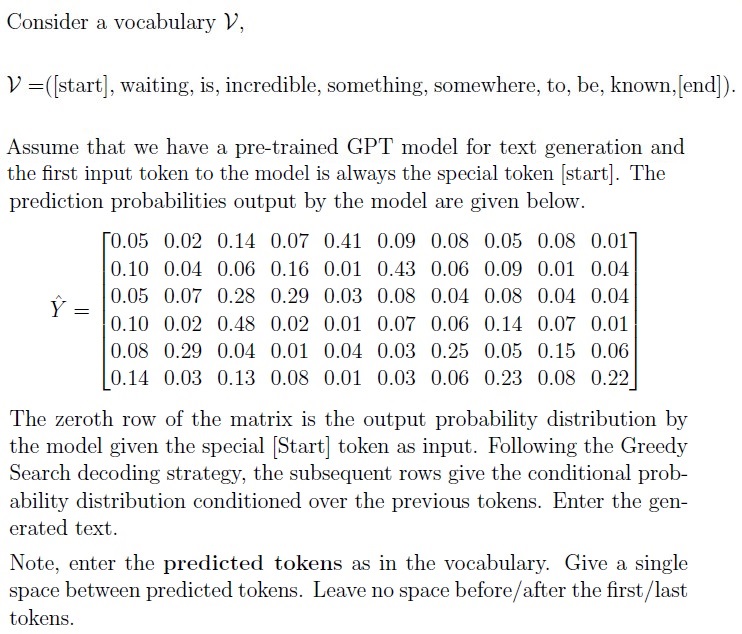
Consider a vocabulary \(V\),
Assume that we have a pre-trained GPT model for text generation and the first input token to the model is always the special token [start]. The prediction probabilities output by the model are given below.
The zeroth row of the matrix is the output probability distribution by the model given the special [start] token as input. Following the Greedy Search decoding strategy, the subsequent rows give the conditional probability distribution conditioned over the previous tokens. Enter the generated text.
Note, enter the predicted tokens as in the vocabulary. Give a single space between predicted tokens. Leave no space before/after the first /last tokens.
Worked answer
Final answer: something somewhere incredible is waiting be
Steps: Take each row maximum: 0.41, 0.43, 0.29, 0.48, 0.29, 0.23. No [end] is selected in these six rows.
Status: derived
verified_by_code: false — depends on figure, no code path
2024 T1 End Term AN, Q150
Paper: 2024T1_ET_AN · Type: MSQ · Marks: 3 · Topic(s): w4-exhaustive-greedy, w4-beam-search, w4-topk-temperature, w4-topp-nucleus
A user runs inference on the model N times with an input text that contains 712 tokens (including the special [start] token). However, the user observed that in each run the model generated the exact same summary. Based on this observation, select the decoding strategy that the model might be using
A. Greedy decoding strategy
Label added for presentation.
B. Beam search with beam size K > 2
Label added for presentation.
C. Top-k sampling with k > 3
Label added for presentation.
D. Top-p sampling with p = 0.25
Label added for presentation.
E. Greedy decoding by varying the temperature parameter T in the softmax function for each run
Label added for presentation.
Worked answer
Final answer: A, B, C, D, E
Steps: The question asks what might have happened, not what guarantees repetition. Greedy and beam can repeat; top-k and top-p may sample the same sequence repeatedly, including a singleton nucleus; positive temperature does not change greedy argmax. Thus all five are possible, assuming a finite number of runs and consistent ties. The old note correctly observes this distinction but treats the conditional alternative as ambiguity.
Status: derived
verified_by_code: false — Non-numeric response; no numeric checker path applies.
2024 T1 End Term FN, Q198
Paper: 2024T1_ET_FN · Type: MCQ · Marks: 2 · Topic(s): w4-bert-architecture-params
BERT stands for
A. Bidirectional Encoder Representation for Text
Label added for presentation.
B. Bidirectional Encoder Representation from Transformer
Label added for presentation.
C. Bidirectionaly Extracted Representation from Transformer
Label added for presentation.
D. Bidirectionaly Extracted Representation of Text
Label added for presentation.
Worked answer
Final answer: B
Steps: B is the unique option with the correct constituent words Bidirectional Encoder Representation from Transformer. The primary BERT paper uses plurals, “Representations from Transformers”; the singular inflection does not alter which option expands the acronym.
Status: derived
verified_by_code: false — Non-numeric response; no numeric checker path applies.
2024 T1 End Term FN, Q201
Paper: 2024T1_ET_FN · Type: SA · Marks: 4 · Topic(s): w4-exhaustive-greedy
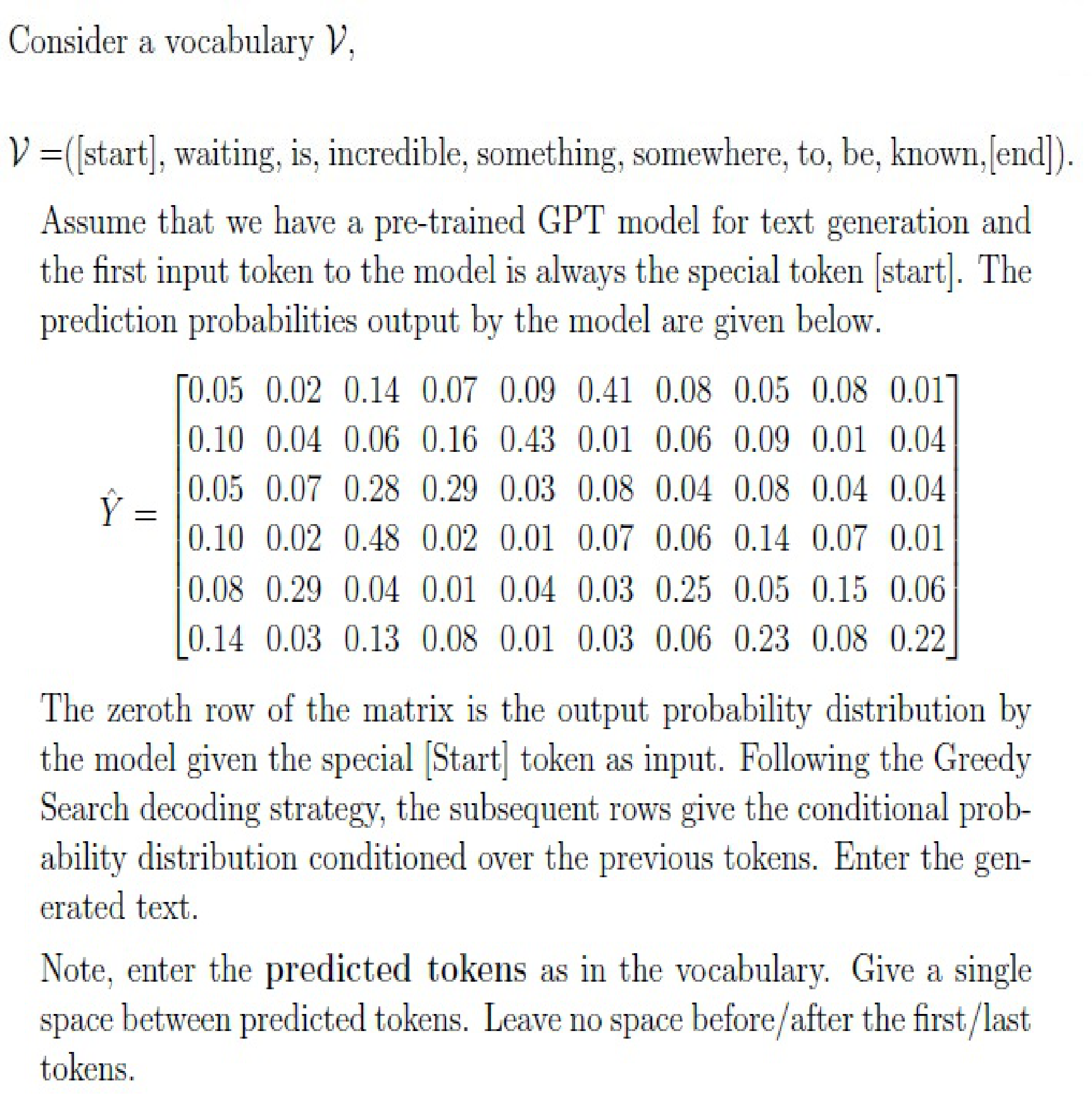
Consider a vocabulary \(V\),
Assume that we have a pre-trained GPT model for text generation and the first input token to the model is always the special token \([\text{start}]\). The prediction probabilities output by the model are given below.
The zeroth row of the matrix is the output probability distribution by the model given the special \([\text{Start}]\) token as input. Following the Greedy Search decoding strategy, the subsequent rows give the conditional probability distribution conditioned over the previous tokens. Enter the generated text.
Note, enter the predicted tokens as in the vocabulary. Give a single space between predicted tokens. Leave no space before/after the first/last tokens.
Worked answer
Final answer: somewhere something incredible is waiting be
Steps: Select the largest entry in each row: 0.41, 0.43, 0.29, 0.48, 0.29, 0.23; no [end] appears.
Status: derived
verified_by_code: false — depends on figure, no code path
2024 T1 End Term FN, Q203
Paper: 2024T1_ET_FN · Type: MSQ · Marks: 3 · Topic(s): w4-exhaustive-greedy, w4-beam-search, w4-topk-temperature, w4-topp-nucleus
A user runs inference on the model N times with an input text that contains 712 tokens (including the special [start] token). However, the user observed that in each run the model generated the exact same summary. Based on this observation, select the decoding strategy that the model might be using
A. Greedy decoding strategy
Label added for presentation.
B. Beam search with beam size K > 2
Label added for presentation.
C. Top-k sampling with K > 3
Label added for presentation.
D. Top-P sampling with p = 0.25
Label added for presentation.
E. Greedy decoding by varying the temperature parameter T in the softmax function for each run
Label added for presentation.
Worked answer
Final answer: A, B, C, D, E
Steps: The question asks what might have happened, not what guarantees repetition. Greedy and beam can repeat; top-k and top-p may sample the same sequence repeatedly, including a singleton nucleus; positive temperature does not change greedy argmax. Thus all five are possible, assuming a finite number of runs and consistent ties. The old note correctly observes this distinction but treats the conditional alternative as ambiguity.
Status: derived
verified_by_code: false — Non-numeric response; no numeric checker path applies.
2024 T3 End Term AN, Q178
Paper: 2024T3_ET_AN · Type: MCQ · Marks: 3 · Topic(s): w4-exhaustive-greedy, w4-beam-search, w4-topk-temperature
Suppose we use a pre-trained model for text generation with the given prompt “I am going to”.
Which of the following decoding strategies can be used such that the pre-trained model generates
same text completion each time it is executed
A. Beam search with beam size 4
B. Greedy approach
C. Top-K with k = 2
D. None of these
Worked answer
Final answer: A and B
Steps: With a fixed model and deterministic tie-breaking both beam search with width four and greedy decoding return the same completion. The item is single-choice but has two correct choices.
Status: ambiguous
Ambiguity note: With a fixed model and deterministic tie-breaking both beam search with width four and greedy decoding return the same completion. The item is single-choice but has two correct choices.
verified_by_code: false — No numeric checker path; answer remains explicitly ambiguous.
2024 T3 End Term FN, Q196
Paper: 2024T3_ET_FN · Type: MCQ · Marks: 3 · Topic(s): w4-topk-temperature
Suppose we use a pre-trained model for text generation with the given prompt “I am going to”. Which of the following decoding strategies can be used such that the pre-trained model generates different text completion each time it is executed
A. Beam search with beam size 1
Label added for presentation.
B. Greedy approach
Label added for presentation.
C. Top-K with k = 2
Label added for presentation.
D. None of these
Label added for presentation.
Worked answer
Final answer: C
Steps: Top-k sampling with k=2 is the only listed stochastic method and can yield different continuations; width-one beam search and greedy search are deterministic with fixed ties. A sample need not differ on every run, but the standard contrast asks which can produce variation.
Status: derived
verified_by_code: false — Non-numeric response; no numeric checker path applies.
2025 T2 End Term AN, Q198
Paper: 2025T2_ET_AN · Type: SA · Marks: 2 · Topic(s): w4-topp-nucleus
Consider the following probability distribution over a vocabulary of 10 tokens:
[0.06, 0.20, 0.14, 0.06, 0.09, 0.08, 0.05, 0.15, 0.06, 0.11]
You apply top-p (nucleus) sampling with p = 0.7. How many tokens are included in the sampling pool?

Worked answer
Final answer: 6 tokens.
Steps: Sorted probabilities accumulate 0.20+0.15+0.14+0.11=0.60; adding 0.09 reaches 0.69 and the sixth, 0.08, reaches 0.77.
Status: derived
verified_by_code: false — depends on figure, no code path
2025 T2 End Term FN, Q141
Paper: 2025T2_ET_FN · Type: MSQ · Marks: 3 · Topic(s): w4-exhaustive-greedy, w4-beam-search, w4-topk-temperature, w4-topp-nucleus
A GPT-based model is fine-tuned for story generation. During evaluation, you test different
decoding strategies on the same prompt:
- Method A: Every run produces the exact same story, even when executed multiple times.
-
Method B: The story changes slightly in each run, but overall structure and key events remain
similar. -
Method C: The story is wildly different each time, sometimes even changing the genre.
Based on the observations, select the most likely decoding strategies for each method:
A. Method A: Greedy decoding
Label added for presentation.
B. Method A: Top-K sampling with K = 50
Label added for presentation.
C. Method B: Top-P sampling with p = 0.9
Label added for presentation.
D. Method C: Top-P sampling with p = 0.5 and high temperature T = 1.5
Label added for presentation.
E. Method C: Beam search with K = 5
Label added for presentation.
Worked answer
Final answer: A, B, C and D are possible; the most likely assignments are not identifiable
Steps: Deterministic greedy is consistent with repeated stories, and top-p sampling can produce variation; a fixed model and unspecified stochastic seed, sample size, probability distribution and priors do not determine the “most likely” mappings. Top-k can repeat by chance and p=0.5 can even yield a one-token nucleus despite T=1.5.
Status: ambiguous
Ambiguity note: Deterministic greedy is consistent with repeated stories, and top-p sampling can produce variation; a fixed model and unspecified stochastic seed, sample size, probability distribution and priors do not determine the “most likely” mappings. Top-k can repeat by chance and p=0.5 can even yield a one-token nucleus despite T=1.5.
verified_by_code: false — No numeric checker path; answer remains explicitly ambiguous.
2025 T2 End Term FN, Q143
Paper: 2025T2_ET_FN · Type: MSQ · Marks: 3 · Topic(s): w4-topk-temperature, w4-topp-nucleus
Which of the following statements about Top-k and Nucleus (Top-p) sampling are correct?
A. Top-k keeps only the k most probable tokens before sampling.
Label added for presentation.
B. Top-p dynamically chooses the smallest set of tokens whose cumulative
probability exceeds p.
Label added for presentation.
C. Top-k is always a subset of Top-p.
Label added for presentation.
D. Top-p always has a fixed number of candidate tokens.
Label added for presentation.
Worked answer
Final answer: A and B.
Steps: A retains k largest probabilities. B retains the smallest prefix reaching p (the question says exceeds). C is false because their candidate sets vary independently; D is false since nucleus size varies.
Status: derived
verified_by_code: false — Non-numeric response; no numeric checker path applies.
2025 T2 End Term FN, Q145
Paper: 2025T2_ET_FN · Type: SA · Marks: 3 · Topic(s): w4-topk-temperature
Suppose a language model outputs the following logits for a vocabulary of size 4:
| Token | Logit |
|---|---|
| cat | 1.5 |
| sat | 0.5 |
| on | 0.0 |
| mat | -0.5 |
You apply Low Temperature Sampling with temperature \(T = 2.0\). After applying the softmax on the temperature-scaled logits, what is the probability assigned to the token “cat”? (Give your answer up to 2 decimal places)
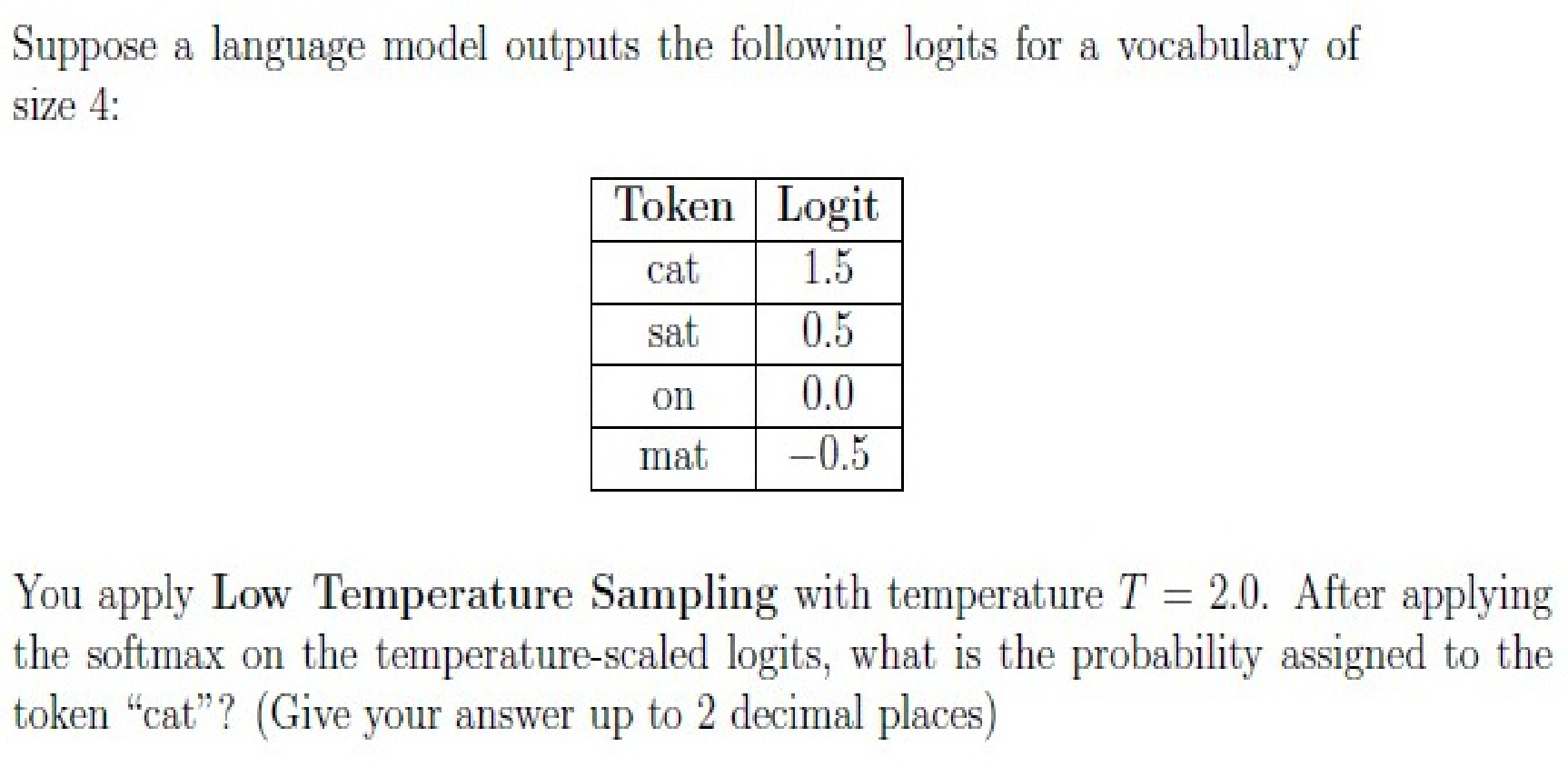
Worked answer
Final answer: 0.41
Steps: The explicit temperature is T=2 regardless of the erroneous adjective “low”. Softmax gives exp(1.5/2)/[exp(1.5/2)+exp(0.5/2)+exp(0)+exp(-0.5/2)]=0.40870097, which rounds to 0.41.
Status: derived
verified_by_code: true — solve_numeric.py recomputed adjudicated inputs/conventions; all recorded values and adjudication checks MATCH.
2025 T3 End Term AN, Q2
Paper: 2025T3_ET_AN · Type: MCQ · Marks: 2 · Topic(s): w4-topk-temperature
A language model produces the following logits for the next token:
{apple : 2.1, banana : 1.8, grape : 0.4, orange : 0.3, melon : -1.0}
Before sampling, the model applies:
• Temperature scaling with \(T = 0.5\)
• Top-K sampling with \(K = 2\)
Which tokens are eligible to be sampled?

A. Only ''apple''
B. "apple'' or ''banana''
C. "apple'', ''banana'' or ''grape''
D. "apple''or ''grape''
Worked answer
Final answer: B: apple or banana.
Steps: Dividing by positive T preserves ranking; the two largest logits are 2.1 and 1.8. A omits banana, C includes a third token, D replaces banana with grape.
Status: derived
verified_by_code: false — Non-numeric response; no numeric checker path applies.
2025 T3 End Term AN, Q5
Paper: 2025T3_ET_AN · Type: MCQ · Marks: 2 · Topic(s): w4-bert-finetuning
For a 4-category classification task, how would you use BERT's output?
A. Use all token embeddings and average them.
B. Use the [CLS] token embedding as input to a classification layer.
C. Use only the [SEP] token
D. Use the [MASK] token predictions.
Worked answer
Final answer: B: use [CLS] for a classification head.
Steps: Original BERT uses final [CLS] representation and a classifier. A is a possible alternative pooling method, not the canonical BERT design; C and D do not specify the standard sequence classifier.
Status: derived
verified_by_code: false — Non-numeric response; no numeric checker path applies.
2025 T3 End Term AN, Q6
Paper: 2025T3_ET_AN · Type: MCQ · Marks: 2 · Topic(s): w4-bert-finetuning
A hospital wants to extract disease mentions and treatment plans from unstructured clinical
notes. Notes use heavy abbreviations like ``pt dx w/ CAD, rx aspirin''
For extracting specific disease names from text, which task should you fine-tune BERT for?
A. Masked Language Modeling
B. Next Sentence Prediction
C. Named Entity Recognition
D. Text generation
Worked answer
Final answer: C: named entity recognition.
Steps: NER labels spans such as disease names. A is a pretraining objective, B is sentence-pair classification, and D generates text instead of tagging spans.
Status: derived
verified_by_code: false — Non-numeric response; no numeric checker path applies.
2025 T3 End Term AN, Q15
Paper: 2025T3_ET_AN · Type: MSQ · Marks: 3 · Topic(s): w4-topp-nucleus
Which of the following decoding method(s) can generate a different output every time you run the
model with the same prompt?
A. Greedy decoding
B. Beam search with beam width = 1
C. Top-p sampling with temperature T = 1
D. Top-p sampling with temperature T > 1
E. Beam search with beam width < 1
Worked answer
Final answer: C and D.
Steps: Top-p can sample different continuations at positive T. Greedy A and width-one beam B are deterministic with fixed tie-breaking; E is not a valid positive integer beam width.
Status: derived
verified_by_code: false — Non-numeric response; no numeric checker path applies.
2025 T3 End Term FN, Q3
Paper: 2025T3_ET_FN · Type: MCQ · Marks: 2 · Topic(s): w4-topk-temperature
A language model outputs the following logits for the next token:
{cat: 3.2, dog: 2.9, bird: 1.1, fish: 0.5, snake: -0.4}
Before sampling, the decoding pipeline performs:
• Temperature scaling with T = 2.0
• Top-K filtering with K = 3
After applying both steps, which tokens remain eligible for sampling?
A. Only ''cat''
B. 'cat'' or ''dog''
C. 'cat'', ''dog'' or ''bird''
D. 'dog'', ''bird'' or ''fish''
Worked answer
Final answer: C: cat, dog and bird.
Steps: Positive temperature preserves ranking 3.2 > 2.9 > 1.1 > 0.5 > −0.4. A and B omit eligible tokens; D includes fish and omits cat.
Status: derived
verified_by_code: false — Non-numeric response; no numeric checker path applies.
2025 T3 End Term FN, Q4
Paper: 2025T3_ET_FN · Type: MCQ · Marks: 2 · Topic(s): w4-topp-nucleus
If a model's next-token probabilities are \(P(A) = 0.5\), \(P(B) = 0.2\), \(P(C) = 0.15\), \(P(D) = 0.1\), and \(P(E) = 0.05\), and Top-P is set to \(p = 0.8\). Which set of tokens will be included in the nucleus for sampling?

A. Tokens A, B, C, D, E
B. Tokens A, B
C. Tokens A, B, C
D. Tokens A, B, C, D
E. Tokens A, B, D
Worked answer
Final answer: C: A, B and C.
Steps: Cumulative 0.5+0.2=0.7 < 0.8; adding C reaches 0.85. A and D include unnecessary tokens; B omits C; E skips a higher-probability token.
Status: derived
verified_by_code: false — depends on figure, no code path
2025 T3 End Term FN, Q6
Paper: 2025T3_ET_FN · Type: MCQ · Marks: 2 · Topic(s): w4-bert-finetuning
A research team wants to classify scientific abstracts into multiple topics simultaneously (e.g.,
''ML'', ''biology'', ''statistics''), where each abstract may belong to more than one topic. They fine-
tune BERT for this task. Which modification is MOST appropriate?
A. Replace the [CLS] vector with an average of the top-4 attention heads
B. Feed the [CLS] embedding into a linear layer with a sigmoid activation per
label
C. Use token embeddings individually and classify each token
D. Use the [SEP] token embedding for multi-label prediction
Worked answer
Final answer: B: sigmoid for each label.
Steps: Independent sigmoid outputs allow several topics at once. A changes pooling, C is token labeling, and D does not specify the required multi-label activation.
Status: derived
verified_by_code: false — Non-numeric response; no numeric checker path applies.
2025 T3 End Term FN, Q24
Paper: 2025T3_ET_FN · Type: MSQ · Marks: 3 · Topic(s): w4-topk-temperature
Under which of the following decoding settings can the model produce different outputs across
multiple runs on the same prompt?
A. Top-K sampling with \(K = 1\) and temperature \(T = 0\)

B. Top-K sampling with \(K = 50\) and temperature \(T = 1\)

C. Nucleus (Top-p) sampling with \(p = 0.9\) and temperature \(T = 0.7\)

D. Greedy decoding after applying a temperature \(T = 2\) to the logits

E. Beam search with beam width = 5

Worked answer
Final answer: B and C.
Steps: Sampling from nontrivial top-k or top-p sets may vary. A has one candidate and T=0 is undefined as division but has a greedy limit; D retains the argmax under positive temperature; E is deterministic with fixed ties.
Status: derived
verified_by_code: false — Non-numeric response; no numeric checker path applies.
2026 T1 End Term AN, Q8
Paper: 2026T1_ET_AN · Type: SA · Marks: 2 · Topic(s): w4-topp-nucleus
You are using Top-\(p\) (Nucleus) Sampling with \(p = 0.80\). The model outputs the following sorted probability distribution for the next token:
• "apple": 0.40
• "banana": 0.25
• "cherry": 0.15
• "date": 0.10
• "elderberry": 0.10
How many tokens will be included in the candidate pool from which the final token is sampled? Enter the integer count.
Worked answer
Final answer: 3 tokens.
Steps: Cumulative mass reaches 0.40+0.25+0.15=0.80 with three tokens, using the standard threshold ≥ p.
Status: derived
verified_by_code: true — solve_numeric.py recomputed adjudicated inputs/conventions; all recorded values and adjudication checks MATCH.
2026 T1 End Term AN, Q11
Paper: 2026T1_ET_AN · Type: SA · Marks: 3 · Topic(s): w4-topk-temperature
Suppose a language model outputs the following logits for a vocabulary of size 4:
| Token | Logit |
|---|---|
| apple | 2 |
| banana | 1 |
| cherry | 0 |
| date | -1 |
You apply High Temperature Sampling with temperature \(T = 2.0\). After applying the softmax on the temperature-scaled logits, what is the probability assigned to the token "apple"? (Give your answer up to 2 decimal places).
First, apply temperature scaling with \(T = 2.0\):
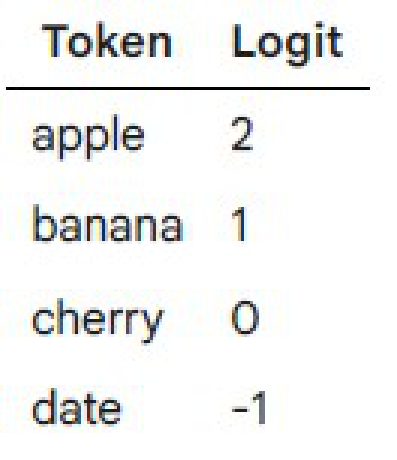
Worked answer
Final answer: 0.46.
Steps: Scale logits to [1,0.5,0,−0.5], then exp(1)/sum(exp([1,0.5,0,−0.5])) ≈ 0.4551.
Status: derived
verified_by_code: false — depends on figure, no code path
2026 T1 End Term FN, Q6
Paper: 2026T1_ET_FN · Type: MCQ · Marks: 2 · Topic(s): w4-bert-nsp-inputs
In BERT's Next Sentence Prediction task, how are the negative (NotNext) examples created?
A. By taking the sentence that immediately precedes the current sentence.
B. By reversing the word order of the actual next sentence.
C. By picking a random sentence from the corpus (50% of the time).
D. By masking all verbs in the actual next sentence.
Worked answer
Final answer: C: randomly sample another corpus sentence.
Steps: Original BERT uses actual next sentences for half the pairs and random corpus sentences for the other half. A uses the preceding sentence, B reverses order, D masks verbs.
Status: derived
verified_by_code: false — Non-numeric response; no numeric checker path applies.
2026 T1 End Term FN, Q12
Paper: 2026T1_ET_FN · Type: MSQ · Marks: 3 · Topic(s): w4-bert-finetuning
Comparing the architectures of BERT and GPT, select all the structural differences that are true.
A. BERT uses bidirectional self-attention, allowing tokens to attend to both left and right contexts.
B. GPT uses masked (causal) self-attention, allowing tokens to attend only to previous tokens.
C. BERT is an autoregressive model, while GPT is an autoencoding model.
D. During pre-training, BERT predicts masked tokens, whereas GPT predicts the next token in the sequence.
Worked answer
Final answer: A, B, D
Steps: BERT self-attention is bidirectional and predicts masked tokens; GPT uses causal attention and next-token prediction. B’s “previous tokens” is the usual prediction-relative shorthand: the current input position is among the tokens preceding the predicted next token. C reverses the architectures.
Status: derived
verified_by_code: false — Non-numeric response; no numeric checker path applies.
2026 T1 End Term FN, Q15
Paper: 2026T1_ET_FN · Type: MSQ · Marks: 2 · Topic(s): w4-beam-search
Select all correct statements regarding Decoding Strategies in language generation.
A. Beam Search with a beam width \(k = 1\) is mathematically equivalent to Greedy Search.
B. Greedy search is deterministic and often leads to repetitive or degenerative text loops.
C. Top-\(k\) sampling guarantees that the generated text will always be grammatically correct.
D. Top-\(p\) (Nucleus) sampling allows for a dynamic vocabulary size at each step, whereas Top-\(k\) uses a fixed number of candidates.
Worked answer
Final answer: A, B and D.
Steps: With identical scoring and stopping, width-one beam equals greedy; greedy can degenerate into repetition; nucleus size adapts to the distribution while k is fixed. C falsely guarantees grammar.
Status: derived
verified_by_code: false — Non-numeric response; no numeric checker path applies.
2026 T1 End Term FN, Q16
Paper: 2026T1_ET_FN · Type: MSQ · Marks: 2 · Topic(s): w4-bert-finetuning
In a feature-based approach using a pretrained transformer (like BERT) for a Multiple-Choice QA task, which of the following statements regarding the methodology are correct? (Select all that apply)
A. The weights of the pretrained transformer are updated via backpropagation during the training phase.
B. The input must be formatted as multiple pairs, such as [CLS] Question [SEP] Choice_n, creating a distinct representation for each candidate answer.
C. The final prediction is determined by passing the fixed output representations through a trainable linear layer and applying a Softmax function.
D. The model generates the correct answer string token-by-token using an autoregressive decoding strategy like Greedy Search.
Worked answer
Final answer: C
Steps: A frozen encoder produces fixed features; a trainable linear layer scores candidates and softmax normalizes scores (C). Joint or separately encoded question/choice features are possible, so the particular pair format in B is not mandatory; A updates the body and D describes generation.
Status: derived
verified_by_code: false — Non-numeric response; no numeric checker path applies.
2026 T1 End Term FN, Q17
Paper: 2026T1_ET_FN · Type: MCQ · Marks: 3 · Topic(s): w4-bert-finetuning
A Transformer processes a sequence of length 5 using 6 identical self-attention layers. Count the total number of allowed attention links across all layers and Choose the option representing the correct pair
(A) BERT
(B) GPT
A. BERT: 150, GPT: 90
B. BERT: 90, GPT: 150
C. BERT: 150, GPT: 150
D. BERT: 90, GPT: 90
E. BERT: 30, GPT: 36
F. BERT: 36, GPT: 30
Worked answer
Final answer: A: BERT 150, GPT 90.
Steps: Per layer, unrestricted attention has 5²=25 links and causal attention has 5×6/2=15. Across six layers these are 150 and 90. B swaps totals; C and D equate masks; E and F omit pairwise links.
Status: derived
verified_by_code: true — solve_numeric.py recomputed adjudicated inputs/conventions; all recorded values and adjudication checks MATCH.
2026 T2 End Term AN, Q4
Paper: 2026T2_ET_AN · Type: MCQ · Marks: 2 · Topic(s): w4-beam-search
You are designing an LLM to translate a sentence from English to Spanish with low computational complexity. The system has to consider a few possible sequences of words rather than committing to the single highest-probability word at every step. Which of the following decoding strategies is the most appropriate?
A. Beam search
B. Exhaustive search
C. Top-p sampling with p = 0.85
D. Greedy decoding
Worked answer
Final answer: A: beam search.
Steps: A retains a small set of high-scoring partial sequences. B expands exponentially, C samples a token at a time instead of explicitly tracking competing sequences, and D commits to one.
Status: derived
verified_by_code: false — Non-numeric response; no numeric checker path applies.
2026 T2 End Term AN, Q5
Paper: 2026T2_ET_AN · Type: MCQ · Marks: 2 · Topic(s): w4-bert-nsp-inputs
In the Next Sentence Prediction task, how are the two input sentences distinguished by the BERT architecture?
A. By utilizing separate transformer encoders for each sentence and concatenating the outputs.
B. By adding learnable segment embeddings to the token and positional embeddings of the respective sentences.
C. By inserting a [MASK] token between the two sentences.
D. By ensuring two different heads in the Multi-Head Attention setup attend to the specific sentences.
Worked answer
Final answer: B.
Steps: BERT adds learned segment/type embeddings to token and positional embeddings. A invents separate encoders, C confuses [MASK] with [SEP], D wrongly assigns attention heads by segment.
Status: derived
verified_by_code: false — Non-numeric response; no numeric checker path applies.
2026 T2 End Term AN, Q9
Paper: 2026T2_ET_AN · Type: SA · Marks: 2 · Topic(s): w4-topp-nucleus
How many tokens are selected as candidate tokens?
Worked answer
Final answer: 3 tokens.
Steps: Softmax logits give approximately [0.5072, 0.2519, 0.1382, 0.0686, 0.0341]; first two total 0.7590 < 0.8, first three 0.8973 ≥ 0.8.
Status: derived
verified_by_code: true — solve_numeric.py recomputed adjudicated inputs/conventions; all recorded values and adjudication checks MATCH.
2026 T2 End Term AN, Q10
Paper: 2026T2_ET_AN · Type: SA · Marks: 2 · Topic(s): w4-topp-nucleus
After renormalization of the probabilities, what is the highest probability value among those? (Round off to three decimal places)
Worked answer
Final answer: 0.565.
Steps: Three candidates survive top-p. The largest renormalized probability is exp(2.5)/(exp(2.5)+exp(1.8)+exp(1.2))≈0.565254.
Status: derived
verified_by_code: true — solve_numeric.py recomputed adjudicated inputs/conventions; all recorded values and adjudication checks MATCH.
2026 T2 End Term FN, Q6
Paper: 2026T2_ET_FN · Type: MCQ · Marks: 2 · Topic(s): w4-bert-nsp-inputs
In BERT's Next Sentence Prediction task, how are the negative (NotNext) examples created?
A. By taking the sentence that immediately precedes the current sentence.
B. By reversing the word order of the actual next sentence.
C. By picking a random sentence from the corpus (50% of the time).
D. By masking all verbs in the actual next sentence.
Worked answer
Final answer: C: randomly sample another corpus sentence.
Steps: Original BERT uses actual next sentences for half the pairs and random corpus sentences for the other half. A uses the preceding sentence, B reverses order, D masks verbs.
Status: derived
verified_by_code: false — Non-numeric response; no numeric checker path applies.
2026 T2 End Term FN, Q12
Paper: 2026T2_ET_FN · Type: MSQ · Marks: 3 · Topic(s): w4-bert-finetuning
Comparing the architectures of BERT and GPT, select all the structural differences that are true.
A. BERT uses bidirectional self-attention, allowing tokens to attend to both left and right contexts.
B. GPT uses masked (causal) self-attention, allowing tokens to attend only to previous tokens.
C. BERT is an autoregressive model, while GPT is an autoencoding model.
D. During pre-training, BERT predicts masked tokens, whereas GPT predicts the next token in the sequence.
Worked answer
Final answer: A, B, D
Steps: BERT self-attention is bidirectional and predicts masked tokens; GPT uses causal attention and next-token prediction. B’s “previous tokens” is the usual prediction-relative shorthand: the current input position is among the tokens preceding the predicted next token. C reverses the architectures.
Status: derived
verified_by_code: false — Non-numeric response; no numeric checker path applies.
2026 T2 End Term FN, Q15
Paper: 2026T2_ET_FN · Type: MSQ · Marks: 2 · Topic(s): w4-beam-search
Select all correct statements regarding Decoding Strategies in language generation.
A. Beam Search with a beam width \(k = 1\) is mathematically equivalent to Greedy Search.
B. Greedy search is deterministic and often leads to repetitive or degenerative text loops.
C. Top-\(k\) sampling guarantees that the generated text will always be grammatically correct.
D. Top-\(p\) (Nucleus) sampling allows for a dynamic vocabulary size at each step, whereas Top-\(k\) uses a fixed number of candidates.
Worked answer
Final answer: A, B and D.
Steps: With identical scoring and stopping, width-one beam equals greedy; greedy can degenerate into repetition; nucleus size adapts to the distribution while k is fixed. C falsely guarantees grammar.
Status: derived
verified_by_code: false — Non-numeric response; no numeric checker path applies.
2026 T2 End Term FN, Q16
Paper: 2026T2_ET_FN · Type: MSQ · Marks: 2 · Topic(s): w4-bert-finetuning
In a feature-based approach using a pretrained transformer (like BERT) for a Multiple-Choice QA task, which of the following statements regarding the methodology are correct? (Select all that apply)
A. The weights of the pretrained transformer are updated via backpropagation during the training phase.
B. The input must be formatted as multiple pairs, such as [CLS] Question [SEP] Choice_n, creating a distinct representation for each candidate answer.
C. The final prediction is determined by passing the fixed output representations through a trainable linear layer and applying a Softmax function.
D. The model generates the correct answer string token-by-token using an autoregressive decoding strategy like Greedy Search.
Worked answer
Final answer: C
Steps: A frozen encoder produces fixed features; a trainable linear layer scores candidates and softmax normalizes scores (C). Joint or separately encoded question/choice features are possible, so the particular pair format in B is not mandatory; A updates the body and D describes generation.
Status: derived
verified_by_code: false — Non-numeric response; no numeric checker path applies.
2026 T2 End Term FN, Q17
Paper: 2026T2_ET_FN · Type: MCQ · Marks: 3 · Topic(s): w4-bert-finetuning
A Transformer processes a sequence of length 5 using 6 identical self-attention layers. Count the total number of allowed attention links across all layers and Choose the option representing the correct pair
(A) BERT
(B) GPT
A. BERT: 150, GPT: 90
B. BERT: 90, GPT: 150
C. BERT: 150, GPT: 150
D. BERT: 90, GPT: 90
E. BERT: 30, GPT: 36
F. BERT: 36, GPT: 30
Worked answer
Final answer: A: BERT 150, GPT 90.
Steps: Per layer, unrestricted attention has 5²=25 links and causal attention has 5×6/2=15. Across six layers these are 150 and 90. B swaps totals; C and D equate masks; E and F omit pairwise links.
Status: derived
verified_by_code: true — solve_numeric.py recomputed adjudicated inputs/conventions; all recorded values and adjudication checks MATCH.
Source and reproducibility
Questions preserve each routed paper occurrence, including repeated stems from different papers or sessions. Images are linked from the archived extraction assets. Rebuild with uv run python scripts/build_exam_question_banks.py; run uv run python scripts/build_exam_study_priorities.py for the ranked study guide.