LLM — da5004_2025T2_ET_AN
Source: da5004_2025T2_ET_AN.pdf · Academic questions: 17 · Separately counted children: 0
Provenance: Large_Language_Models/da5004_2025T2_ET_AN.pdf · SHA-256 ebfbbeca42f9982db555b144a29fab8641c6557f65bf498714e879a0c7f2cf00
Scope: LLM (Degree Level : Large Language Models (Computer Based Exam)), Section 9, physical pages 1 to 12. Exam content begins on page 1 with Section 9 header (Section Id 64065399890) and Question 191 on page 2, and terminates on page 12 following Question 208 prior to Section 10 DLP.
Questions
Question 192
Question ID: 6406531425134
Type: Multiple Choice Question · Marks: 3
PDF pages: 2, 3
Given the input string:
sunshine
And the following vocabulary of subword tokens with their corresponding log-probabilities:
| Subword | Log-Probability (base e) |
|---|---|
| sun | -0.5 |
| shine | -0.7 |
| sunshine | -1.6 |
| su | -0.3 |
| nshine | -0.4 |
| n | -1.8 |
| shi | -0.6 |
| ne | -0.5 |
Using the Viterbi algorithm (as used in the SentencePiece tokenizer), determine the most probable tokenization of the input string. The probability of a tokenized sequence is the sum of the log-probabilities of the selected subwords. Only subwords from the vocabulary may be used.
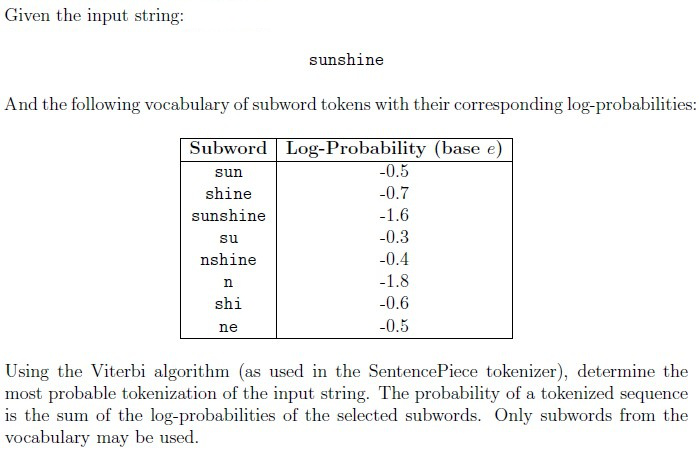
Figure 1. SentencePiece vocabulary dictionary with token log-probabilities and Viterbi algorithm instructions
Options
A.
[sunshine]

Figure 2. Subword tokenization candidate sequence [sunshine]
Source option ID: 6406534763570
Label added for presentation.
B.
[su, nshine]
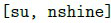
Figure 3. Subword tokenization candidate sequence [su, nshine]
Source option ID: 6406534763571
Label added for presentation.
C.
[sun, shine]

Figure 4. Subword tokenization candidate sequence [sun, shine]
Source option ID: 6406534763572
Label added for presentation.
D.
[sun, shi, ne]

Figure 5. Subword tokenization candidate sequence [sun, shi, ne]
Source option ID: 6406534763573
Label added for presentation.
Correct answer: [su, nshine]
Source evidence: [{"page": 3, "bbox": [23.62, 21.93, 119.02, 38.25], "type": "green source option", "detail": "Option 6406534763571 is rendered in green (color 32768)"}]
Question 193
Question ID: 6406531425135
Type: Multiple Choice Question · Marks: 2
PDF pages: 3
A GPT model is trained using causal language modeling. During training, for a sequence of T = 4
tokens, which of the following correctly represents the attention mask matrix applied to the
attention logits?
Options
A.
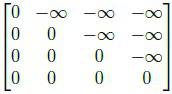
Figure 6. Causal attention mask candidate matrix with zero lower triangle and minus infinity upper triangle
Source option ID: 6406534763574
Label added for presentation.
B.
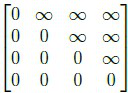
Figure 7. Attention mask candidate matrix with positive infinity in upper triangle
Source option ID: 6406534763575
Label added for presentation.
C.

Figure 8. Attention mask candidate matrix with 1 lower triangle and 0 upper triangle
Source option ID: 6406534763576
Label added for presentation.
D.

Figure 9. Attention mask candidate matrix with 0 lower triangle and 1 upper triangle
Source option ID: 6406534763577
Label added for presentation.
Correct answer: $\(\begin{bmatrix} 0 & -\infty & -\infty & -\infty \\ 0 & 0 & -\infty & -\infty \\ 0 & 0 & 0 & -\infty \\ 0 & 0 & 0 & 0 \end{bmatrix}\)$
Source evidence: [{"page": 3, "bbox": [23.62, 407.95, 119.02, 424.27], "type": "green source option", "detail": "Option 6406534763574 is rendered in green (color 32768)"}]
Question 194
Question ID: 6406531425136
Type: Multiple Choice Question · Marks: 2
PDF pages: 3, 4
Match the given attention masks with their corresponding variants of attention mechanisms. In each figure, the colored cells indicate positions where a query token (\(Q_i\)) attends to a key token (\(K_j\)), while the white cells represent positions that are not attended. Choose the correct option.
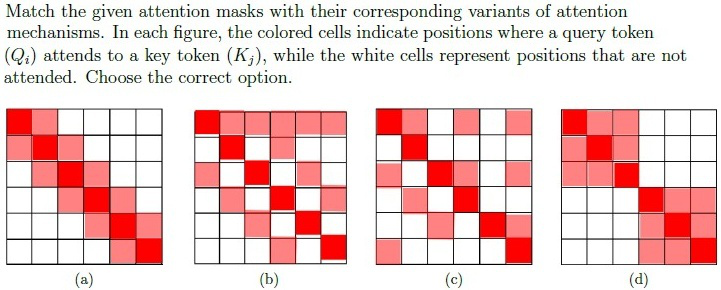
Figure 10. Attention mask patterns (a), (b), (c), and (d) for sparse attention mechanisms
Options
A.
(a) : Random Local Attention,
(b) : Strided Local Attention,
(c) : Sparse Block Attention,
(d) : Local + Global Attention
Source option ID: 6406534763578
Label added for presentation.
B.
(a) : Strided Local Attention,
(b) : Local + Global Attention,
(c) : Random Local Attention,
(d) : Sparse Block Attention
Source option ID: 6406534763579
Label added for presentation.
C.
(a) : Strided Local Attention,
(b) : Random Local Attention,
(c) : Local + Global Attention,
(d) : Sparse Block Attention
Source option ID: 6406534763580
Label added for presentation.
D.
(a) : Sparse Block Attention,
(b) : Local + Global Attention,
(c) : Strided Local Attention,
(d) : Random Local Attention
Source option ID: 6406534763581
Label added for presentation.
Correct answer: (a) : Strided Local Attention, (b) : Local + Global Attention, (c) : Random Local Attention, (d) : Sparse Block Attention
Source evidence: [{"page": 4, "bbox": [23.62, 330.6, 119.02, 346.92], "type": "green source option", "detail": "Option 6406534763579 is rendered in green (color 32768)"}]
Question 195
Question ID: 6406531425137
Type: Multiple Select Question · Marks: 3
PDF pages: 4, 5
Which of the following preprocessing steps are commonly used when preparing data for
transformer models like BERT?
Options
A.
Adding special tokens such as [CLS] and [SEP] to the sequence
Source option ID: 6406534763582
Label added for presentation.
B.
Splitting tokens into subword units using a model-specific tokenizer
Source option ID: 6406534763583
Label added for presentation.
C.
Removing all punctuation marks to ensure cleaner embeddings
Source option ID: 6406534763584
Label added for presentation.
D.
Adding positional information to each token embedding
Source option ID: 6406534763585
Label added for presentation.
Correct answer: Adding special tokens such as [CLS] and [SEP] to the sequence; Splitting tokens into subword units using a model-specific tokenizer; Adding positional information to each token embedding
Source evidence: [{"page": 4, "bbox": [23.62, 734.64, 119.02, 813.42], "type": "green source option", "detail": "Options 6406534763582, 6406534763583, 6406534763585 are rendered in green (color 32768)"}]
Question 196
Question ID: 6406531425138
Type: Multiple Select Question · Marks: 3
PDF pages: 5
Which modifications are used in transformers to handle longer sequences efficiently?
Options
A.
Using sparse attention patterns to reduce computational complexity
Source option ID: 6406534763586
Label added for presentation.
B.
Applying low-rank matrix factorization to approximate attention
Source option ID: 6406534763587
Label added for presentation.
C.
Increasing only the feed-forward network width without modifying attention
Source option ID: 6406534763588
Label added for presentation.
D.
Replacing the softmax function in attention with other activation function for
faster training
Source option ID: 6406534763589
Label added for presentation.
Correct answer: Using sparse attention patterns to reduce computational complexity; Applying low-rank matrix factorization to approximate attention
Source evidence: [{"page": 5, "bbox": [23.62, 133.42, 119.02, 170.56], "type": "green source option", "detail": "Options 6406534763586, 6406534763587 are rendered in green (color 32768)"}]
Question 197
Question ID: 6406531425139
Type: Multiple Select Question · Marks: 3
PDF pages: 5
In Transformer models that use relative position embeddings (such as in Transformer-XL or T5),
clipping is often applied to the relative position indices. Which of the following statements about
clipping in relative position embeddings are correct?
Options
A.
Clipping ensures that very large relative distances are mapped to a fixed
maximum distance.
Source option ID: 6406534763590
Label added for presentation.
B.
Without clipping, the model would require embeddings for every possible
relative distance, which is infeasible for long sequences.
Source option ID: 6406534763591
Label added for presentation.
C.
Clipping increases the precision of embeddings for large relative distances.
Source option ID: 6406534763592
Label added for presentation.
D.
Clipping introduces an upper bound k such that all distances greater than k
are mapped to the same index.
Source option ID: 6406534763593
Label added for presentation.
Correct answer: Clipping ensures that very large relative distances are mapped to a fixed maximum distance.; Without clipping, the model would require embeddings for every possible relative distance, which is infeasible for long sequences.; Clipping introduces an upper bound k such that all distances greater than k are mapped to the same index.
Source evidence: [{"page": 5, "bbox": [23.62, 386.08, 119.02, 497.51], "type": "green source option", "detail": "Options 6406534763590, 6406534763591, 6406534763593 are rendered in green (color 32768)"}]
Question 198
Question ID: 6406531425140
Type: Short Answer Question · Marks: 2
PDF pages: 5, 6
Consider the following probability distribution over a vocabulary of 10 tokens:
[0.06, 0.20, 0.14, 0.06, 0.09, 0.08, 0.05, 0.15, 0.06, 0.11]
You apply top-p (nucleus) sampling with p = 0.7. How many tokens are included in the sampling pool?

Figure 11. Vocabulary token probability distribution array and nucleus sampling parameters
Correct answer: 6
Source evidence: [{"page": 6, "bbox": [22.87, 50.0, 180.0, 90.0], "type": "explicit field", "detail": "Possible Answers: 6"}]
Shared context 199 to 200
Question ID: 6406531425141
Type: Comprehension
PDF pages: 6
A vocabulary \(\mathcal{V} = \{\text{tea}, \text{you}, \text{enjoy}, \text{often}\}\) is associated with the following embedding matrix:
Words are indexed in the order shown above: “tea” (index 0), “you” (1), “enjoy” (2), and “often” (3). No positional encodings are used.
The parameters of the attention layer are:
For the input sequence “you enjoy tea often”. The computed attention matrix \(A = \text{softmax}\left(\frac{Q K^T}{\sqrt{d_k}}\right)\) is given as:
Answer the given subquestions. If you believe the information is insufficient, enter -1 as your answer.
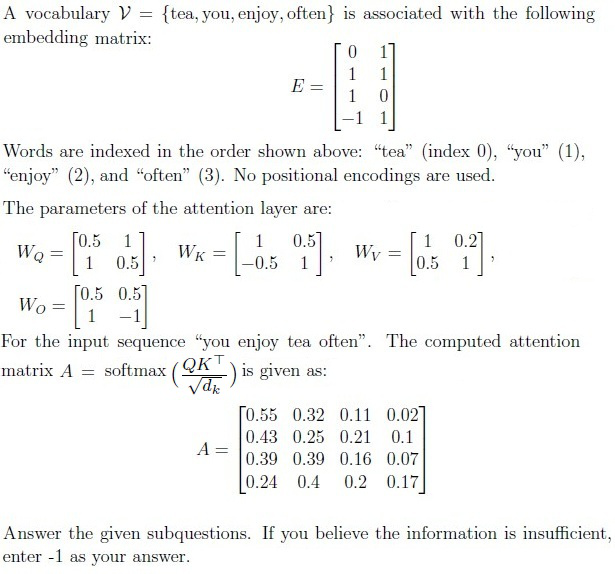
Figure 12. Vocabulary embedding matrix, projection matrices WQ, WK, WV, WO, and computed attention matrix A
Question 199
Question ID: 6406531425142
Portal container ID: 6406531425141
Type: Short Answer Question · Marks: 3
PDF pages: 6, 7
Shared context: ctx-199-200
For the input “you enjoy tea often”, compute the final representation of the word “enjoy” after the
attention layer (i.e., after applying WQ, WK, WV , attention weights, and WO). Enter the sum of the
elements in the resulting vector.
Correct answer: 0.92 to 1.0
Source evidence: [{"page": 7, "bbox": [22.87, 85.0, 180.0, 150.0], "type": "explicit field", "detail": "Possible Answers: 0.92 to 1.0"}]
Question 200
Question ID: 6406531425143
Portal container ID: 6406531425141
Type: Short Answer Question · Marks: 2
PDF pages: 7
Shared context: ctx-199-200
Suppose the input sentence is “tea you enjoy often”. Using the same matrices and processing
method, what is the attention score (i.e., softmax entry from A) for the query word “tea” attending
to key word “often”?
Correct answer: 0.04 to 0.10
Source evidence: [{"page": 7, "bbox": [22.87, 280.0, 180.0, 340.0], "type": "explicit field", "detail": "Possible Answers: 0.04 to 0.10"}]
Shared context 201 to 203
Question ID: 6406531425150
Type: Comprehension
PDF pages: 7, 8
Suppose we have context length \(T = 30\) and the number of blocks \(n = 5\) for the block attention mechanism.
The masking matrix \(M\) is defined as:
where \(i\) is row indices and \(j\) is columns indexes both starting from 0. Here, \(\pi\) is a permutation of \(\{0, 1, \dots, (n - 1)\}\), which determines the allowed query—key block pairs. Specifically, if a query token \(i\) lies in block \(r = \lfloor i / (T/n) \rfloor\), then it can attend only to key tokens in block \(\pi(r)\).
Equivalently, if we partition queries and keys into blocks,
$\(Q = (Q_0, Q_1, \dots, Q_{n-1}), \quad K = (K_0, K_1, \dots, K_{n-1})\)$
then block \(Q_r\) attends only to block \(K_{\pi(r)}\).
This block-restricted attention reduces computation by limiting interactions to the query—key block pairs specified by \(\pi\).
Answer the given subquestions using the attention mask \(M \in \{0, 1\}^{T \times T}\) image, where black squares represent entries equal to 1 and white squares represent entries equal to 0.
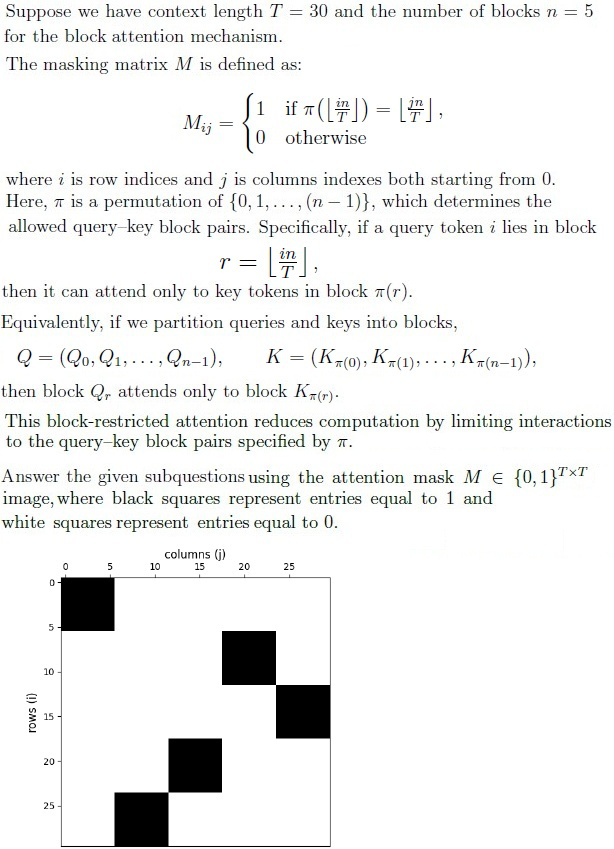
Figure 13. Block attention formulation, query-key block permutation equations, and 30x30 masking grid image
Question 201
Question ID: 6406531425151
Portal container ID: 6406531425150
Type: Multiple Choice Question · Marks: 2
PDF pages: 8, 9
Shared context: ctx-201-203
Choose the correct representation of π for the given mask image.
Options
A.
π = (2, 1, 3, 4, 0)
Source option ID: 6406534763608
Label added for presentation.
B.
π = (0, 4, 3, 1, 2)
Source option ID: 6406534763609
Label added for presentation.
C.
π = (0, 3, 4, 2, 1)
Source option ID: 6406534763610
Label added for presentation.
D.
All of these
Source option ID: 6406534763611
Label added for presentation.
Correct answer: π = (0, 3, 4, 2, 1)
Source evidence: [{"page": 9, "bbox": [23.62, 59.14, 119.02, 75.46], "type": "green source option", "detail": "Option 6406534763610 is rendered in green (color 32768)"}]
Question 202
Question ID: 6406531425152
Portal container ID: 6406531425150
Type: Short Answer Question · Marks: 1
PDF pages: 9
Shared context: ctx-201-203
How many permutations of π are possible for n = 5?
Correct answer: 120
Source evidence: [{"page": 9, "bbox": [22.87, 240.0, 180.0, 290.0], "type": "explicit field", "detail": "Possible Answers: 120"}]
Question 203
Question ID: 6406531425153
Portal container ID: 6406531425150
Type: Short Answer Question · Marks: 2
PDF pages: 9
Shared context: ctx-201-203
What percentage of entries in the attention matrix are zero (i.e., the sparsity)?
Correct answer: 80
Source evidence: [{"page": 9, "bbox": [22.87, 450.0, 180.0, 500.0], "type": "explicit field", "detail": "Possible Answers: 80"}]
Shared context 204 to 208
Question ID: 6406531425144
Type: Comprehension
PDF pages: 9, 10
Consider the short sentence:
“small models sometimes beat big ones”
A model processes this sequence using the naive relative positional embedding method. The model’s embedding dimension is \(d_{\text{model}} = 4\), and the number of tokens is \(T = 6\). We use zero-based indexing for token positions:
0: small, 1: models, 2: sometimes, 3: beat, 4: big, 5: ones
Note: In this context, the relative position between two tokens is:
$\(\text{Relative position} = j - i\)$
(rows = current token \(i\), columns = other token \(j\)).
- Token embeddings (rows correspond to tokens in order):
Denote the \(i\)-th row by \(x_i\).
- Positional embedding definition: For a relative position,
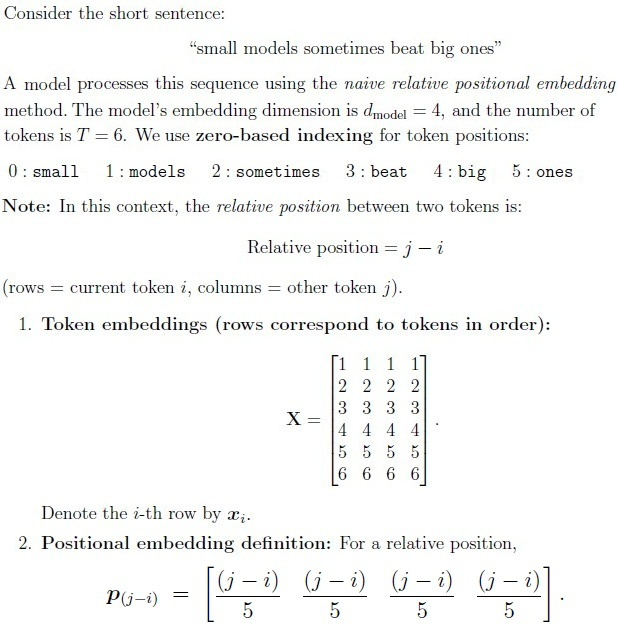
Figure 14. Sentence token definitions, embedding matrix X, and relative positional embedding formula
Question 204
Question ID: 6406531425145
Portal container ID: 6406531425144
Type: Multiple Choice Question · Marks: 2
PDF pages: 10
Shared context: ctx-204-208
Choose the sequence of relative positions \((j - i)\) for the token "sometimes" with respect to each token in the sentence.
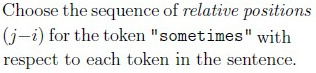
Figure 15. Relative position sequence question stem for token sometimes
Options
A.
(0, 1, 2, 3, 4, 5)
Source option ID: 6406534763597
Label added for presentation.
B.
(-1, 0, 1, 2, 3, 4)
Source option ID: 6406534763598
Label added for presentation.
C.
(-3, -2, -1, 0, 1, 2)
Source option ID: 6406534763599
Label added for presentation.
D.
(-2, -1, 0, 1, 2, 3)
Source option ID: 6406534763600
Label added for presentation.
Correct answer: (-2, -1, 0, 1, 2, 3)
Source evidence: [{"page": 10, "bbox": [23.62, 768.02, 119.02, 784.34], "type": "green source option", "detail": "Option 6406534763600 is rendered in green (color 32768)"}]
Question 205
Question ID: 6406531425146
Portal container ID: 6406531425144
Type: Multiple Choice Question · Marks: 2
PDF pages: 10, 11
Shared context: ctx-204-208
Choose the value of \(p_{(j - i)}\) for the current token “big” and the other token ”small”.

Figure 16. Positional embedding value question stem for current token big and other token small
Options
A.
[−0.4,−0.4,−0.4,−0.4]
Source option ID: 6406534763601
Label added for presentation.
B.
[−0.1,−0.1,−0.1,−0.1]
Source option ID: 6406534763602
Label added for presentation.
C.
[−0.8,−0.8,−0.8,−0.8]
Source option ID: 6406534763603
Label added for presentation.
D.
[−0.2,−0.2,−0.2,−0.2]
Source option ID: 6406534763604
Label added for presentation.
Correct answer: [−0.8,−0.8,−0.8,−0.8]
Source evidence: [{"page": 11, "bbox": [23.62, 162.6, 119.02, 178.92], "type": "green source option", "detail": "Option 6406534763603 is rendered in green (color 32768)"}]
Question 206
Question ID: 6406531425147
Portal container ID: 6406531425144
Type: Short Answer Question · Marks: 3
PDF pages: 11
Shared context: ctx-204-208
With a naive implementation, for each token embedding we combine (by addition) relative position embeddings. For token index \(i \in \{0, \dots, T - 1\}\),
compute the final combined embedding \(h_i\) for the token "models" (i.e., \(i = 1\)).
Submit the sum of all the elements of \(h_i\).
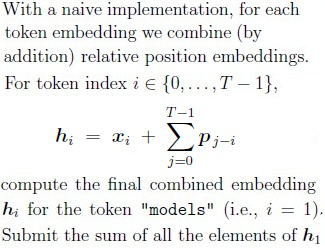
Figure 17. Naive relative position combined embedding formulation and question for token models
Correct answer: 15.2
Source evidence: [{"page": 11, "bbox": [22.87, 600.0, 180.0, 660.0], "type": "explicit field", "detail": "Possible Answers: 15.2"}]
Question 207
Question ID: 6406531425148
Portal container ID: 6406531425144
Type: Short Answer Question · Marks: 2
PDF pages: 11, 12
Shared context: ctx-204-208
Compute \(e_{ij}\) for the current token “big” and other token “small”.
Assume \(W_Q = I\) and \(W_K = 2I\) where \(I\) is an identity matrix. Answer \(e_{ij}\) correct upto 1 digit after the decimal.
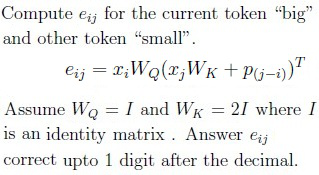
Figure 18. Pre-attention score e_ij formula with relative position embedding and parameters WQ, WK
Correct answer: 23.7 to 24.3
Source evidence: [{"page": 12, "bbox": [22.87, 120.0, 180.0, 160.0], "type": "explicit field", "detail": "Possible Answers: 23.7 to 24.3"}]
Question 208
Question ID: 6406531425149
Portal container ID: 6406531425144
Type: Short Answer Question · Marks: 3
PDF pages: 12
Shared context: ctx-204-208
Now consider the same sequence but assume the model uses the ALiBi (Attention with Linear Biases) method. The model has \(H = 4\) heads and the per-head slope is defined as
The pre-attention \(e_{ij}\) for head \(h\) are computed as:
Assume \(W_Q = I\) and \(W_K = 2I\) where \(I\) is an identity matrix. Answer \(e_{ij}\) for the current token “big” and other token “small” for head \(h = 2\), correct upto 1 digit after the decimal.
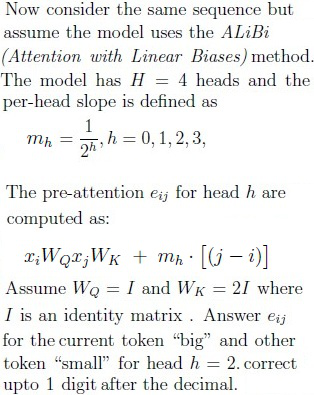
Figure 19. ALiBi pre-attention score formulation with slope m_h and linear bias term
Correct answer: 39
Source evidence: [{"page": 12, "bbox": [22.87, 630.0, 180.0, 680.0], "type": "explicit field", "detail": "Possible Answers: 39"}]
Answer key
| Source question | Source identity | Correct answer | PDF pages |
|---|---|---|---|
| 192 | 6406531425134 | [su, nshine] | 2, 3 |
| 193 | 6406531425135 | $\(\begin{bmatrix} 0 & -\infty & -\infty & -\infty \\ 0 & 0 & -\infty & -\infty \\ 0 & 0 & 0 & -\infty \\ 0 & 0 & 0 & 0 \end{bmatrix}\)$ | 3 |
| 194 | 6406531425136 | (a) : Strided Local Attention, (b) : Local + Global Attention, (c) : Random Local Attention, (d) : Sparse Block Attention | 3, 4 |
| 195 | 6406531425137 | Adding special tokens such as [CLS] and [SEP] to the sequence; Splitting tokens into subword units using a model-specific tokenizer; Adding positional information to each token embedding | 4, 5 |
| 196 | 6406531425138 | Using sparse attention patterns to reduce computational complexity; Applying low-rank matrix factorization to approximate attention | 5 |
| 197 | 6406531425139 | Clipping ensures that very large relative distances are mapped to a fixed maximum distance.; Without clipping, the model would require embeddings for every possible relative distance, which is infeasible for long sequences.; Clipping introduces an upper bound k such that all distances greater than k are mapped to the same index. | 5 |
| 198 | 6406531425140 | 6 | 5, 6 |
| 199 | 6406531425142 | 0.92 to 1.0 | 6, 7 |
| 200 | 6406531425143 | 0.04 to 0.10 | 7 |
| 201 | 6406531425151 | π = (0, 3, 4, 2, 1) | 8, 9 |
| 202 | 6406531425152 | 120 | 9 |
| 203 | 6406531425153 | 80 | 9 |
| 204 | 6406531425145 | (-2, -1, 0, 1, 2, 3) | 10 |
| 205 | 6406531425146 | [−0.8,−0.8,−0.8,−0.8] | 10, 11 |
| 206 | 6406531425147 | 15.2 | 11 |
| 207 | 6406531425148 | 23.7 to 24.3 | 11, 12 |
| 208 | 6406531425149 | 39 | 12 |
Extraction notes
Status: verified
Count reconciliation: Section 9 declares 11 questions and 40 marks. The 11 portal question entries correspond to 1 administrative subject-confirmation question (Question 191), 7 standalone academic questions (Questions 192-198), and 3 comprehension blocks (Questions 199-200, 201-203, and 204-208) containing 10 subquestions. Total academic questions reconcile to exactly 17 (7 standalone + 10 comprehension subquestions). Marks sum exactly to 3 + 2 + 2 + 3 + 3 + 3 + 2 + 3 + 2 + 2 + 1 + 2 + 2 + 2 + 3 + 2 + 3 = 40, matching the declared Section Marks of 40.
- Comprehension passages ctx-199-200, ctx-201-203, and ctx-204-208 contain shared context mathematical layouts and diagrams; complete transcriptions and high-resolution crops are retained.
- Official answers for all questions are directly verifiable from the source PDF (green answer markers for MCQs/MSQs and explicit Possible Answers fields for Numeric/SA questions).
Excluded source entries:
- {"classification": "out-of-scope-section", "page": 1, "bbox": [0.0, 0.0, 595.3, 373.69], "reason": "Preceding section exam content (Multiple Choice Question, options 6406534763564 to 6406534763567) before Section 9 LLM header", "identity": "preceding-section"}
- {"classification": "subject-confirmation", "page": 2, "bbox": [22.87, 16.75, 580.0, 280.0], "reason": "Administrative subject confirmation asking candidate to confirm subject and cross check hall ticket", "identity": "191"}
- {"classification": "out-of-scope-section", "page": 12, "bbox": [0.0, 673.59, 595.3, 841.9], "reason": "Subsequent Section 10 DLP (Deep Learning for Perception) exam header terminating LLM section", "identity": "following-section-10"}