LLM — da5004_2025T3_ET_FN
Source: da5004_2025T3_ET_FN.pdf · Academic questions: 24 · Separately counted children: 0
Provenance: Large_Language_Models/da5004_2025T3_ET_FN.pdf · SHA-256 b55b6f7161c9d34961aac63d768c4345e767ccdbbd25a5efa8b32c7ae3149f59
Scope: LLM (Degree Level : Large Language Models), physical pages 1 to 11. Section Id: 640653124706. In-scope content starts on physical page 1 with LLM section header and continues through physical page 11.
Questions
Question 2
Question ID: 6406531863525
Type: MCQ · Marks: 1
PDF pages: 2
What happens when you use Batch Normalization with a batch size of 1?
Options
A.
It works perfectly fine
Source option ID: 6406536036762
B.
The statistics become meaningless (mean=0, std=0)
Source option ID: 6406536036763
C.
It automatically switches to Layer Normalization
Source option ID: 6406536036764
D.
It uses the running statistics from training
Source option ID: 6406536036765
Correct answer: The statistics become meaningless (mean=0, std=0)
Source evidence: [{"page": 2, "bbox": [23.62, 134.92, 119.02, 151.24], "type": "green source option", "detail": "Option 6406536036763 marked in green (color 32768)"}]
Question 3
Question ID: 6406531863526
Type: MCQ · Marks: 2
PDF pages: 2
A language model outputs the following logits for the next token:
{cat: 3.2, dog: 2.9, bird: 1.1, fish: 0.5, snake: -0.4}
Before sampling, the decoding pipeline performs:
• Temperature scaling with T = 2.0
• Top-K filtering with K = 3
After applying both steps, which tokens remain eligible for sampling?
Options
A.
Only ''cat''
Source option ID: 6406536036766
B.
'cat'' or ''dog''
Source option ID: 6406536036767
C.
'cat'', ''dog'' or ''bird''
Source option ID: 6406536036768
D.
'dog'', ''bird'' or ''fish''
Source option ID: 6406536036769
Correct answer: 'cat'', ''dog'' or ''bird''
Source evidence: [{"page": 2, "bbox": [23.62, 441.08, 119.02, 457.4], "type": "green source option", "detail": "Option 6406536036768 marked in green (color 32768)"}]
Question 4
Question ID: 6406531863527
Type: MCQ · Marks: 2
PDF pages: 2
If a model's next-token probabilities are \(P(A) = 0.5\), \(P(B) = 0.2\), \(P(C) = 0.15\), \(P(D) = 0.1\), and \(P(E) = 0.05\), and Top-P is set to \(p = 0.8\). Which set of tokens will be included in the nucleus for sampling?

Figure 1. Next-token probabilities P(A)=0.5, P(B)=0.2, P(C)=0.15, P(D)=0.1, P(E)=0.05 and Top-P p=0.8 problem statement
Options
A.
Tokens A, B, C, D, E
Source option ID: 6406536036770
B.
Tokens A, B
Source option ID: 6406536036771
C.
Tokens A, B, C
Source option ID: 6406536036772
D.
Tokens A, B, C, D
Source option ID: 6406536036773
E.
Tokens A, B, D
Source option ID: 6406536036774
Correct answer: Tokens A, B, C
Source evidence: [{"page": 2, "bbox": [23.62, 690.79, 119.02, 707.11], "type": "green source option", "detail": "Option 6406536036772 marked in green (color 32768)"}]
Question 5
Question ID: 6406531863528
Type: MCQ · Marks: 2
PDF pages: 3
In a WordPiece vocabulary-building step, the corpus contains the following tokenized sequences:
• un, ##happy (frequency = 120)
• un, ##helpful (frequency = 8)
The current vocabulary includes the tokens:
un, happy, helpful, ##happy, ##helpful
Two candidate merges are being evaluated:
• Merge A: un + ##happy \(\rightarrow\) unhappy
• Merge B: un + ##helpful \(\rightarrow\) unhelpful
Based purely on WordPiece's likelihood-based merge selection, which merge is more likely to be chosen?
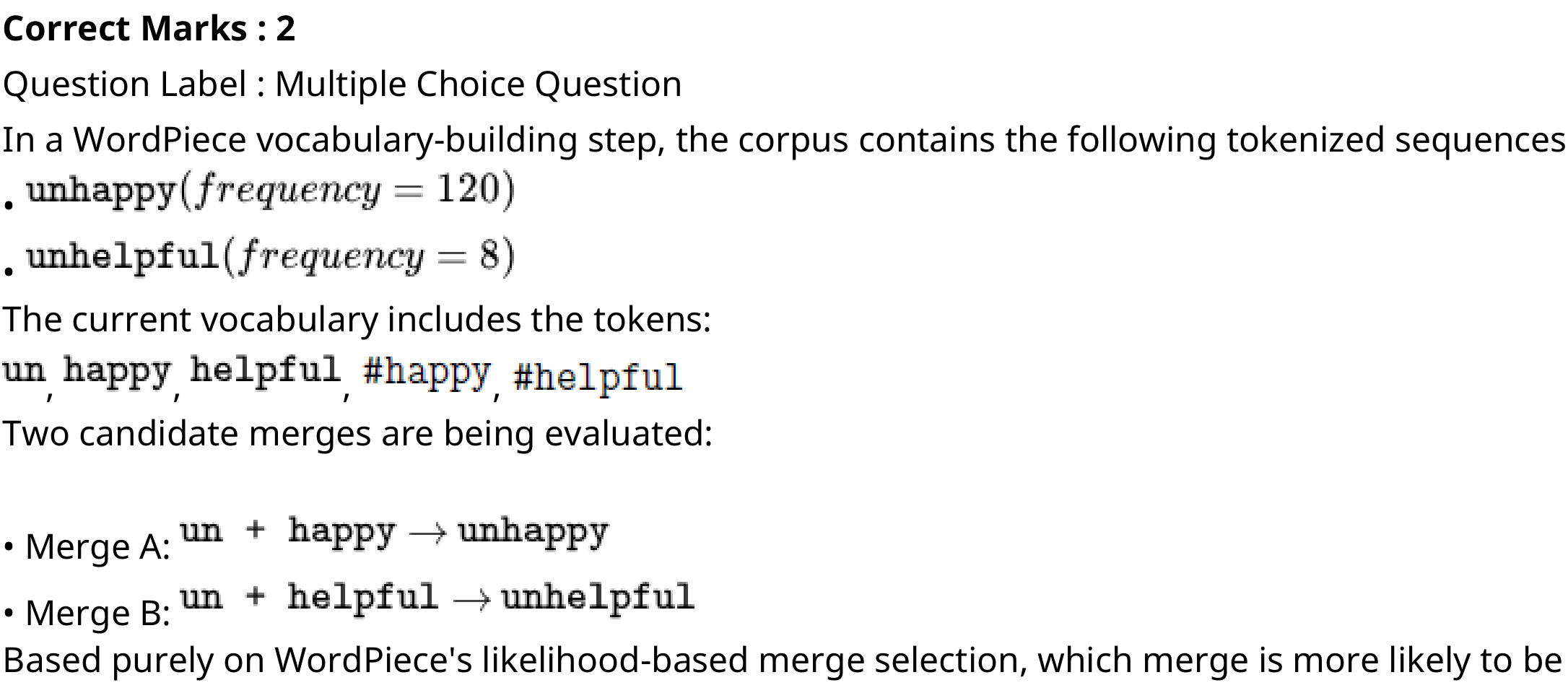
Figure 2. WordPiece vocabulary-building tokenized sequences, vocabulary tokens, and candidate merges A and B
Options
A.
Merge un + ##happy

Figure 3. Option A candidate merge un + ##happy
Source option ID: 6406536036775
B.
Merge un + ##helpful

Figure 4. Option B candidate merge un + ##helpful
Source option ID: 6406536036776
C.
Insufficient information to determine
Source option ID: 6406536036777
Correct answer: Insufficient information to determine
Source evidence: [{"page": 3, "bbox": [23.62, 398.36, 119.02, 414.68], "type": "green source option", "detail": "Option 6406536036777 marked in green (color 32768)"}]
Question 6
Question ID: 6406531863529
Type: MCQ · Marks: 2
PDF pages: 3
A research team wants to classify scientific abstracts into multiple topics simultaneously (e.g.,
''ML'', ''biology'', ''statistics''), where each abstract may belong to more than one topic. They fine-
tune BERT for this task. Which modification is MOST appropriate?
Options
A.
Replace the [CLS] vector with an average of the top-4 attention heads
Source option ID: 6406536036778
B.
Feed the [CLS] embedding into a linear layer with a sigmoid activation per
label
Source option ID: 6406536036779
C.
Use token embeddings individually and classify each token
Source option ID: 6406536036780
D.
Use the [SEP] token embedding for multi-label prediction
Source option ID: 6406536036781
Correct answer: Feed the [CLS] embedding into a linear layer with a sigmoid activation per
label
Source evidence: [{"page": 3, "bbox": [23.62, 593.06, 119.02, 609.38], "type": "green source option", "detail": "Option 6406536036779 marked in green (color 32768)"}]
Question 7
Question ID: 6406531863530
Type: MCQ · Marks: 1
PDF pages: 4
A company wants to automatically correct noisy OCR text extracted from scanned documents. The
text contains spelling mistakes, missing words, and scrambled phrases. Which model should they
fine-tune?
Options
A.
BERT, because it masks tokens and predicts them independently
Source option ID: 6406536036782
B.
BART, because it is trained with text corruption and autoregressive
reconstruction
Source option ID: 6406536036783
C.
GPT, because it is optimal for bidirectional correction
Source option ID: 6406536036784
D.
BERT, because [CLS] captures global structure
Source option ID: 6406536036785
Correct answer: BART, because it is trained with text corruption and autoregressive
reconstruction
Source evidence: [{"page": 4, "bbox": [23.62, 167.56, 119.02, 183.88], "type": "green source option", "detail": "Option 6406536036783 marked in green (color 32768)"}]
Question 8
Question ID: 6406531863531
Type: MCQ · Marks: 1
PDF pages: 4
Computing the full self-attention matrix has a time complexity of
$\(\mathcal{O}(T^2 d)\)$
where \(T\) is the sequence length and \(d\) is the embedding dimension.
Which step in the self-attention mechanism is primarily responsible for this quadratic scaling?
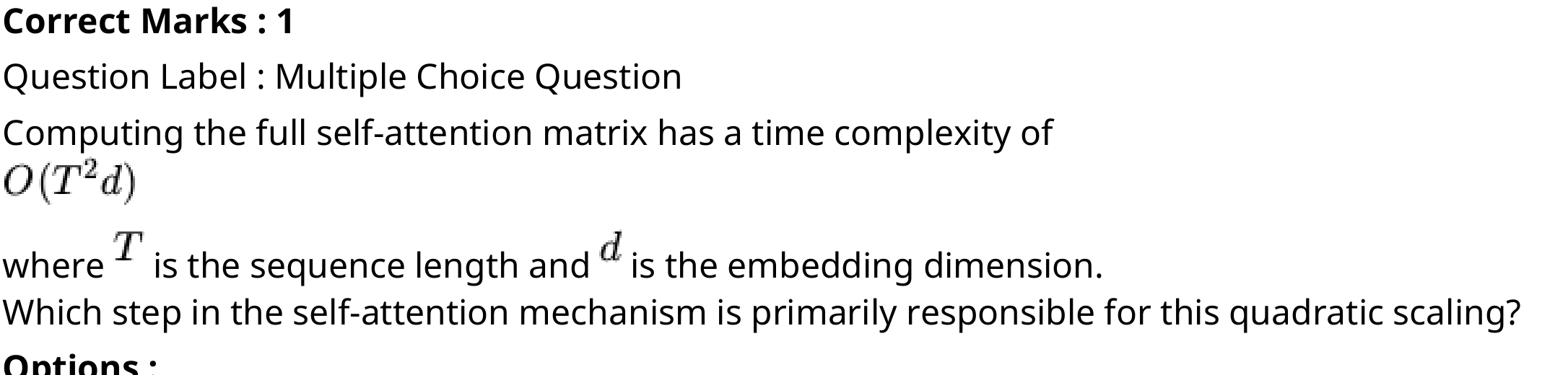
Figure 5. Full self-attention time complexity O(T^2 d) formulation and quadratic scaling inquiry
Options
A.
Computing the softmax for each row
Source option ID: 6406536036786
B.
Computing the matrix product \(QK^T\)

Figure 6. Option B computing matrix product QK^T
Source option ID: 6406536036787
C.
Multiplying the attention matrix \(A\) with the value matrix \(V\)

Figure 7. Option C multiplying attention matrix A with value matrix V
Source option ID: 6406536036788
D.
Performing layer normalization
Source option ID: 6406536036789
Correct answer: Computing the matrix product \(QK^T\)
Source evidence: [{"page": 4, "bbox": [23.62, 456.59, 119.02, 472.91], "type": "green source option", "detail": "Option 6406536036787 marked in green (color 32768)"}]
Question 9
Question ID: 6406531863532
Type: MCQ · Marks: 1
PDF pages: 4
During autoregressive inference, key-value (KV) caching is used to avoid recomputing keys and
values for previously generated tokens. If the KV cache is allowed to grow without any limit, which
of the following failure modes can occur?
Options
A.
GPU memory exhaustion
Source option ID: 6406536036790
B.
Latency becoming quadratic in the output length
Source option ID: 6406536036791
C.
Inability to perform parallel token generation
Source option ID: 6406536036792
D.
Beam search collapsing to a single token
Source option ID: 6406536036793
Correct answer: GPU memory exhaustion
Source evidence: [{"page": 4, "bbox": [23.62, 711.43, 119.02, 727.75], "type": "green source option", "detail": "Option 6406536036790 marked in green (color 32768)"}]
Question 10
Question ID: 6406531863533
Type: MCQ · Marks: 2
PDF pages: 5
Consider a sequence of length \(T\) processed by a local block self-attention mechanism with block size \(B\), where \(T\) is a multiple of \(B\). The sequence is partitioned into \((T/B)\) non-overlapping contiguous blocks, and self-attention is computed only within each block (i.e., attention is restricted to the main diagonal blocks of the \(T \times T\) attention matrix).
Ignoring the cost of linear projections for \(Q, K, V\), what is the time complexity of the self-attention operation for one layer in terms of \(T, B\) and the head dimension \(d\)?
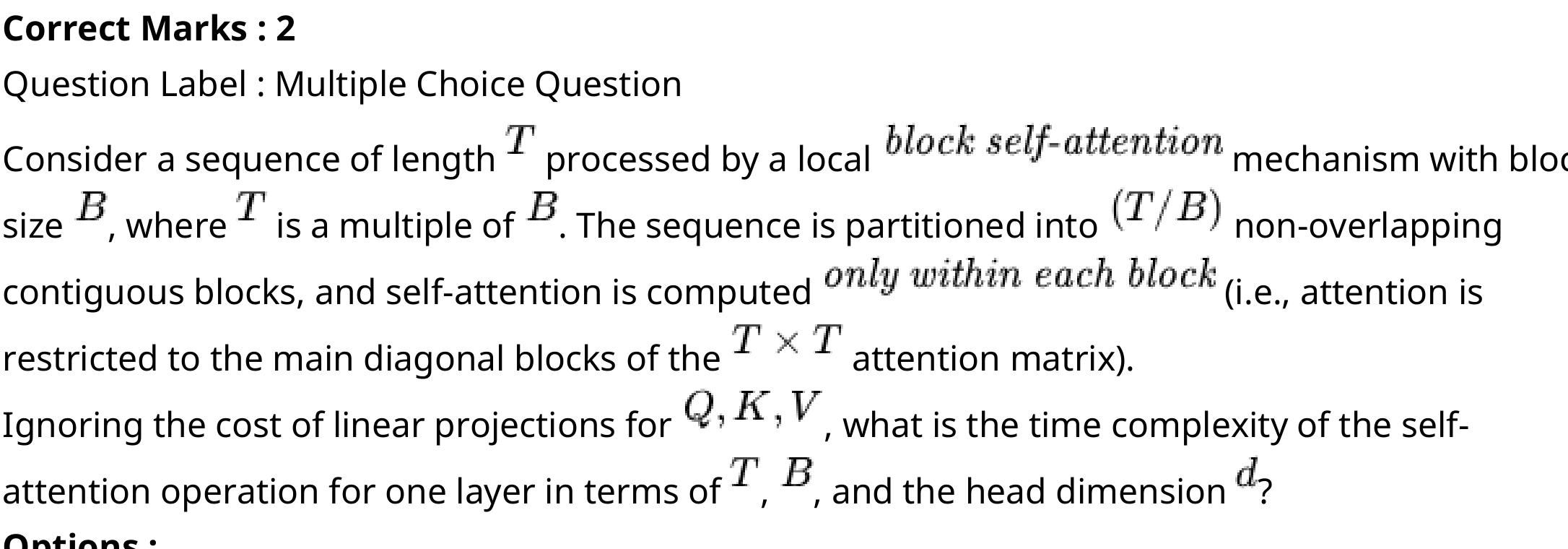
Figure 8. Local block self-attention mechanism configuration with sequence length T, block size B, and (T/B) blocks
Options
A.
\(\mathcal{O}(T^2 \cdot d)\)
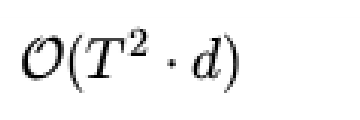
Figure 9. Option A time complexity O(T^2 * d)
Source option ID: 6406536036794
B.
\(\mathcal{O}((T^2 / B) \cdot d)\)
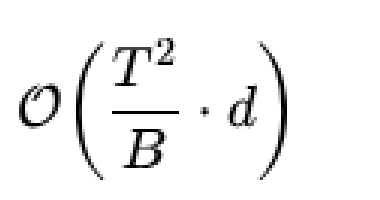
Figure 10. Option B time complexity O((T^2 / B) * d)
Source option ID: 6406536036795
C.
\(\mathcal{O}(T \cdot B \cdot d)\)
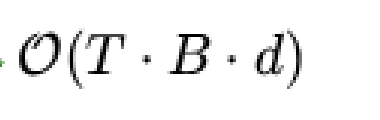
Figure 11. Option C time complexity O(T * B * d)
Source option ID: 6406536036796
D.
\(\mathcal{O}(T \cdot d)\)
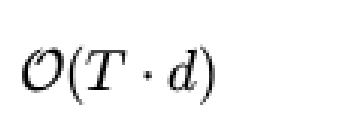
Figure 12. Option D time complexity O(T * d)
Source option ID: 6406536036797
Correct answer: \(\mathcal{O}(T \cdot B \cdot d)\)
Source evidence: [{"page": 5, "bbox": [23.62, 346.63, 119.02, 362.95], "type": "green source option", "detail": "Option 6406536036796 marked in green (color 32768)"}]
Question 11
Question ID: 6406531863534
Type: MCQ · Marks: 2
PDF pages: 5
A 2D vector \([3, 4]\) is rotated by \(180^\circ\) using RoPE. What is the resulting vector?

Figure 13. 2D vector [3, 4] rotated by 180 degrees using RoPE problem prompt
Options
A.
[-3, -4]
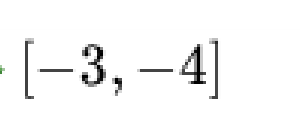
Figure 14. Option A resulting vector [-3, -4]
Source option ID: 6406536036798
B.
[3, -4]
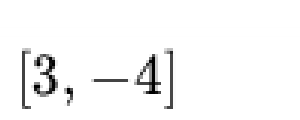
Figure 15. Option B resulting vector [3, -4]
Source option ID: 6406536036799
C.
[-3, 4]
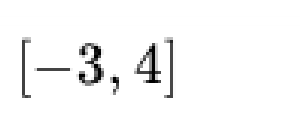
Figure 16. Option C resulting vector [-3, 4]
Source option ID: 6406536036800
D.
[3, 4]
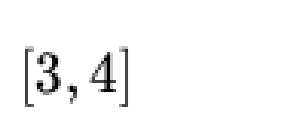
Figure 17. Option D resulting vector [3, 4]
Source option ID: 6406536036801
Correct answer: [-3, -4]
Source evidence: [{"page": 5, "bbox": [23.62, 558.38, 119.02, 574.7], "type": "green source option", "detail": "Option 6406536036798 marked in green (color 32768)"}]
Question 12
Question ID: 6406531863535
Type: MCQ · Marks: 2
PDF pages: 6
If a model uses Absolute Positional Embeddings (APE), increasing the sequence length from 100 to
1000 requires:
Options
A.
No new parameters
Source option ID: 6406536036802
B.
900 additional positional embedding vectors
Source option ID: 6406536036803
C.
A new rotation matrix
Source option ID: 6406536036804
D.
A distance-based bias matrix
Source option ID: 6406536036805
Correct answer: 900 additional positional embedding vectors
Source evidence: [{"page": 6, "bbox": [23.62, 151.24, 119.02, 167.56], "type": "green source option", "detail": "Option 6406536036803 marked in green (color 32768)"}]
Question 13
Question ID: 6406531863536
Type: MCQ · Marks: 3
PDF pages: 6
In a sequence of length \(T = 8\), how many different attention pairs produce a distance of \(+2\)?

Figure 18. Sequence of length T = 8 and distance +2 attention pairs problem statement
Options
A.
3
Source option ID: 6406536036806
B.
5
Source option ID: 6406536036807
C.
6
Source option ID: 6406536036808
D.
7
Source option ID: 6406536036809
Correct answer: 6
Source evidence: [{"page": 6, "bbox": [23.62, 382.44, 119.02, 398.76], "type": "green source option", "detail": "Option 6406536036808 marked in green (color 32768)"}]
Question 14
Question ID: 6406531863537
Type: MCQ · Marks: 3
PDF pages: 6
For a sequence of length \(L = 10\), how many learned positional vectors are required by the following methods?
• Absolute Positional Encoding (APE)
• Relative Positional Encoding (RPE)
• ALiBi
• NoPE (No Positional Encoding)
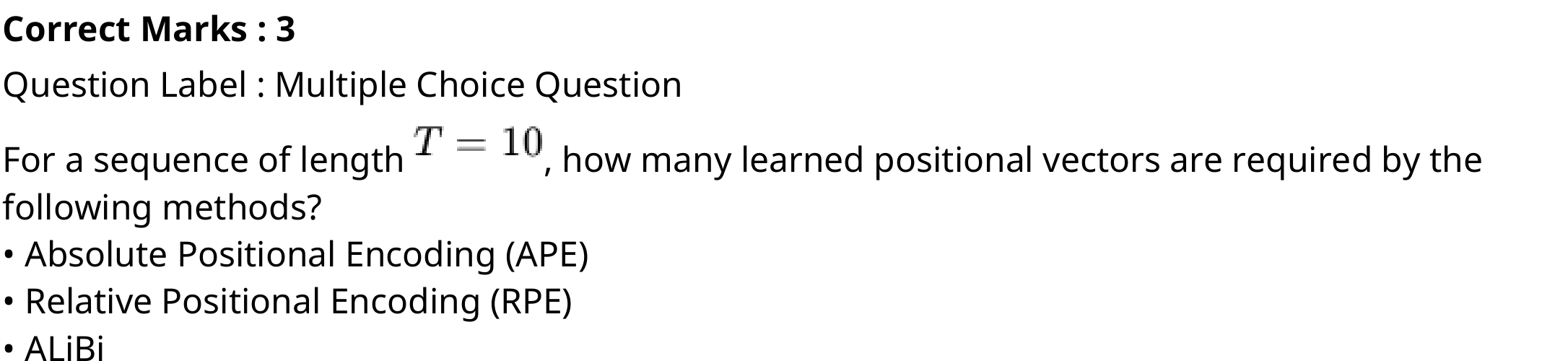
Figure 19. Learned positional vectors evaluation for sequence length L = 10 across APE, RPE, ALiBi, and NoPE
Options
A.
APE = 10, RPE = 19, ALiBi = 0, NoPE = 0
Source option ID: 6406536036810
B.
APE = 10, RPE = 10, ALiBi = 19, NoPE = 0
Source option ID: 6406536036811
C.
APE = 20, RPE = 19, ALiBi = 1, NoPE = 1
Source option ID: 6406536036812
D.
APE = 10, RPE = 2T = 20, ALiBi = 10, NoPE = 0
Source option ID: 6406536036813
Correct answer: APE = 10, RPE = 19, ALiBi = 0, NoPE = 0
Source evidence: [{"page": 6, "bbox": [23.62, 632.78, 119.02, 649.1], "type": "green source option", "detail": "Option 6406536036810 marked in green (color 32768)"}]
Question 15
Question ID: 6406531863538
Type: MCQ · Marks: 2
PDF pages: 7
Which of the following methods uses/use the concept: "The farther apart two tokens are, the less
they should attend to each other''?
Options
A.
RoPE
Source option ID: 6406536036814
B.
APE
Source option ID: 6406536036815
C.
ALiBi
Source option ID: 6406536036816
D.
RPE
Source option ID: 6406536036817
Correct answer: ALiBi
Source evidence: [{"page": 7, "bbox": [23.62, 172.06, 119.02, 188.38], "type": "green source option", "detail": "Option 6406536036816 marked in green (color 32768)"}]
Question 16
Question ID: 6406531863539
Type: MCQ · Marks: 2
PDF pages: 7
You trained a model with max sequence length 512. At inference, you need to process sequence
length 4096 without retraining.
Which positional encoding will perform best out-of-the-box?
Options
A.
APE
Source option ID: 6406536036818
B.
RPE
Source option ID: 6406536036819
C.
RoPE
Source option ID: 6406536036820
D.
ALiBi
Source option ID: 6406536036821
Correct answer: ALiBi
Source evidence: [{"page": 7, "bbox": [23.62, 429.22, 119.02, 445.54], "type": "green source option", "detail": "Option 6406536036821 marked in green (color 32768)"}]
Question 17
Question ID: 6406531863540
Type: MCQ · Marks: 2
PDF pages: 7
A model using ALiBi is extended from context length 1K \(\rightarrow\) 8K.
How many new ALiBi parameters are added?

Figure 20. ALiBi context length extension from 1K to 8K added parameters question prompt
Options
A.
7000
Source option ID: 6406536036822
B.
8000
Source option ID: 6406536036823
C.
Depends on the number of distances
Source option ID: 6406536036824
D.
0
Source option ID: 6406536036825
Correct answer: 0
Source evidence: [{"page": 7, "bbox": [23.62, 654.42, 119.02, 670.74], "type": "green source option", "detail": "Option 6406536036825 marked in green (color 32768)"}]
Question 18
Question ID: 6406531863541
Type: SA · Marks: 3
PDF pages: 8
A mini-batch has 10 sentences, each padded to a length 100. Self-attention (single head) computes one score matrix per sentence. How many scalar scores are computed in total for a single head across the batch?

Figure 21. Mini-batch 10 sentences with padded length 100 scalar attention scores calculation prompt
Correct answer: 100000
Source evidence: [{"page": 8, "bbox": [22.87, 247.77, 69.12, 266.13], "type": "explicit field", "detail": "Possible Answers : 100000 in official source key"}]
Question 19
Question ID: 6406531863542
Type: SA · Marks: 2
PDF pages: 8
Suppose you are working on prefix language modeling. The sequence length is 15 and the first two tokens represent the task-specific prefix. How many non-infinity elements are there in the mask for computing attention scores?

Figure 22. Prefix language modeling with sequence length 15 and two-token prefix non-infinity mask elements prompt
Correct answer: 121
Source evidence: [{"page": 8, "bbox": [22.87, 523.98, 46.0, 542.34], "type": "explicit field", "detail": "Possible Answers : 121 in official source key"}]
Question 20
Question ID: 6406531863543
Type: SA · Marks: 2
PDF pages: 9
A model uses a hybrid attention pattern in which each token attends to:
• A local window of size 10
• A set of 5 random tokens,
• A set of 15 global tokens.
Compute the total number of attention computations per token (integer expression).
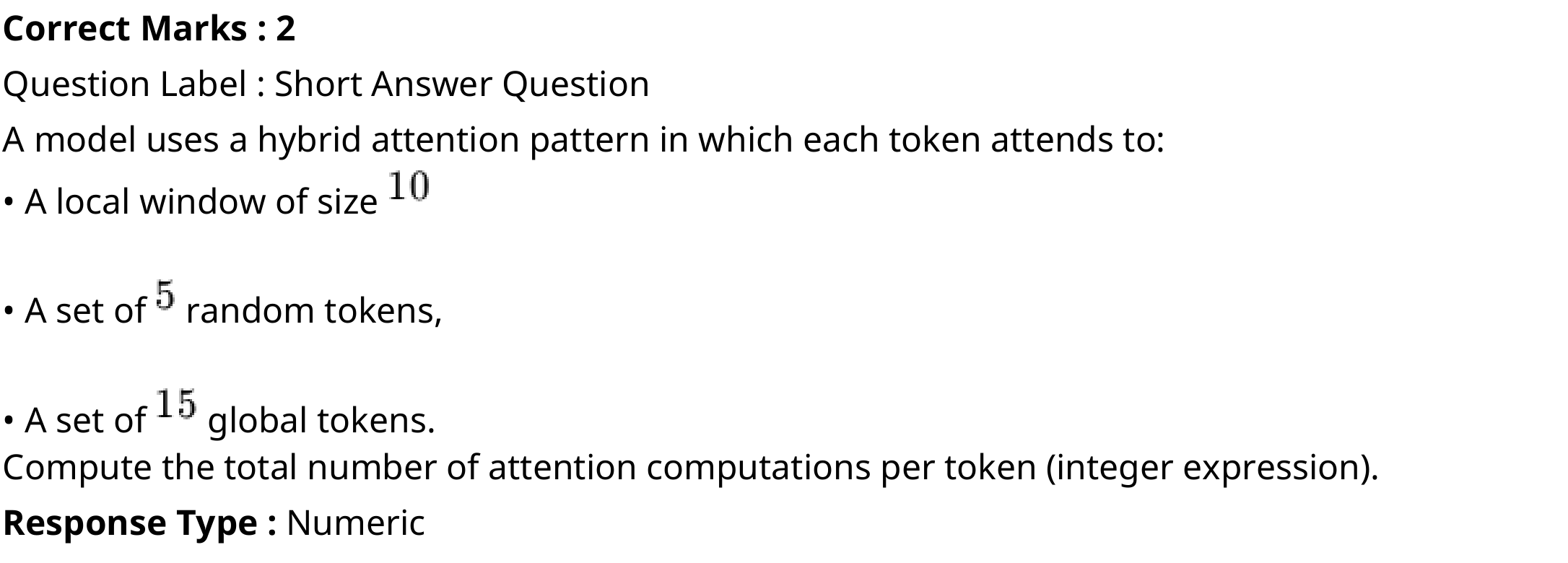
Figure 23. Hybrid attention pattern with local window 10, 5 random tokens, and 15 global tokens computation prompt
Correct answer: 30
Source evidence: [{"page": 9, "bbox": [22.87, 323.42, 41.38, 341.78], "type": "explicit field", "detail": "Possible Answers : 30 in official source key"}]
Question 21
Question ID: 6406531863544
Type: SA · Marks: 2
PDF pages: 9
During deployment of a transformer-based Large Language Model (LLM), you want to estimate the memory usage of the KV cache for efficient batching. Compute the KV-cache memory required per token (in Bytes) for the following model configuration:
• Number of Transformer Blocks (\(L\)): 24
• Attention Heads per Layer (\(H\)): 12
• Head Dimension (\(d_{\text{head}}\)): 96
• Precision used for KV tensors: 2 Bytes (FP16)
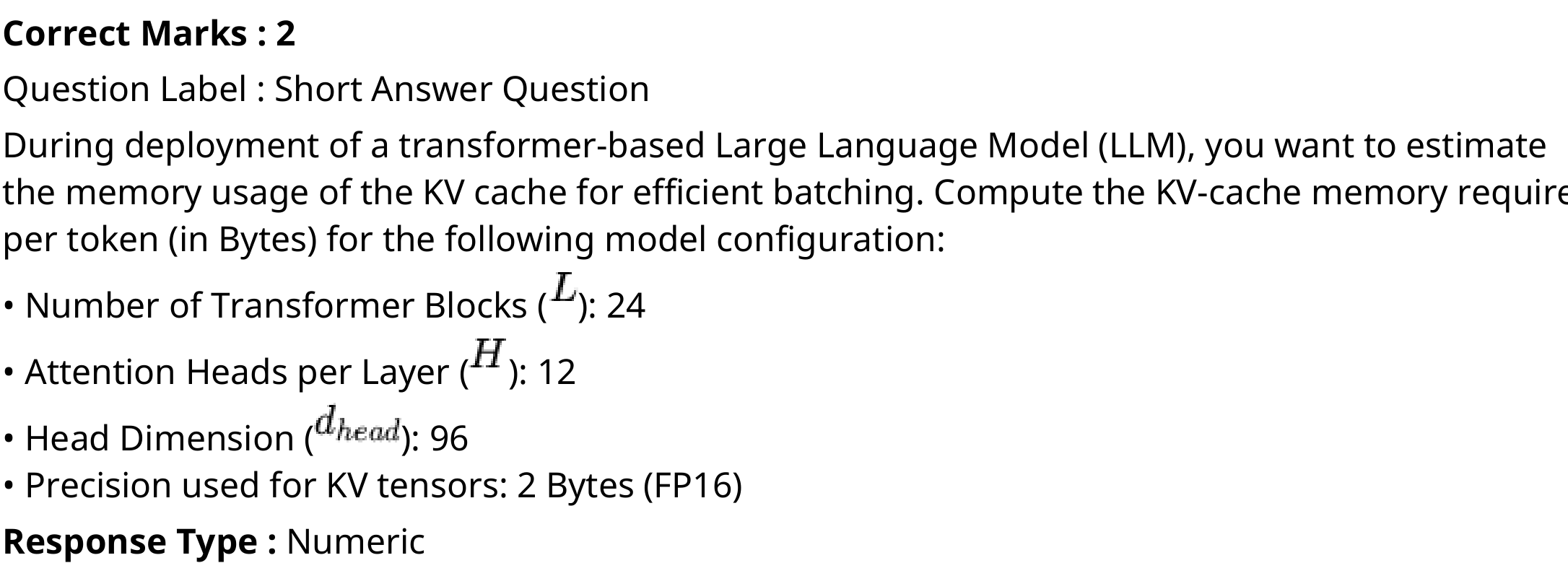
Figure 24. KV-cache memory calculation specifications: 24 blocks, 12 heads, 96 head dimension, FP16 precision
Correct answer: 110592
Source evidence: [{"page": 9, "bbox": [22.87, 694.46, 69.12, 712.82], "type": "explicit field", "detail": "Possible Answers : 110592 in official source key"}]
Question 22
Question ID: 6406531863545
Type: SA · Marks: 3
PDF pages: 10
You are implementing a custom Block Sparse Attention kernel. Given a sequence length \(T = 1024\) and block size \(B = 32\), you decide to compute the main diagonal blocks plus one random off-diagonal block for each block-row. How many total \(B \times B\) block computations are performed?
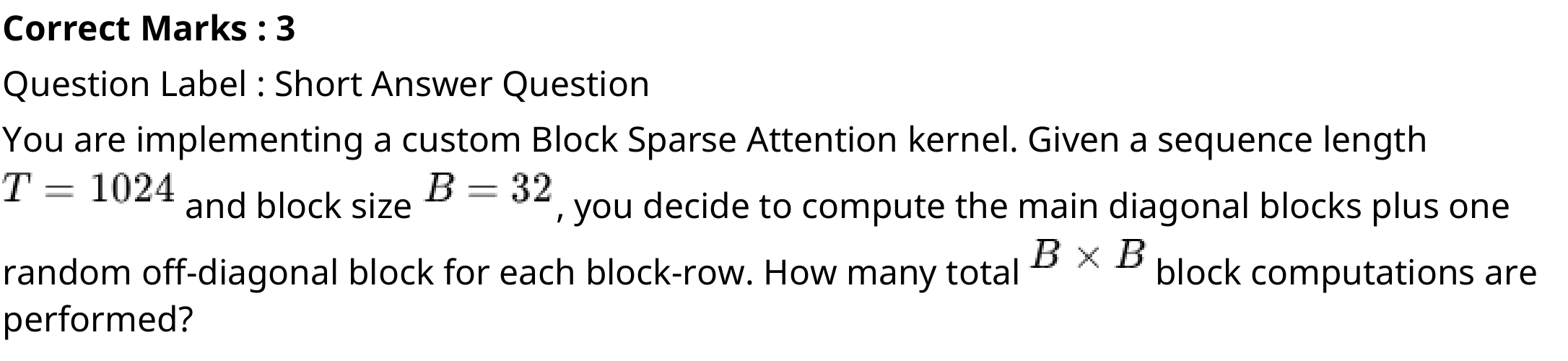
Figure 25. Custom Block Sparse Attention kernel with T = 1024, B = 32, and B x B block computations prompt
Correct answer: 64
Source evidence: [{"page": 10, "bbox": [22.87, 272.27, 41.38, 290.63], "type": "explicit field", "detail": "Possible Answers : 64 in official source key"}]
Question 23
Question ID: 6406531863546
Type: MSQ · Marks: 3
PDF pages: 10
A GPT-style causal language model is trained using the next-token prediction objective:
$\(\mathcal{L} = -\sum_{t=1}^T \log p_\theta(x_t \mid x_{<t})\)$
During inference, the model must generate tokens autoregressively from left to right using only past context.
Consider the following statements about GPT-style causal models.
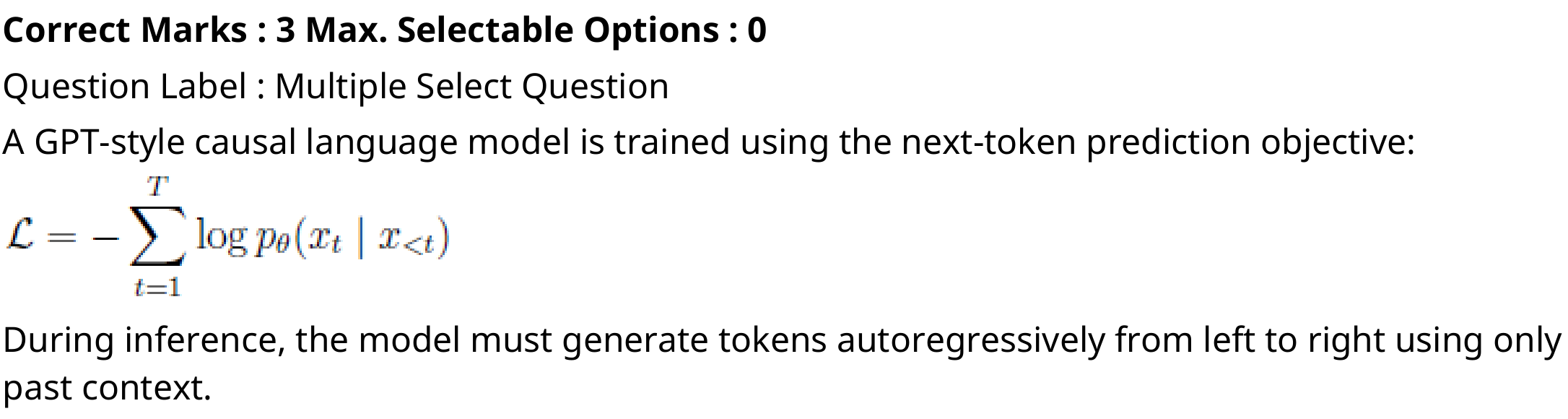
Figure 26. GPT-style causal language model training objective formula and autoregressive inference setup
Options
A.
GPT cannot condition on future tokens during training because the causal mask zeros out all attention to positions \(> t\)

Figure 27. Option A causal mask zeroing out attention to positions > t
Source option ID: 6406536036831
B.
If two prefixes \(x_{<t}\) and \(x'_{<t}\) have identical embeddings at all positions, GPT must assign identical next-token distributions for both contexts

Figure 28. Option B identical embeddings prefixes x_<t and x'_<t next-token distribution statement
Source option ID: 6406536036832
C.
Removing positional encodings would force GPT to treat all permutations of the same set of tokens as equivalent contexts
Source option ID: 6406536036833
D.
Causal masking ensures that the computational cost of training scales linearly with sequence length
Source option ID: 6406536036834
Correct answer: GPT cannot condition on future tokens during training because the causal mask zeros out all attention to positions \(> t\); If two prefixes \(x_{<t}\) and \(x'_{<t}\) have identical embeddings at all positions, GPT must assign identical next-token distributions for both contexts; Removing positional encodings would force GPT to treat all permutations of the same set of tokens as equivalent contexts
Source evidence: [{"page": 10, "bbox": [23.62, 516.02, 119.02, 532.34], "type": "green source option", "detail": "Option 6406536036831 marked in green (color 32768)"}, {"page": 10, "bbox": [23.62, 582.85, 119.02, 599.17], "type": "green source option", "detail": "Option 6406536036832 marked in green (color 32768)"}, {"page": 10, "bbox": [23.62, 636.31, 119.02, 652.63], "type": "green source option", "detail": "Option 6406536036833 marked in green (color 32768)"}]
Question 24
Question ID: 6406531863547
Type: MSQ · Marks: 3
PDF pages: 11
Under which of the following decoding settings can the model produce different outputs across
multiple runs on the same prompt?
Options
A.
Top-K sampling with \(K = 1\) and temperature \(T = 0\)

Figure 29. Option A Top-K sampling with K = 1 and temperature T = 0
Source option ID: 6406536036835
B.
Top-K sampling with \(K = 50\) and temperature \(T = 1\)

Figure 30. Option B Top-K sampling with K = 50 and temperature T = 1
Source option ID: 6406536036836
C.
Nucleus (Top-p) sampling with \(p = 0.9\) and temperature \(T = 0.7\)

Figure 31. Option C Nucleus (Top-p) sampling with p = 0.9 and temperature T = 0.7
Source option ID: 6406536036837
D.
Greedy decoding after applying a temperature \(T = 2\) to the logits

Figure 32. Option D Greedy decoding after applying temperature T = 2 to logits
Source option ID: 6406536036838
E.
Beam search with beam width = 5

Figure 33. Option E Beam search with beam width = 5
Source option ID: 6406536036839
Correct answer: Top-K sampling with \(K = 50\) and temperature \(T = 1\); Nucleus (Top-p) sampling with \(p = 0.9\) and temperature \(T = 0.7\)
Source evidence: [{"page": 11, "bbox": [23.62, 180.95, 119.02, 197.27], "type": "green source option", "detail": "Option 6406536036836 marked in green (color 32768)"}, {"page": 11, "bbox": [23.62, 224.77, 119.02, 241.09], "type": "green source option", "detail": "Option 6406536036837 marked in green (color 32768)"}]
Question 25
Question ID: 6406531863548
Type: MSQ · Marks: 2
PDF pages: 11
Consider a BART encoder with sequence length \(L\) and hidden size \(d_{\text{model}}\) (fixed).
Now suppose the sequence length is doubled from \(L\) to \(2L\), keeping all other parameters unchanged.
Which of the following statements are true?
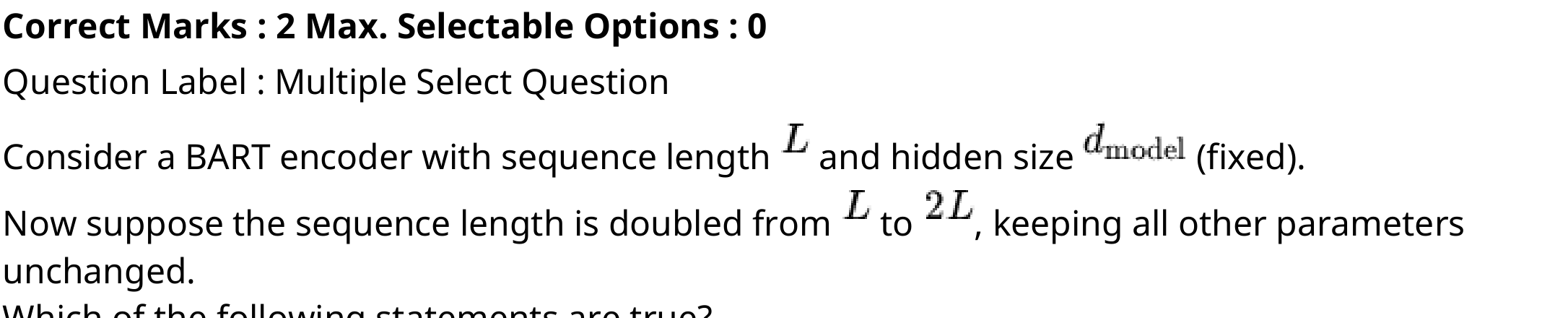
Figure 34. BART encoder sequence length L doubled to 2L with fixed hidden size d_model problem prompt
Options
A.
Self-attention FLOPs increase by a factor of 2
Source option ID: 6406536036840
B.
Self-attention FLOPs increase by a factor of 4
Source option ID: 6406536036841
C.
FFN FLOPs increase by a factor of 2
Source option ID: 6406536036842
D.
FFN FLOPs increase by a factor of 4
Source option ID: 6406536036843
Correct answer: Self-attention FLOPs increase by a factor of 4; FFN FLOPs increase by a factor of 2
Source evidence: [{"page": 11, "bbox": [23.62, 578.32, 119.02, 594.64], "type": "green source option", "detail": "Option 6406536036841 marked in green (color 32768)"}, {"page": 11, "bbox": [23.62, 620.64, 119.02, 636.96], "type": "green source option", "detail": "Option 6406536036842 marked in green (color 32768)"}]
Answer key
| Source question | Source identity | Correct answer | PDF pages |
|---|---|---|---|
| 2 | 6406531863525 | The statistics become meaningless (mean=0, std=0) | 2 |
| 3 | 6406531863526 | 'cat'', ''dog'' or ''bird'' | 2 |
| 4 | 6406531863527 | Tokens A, B, C | 2 |
| 5 | 6406531863528 | Insufficient information to determine | 3 |
| 6 | 6406531863529 | Feed the [CLS] embedding into a linear layer with a sigmoid activation per label | 3 |
| 7 | 6406531863530 | BART, because it is trained with text corruption and autoregressive reconstruction | 4 |
| 8 | 6406531863531 | Computing the matrix product \(QK^T\) | 4 |
| 9 | 6406531863532 | GPU memory exhaustion | 4 |
| 10 | 6406531863533 | \(\mathcal{O}(T \cdot B \cdot d)\) | 5 |
| 11 | 6406531863534 | [-3, -4] | 5 |
| 12 | 6406531863535 | 900 additional positional embedding vectors | 6 |
| 13 | 6406531863536 | 6 | 6 |
| 14 | 6406531863537 | APE = 10, RPE = 19, ALiBi = 0, NoPE = 0 | 6 |
| 15 | 6406531863538 | ALiBi | 7 |
| 16 | 6406531863539 | ALiBi | 7 |
| 17 | 6406531863540 | 0 | 7 |
| 18 | 6406531863541 | 100000 | 8 |
| 19 | 6406531863542 | 121 | 8 |
| 20 | 6406531863543 | 30 | 9 |
| 21 | 6406531863544 | 110592 | 9 |
| 22 | 6406531863545 | 64 | 10 |
| 23 | 6406531863546 | GPT cannot condition on future tokens during training because the causal mask zeros out all attention to positions \(> t\); If two prefixes \(x_{<t}\) and \(x'_{<t}\) have identical embeddings at all positions, GPT must assign identical next-token distributions for both contexts; Removing positional encodings would force GPT to treat all permutations of the same set of tokens as equivalent contexts | 10 |
| 24 | 6406531863547 | Top-K sampling with \(K = 50\) and temperature \(T = 1\); Nucleus (Top-p) sampling with \(p = 0.9\) and temperature \(T = 0.7\) | 11 |
| 25 | 6406531863548 | Self-attention FLOPs increase by a factor of 4; FFN FLOPs increase by a factor of 2 | 11 |
Extraction notes
Status: verified
Count reconciliation: The portal header declared 25 questions and 50 marks for the LLM section. The source PDF contains 1 administrative subject confirmation question (Question 1, 0 marks, excluded) and 24 academic questions (Questions 2 to 25). The 50 section marks reconcile exactly across the 24 academic questions: Q2 (1) + Q3 (2) + Q4 (2) + Q5 (2) + Q6 (2) + Q7 (1) + Q8 (1) + Q9 (1) + Q10 (2) + Q11 (2) + Q12 (2) + Q13 (3) + Q14 (3) + Q15 (2) + Q16 (2) + Q17 (2) + Q18 (3) + Q19 (2) + Q20 (2) + Q21 (2) + Q22 (3) + Q23 (3) + Q24 (3) + Q25 (2) = 50 marks. Total questions (1 confirmation + 24 academic = 25 questions) and total marks (50) reconcile fully without discrepancy.
- All 24 academic questions (Q2-Q25) have been verified against native text and 288 DPI visual renders.
- All mathematical formulas, matrices, vectors, and token variables in stems and options have been transcribed into LaTeX and paired with 288 DPI high-resolution source crops.
Excluded source entries:
- {"classification": "subject-confirmation", "page": 1, "bbox": [22.87, 454.45, 570.0, 710.0], "reason": "Administrative subject confirmation asking candidate to confirm subject and cross check hall ticket", "identity": "1"}