LLM — da5004_2025T2_Q2_NA
Source: da5004_2025T2_Q2_NA.pdf · Academic questions: 17 · Separately counted children: 0
Provenance: Large_Language_Models/da5004_2025T2_Q2_NA.pdf · SHA-256 86c404a53c5610cb48b7c7d701bb4794a5f76fe4fb77a9aa07df66976036a9a5
Scope: Large Language Models (LLM) section (Section 13, Section Id: 64065394491) spanning page 1 at y=78.10 to page 9 at y=842.00. Preceding Section 12 tail content at top of page 1 (y=0 to y=78.10, Possible Answers : 2) is excluded as out of subject scope.
Questions
Question 269
Question ID: 6406531326571
Type: MCQ · Marks: 2
PDF pages: 2
What is a primary motivation for using subword tokenization (like BPE or WordPiece) instead of
word-level tokenization in transformers?
Options
A.
It increases vocabulary size exponentially
Source option ID: 6406534441547
B.
It completely eliminates the need for a tokenizer
Source option ID: 6406534441548
C.
It helps handle out-of-vocabulary words more effectively
Source option ID: 6406534441549
D.
It prevents the model from needing positional encoding
Source option ID: 6406534441550
Correct answer: It helps handle out-of-vocabulary words more effectively
Source evidence: [{"page": 2, "bbox": [23.62, 191.38, 131.02, 207.7], "type": "marked-options", "detail": "Green checkmark option 6406534441549"}]
Question 270
Question ID: 6406531326572
Type: MCQ · Marks: 2
PDF pages: 2
What is a key implication of scaling laws in large language models?
Options
A.
Training longer always leads to better performance
Source option ID: 6406534441551
B.
Larger models require less training data
Source option ID: 6406534441552
C.
Model size and dataset size must scale together to maintain optimal
performance
Source option ID: 6406534441553
D.
None of these
Source option ID: 6406534441554
Correct answer: Model size and dataset size must scale together to maintain optimal
performance
Source evidence: [{"page": 2, "bbox": [23.62, 395.08, 131.02, 411.4], "type": "marked-options", "detail": "Green checkmark option 6406534441553"}]
Question 271
Question ID: 6406531326573
Type: MCQ · Marks: 2
PDF pages: 2
Consider the Following Assertion and Reason pair :
Assertion : In Byte Pair Encoding (BPE), each merge operation adds exactly one new token to the
vocabulary.
Reason : BPE helps reduce the size of the initial vocabulary by merging the most frequent tokens.
Options
A.
Both Assertion and Reason are true, and Reason is the correct explanation of
Assertion.
Source option ID: 6406534441555
B.
Both Assertion and Reason are true, but Reason is not the correct explanation
of Assertion.
Source option ID: 6406534441556
C.
Assertion is true, but Reason is false.
Source option ID: 6406534441557
D.
Assertion is false, but Reason is true.
Source option ID: 6406534441558
Correct answer: Assertion is true, but Reason is false.
Source evidence: [{"page": 2, "bbox": [23.62, 696.7, 131.02, 713.02], "type": "marked-options", "detail": "Green checkmark option 6406534441557"}]
Question 272
Question ID: 6406531326575
Type: MCQ · Marks: 2
PDF pages: 2, 3
What is the primary advantage of T5’s text-to-text approach for transfer learning in NLP?
Options
A.
It reduces the computational cost of training models significantly.
Source option ID: 6406534441563
B.
It allows a single model and architecture to be applied to a wide variety of NLP
tasks without modification.
Source option ID: 6406534441564
C.
It guarantees optimal performance on all tasks without fine-tuning.
Source option ID: 6406534441565
D.
It eliminates the need for any pre-training data.
Source option ID: 6406534441566
Correct answer: It allows a single model and architecture to be applied to a wide variety of NLP
tasks without modification.
Source evidence: [{"page": 3, "bbox": [23.62, 76.96, 131.02, 93.28], "type": "marked-options", "detail": "Green checkmark option 6406534441564"}]
Question 273
Question ID: 6406531326576
Type: MCQ · Marks: 2
PDF pages: 3
What is the format of output the T5 model is expected to generate during its span-corruption
pretraining?
Options
A.
A sentence with masked tokens filled in

Figure 1. Option A: A sentence with masked tokens filled in
Source option ID: 6406534441567
B.
A concatenation of masked spans in order, each preceded by the corresponding sentinel token

Figure 2. Option B: A concatenation of masked spans in order, each preceded by the corresponding sentinel token
Source option ID: 6406534441568
C.
A binary classification of whether the span was masked correctly

Figure 3. Option C: A binary classification of whether the span was masked correctly
Source option ID: 6406534441569
D.
A sequence of original and corrupted spans separated by <mask>

Figure 4. Option D: A sequence of original and corrupted spans separated by <mask>
Source option ID: 6406534441570
Correct answer: A concatenation of masked spans in order, each preceded by the corresponding sentinel token
Source evidence: [{"page": 3, "bbox": [23.62, 362.48, 131.02, 378.8], "type": "marked-options", "detail": "Green checkmark option 6406534441568"}]
Question 274
Question ID: 6406531326574
Type: MCQ · Marks: 3
PDF pages: 3, 4
Given the input string:
peanutbutter
And the following vocabulary of subword tokens with their corresponding log-probabilities:
| Subword | Log-Probability (base \(e\)) |
|---|---|
| pea | -1.0 |
| nut | -0.8 |
| but | -1.2 |
| ter | -0.7 |
| butter | -1.0 |
| peanut | -0.5 |
| t | -2.0 |
| er | -1.5 |
Using the Viterbi algorithm (as used in the SentencePiece tokenizer), determine the most probable tokenization of the input string. The probability of a tokenized sequence is the sum of the log-probabilities of the selected subwords. Only subwords from the vocabulary may be used.
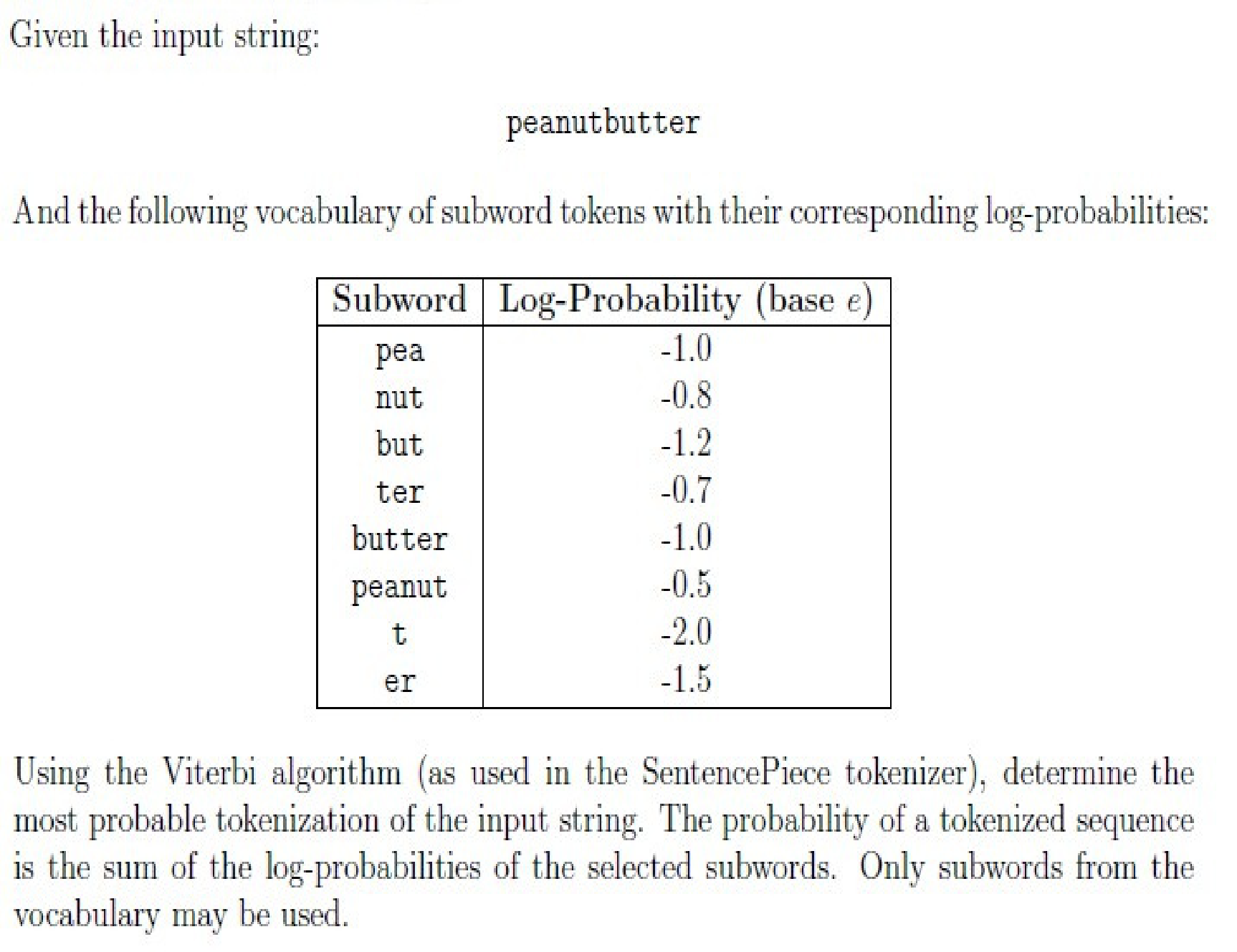
Figure 5. Viterbi algorithm tokenization problem with input string peanutbutter and vocabulary table
Options
A.
[peanut, but, ter]

Figure 6. Option A: [peanut, but, ter]
Source option ID: 6406534441559
B.
[pea, nut, butter]

Figure 7. Option B: [pea, nut, butter]
Source option ID: 6406534441560
C.
[peanut, butter]

Figure 8. Option C: [peanut, butter]
Source option ID: 6406534441561
D.
[pea, nut, but, ter]

Figure 9. Option D: [pea, nut, but, ter]
Source option ID: 6406534441562
Correct answer: [peanut, butter]
Source evidence: [{"page": 4, "bbox": [23.62, 471.4, 131.02, 487.72], "type": "marked-options", "detail": "Green checkmark option 6406534441561"}]
Question 275
Question ID: 6406531326577
Type: MCQ · Marks: 3
PDF pages: 4, 5
Suppose you are given 4x more compute budget to scale a Transformer-based language model.
According to scaling laws, what is the best way to utilize this increased compute for optimal
model performance?
Options
A.
Increase the model size (number of parameters) by 4x and keep the dataset
size and training steps the same.
Source option ID: 6406534441571
B.
Train the same model on 4x more data for 4x more steps without changing
the model size.
Source option ID: 6406534441572
C.
Increase the model size by approximately 2x and increase the amount of
training data by approximately 2x.
Source option ID: 6406534441573
D.
Double the model size and halve the training data size to compensate.
Source option ID: 6406534441574
Correct answer: Increase the model size by approximately 2x and increase the amount of
training data by approximately 2x.
Source evidence: [{"page": 4, "bbox": [23.62, 781.21, 131.02, 797.53], "type": "marked-options", "detail": "Green checkmark option 6406534441573"}]
Question 276
Question ID: 6406531326578
Type: MSQ · Marks: 3
PDF pages: 5
In a data preprocessing stage designed to prepare clean, diverse, and safe data, which of the
following examples is likely to be filtered out?
Options
A.
“All people from that xyz area are thieves. They should be jailed immediately.”
Source option ID: 6406534441575
B.
Kavya’s PAN number is BDZPK1234K and her registered address is 17/4, Green
Park, Delhi.
Source option ID: 6406534441576
C.
[“Reinforcement learning allows agents to learn optimal strategies through
interaction with an environment.”, “Reinforcement learning allows agents to learn optimal
strategies through interaction with an environment.”]
Source option ID: 6406534441577
D.
The Union Budget 2024 proposes increased spending on green energy
infrastructure.
Source option ID: 6406534441578
E.
According to WHO, global life expectancy has increased by 6 years since 2000.
Source option ID: 6406534441579
F.
None of these.
Source option ID: 6406534441580
Correct answer: “All people from that xyz area are thieves. They should be jailed immediately.”; Kavya’s PAN number is BDZPK1234K and her registered address is 17/4, Green
Park, Delhi.; [“Reinforcement learning allows agents to learn optimal strategies through
interaction with an environment.”, “Reinforcement learning allows agents to learn optimal
strategies through interaction with an environment.”]
Source evidence: [{"page": 5, "bbox": [23.62, 233.02, 131.02, 249.34], "type": "marked-options", "detail": "Green checkmark option 6406534441575"}, {"page": 5, "bbox": [23.62, 253.84, 131.02, 270.16], "type": "marked-options", "detail": "Green checkmark option 6406534441576"}, {"page": 5, "bbox": [23.62, 290.98, 131.02, 307.3], "type": "marked-options", "detail": "Green checkmark option 6406534441577"}]
Question 277
Question ID: 6406531326579
Type: MSQ · Marks: 3
PDF pages: 5
What are the key challenges encountered when building a vocabulary for NLP models?
Options
A.
A larger vocabulary leads to a bigger embedding matrix and increased
softmax computation
Source option ID: 6406534441581
B.
Difficulty in handling out-of-vocabulary (OOV) words
Source option ID: 6406534441582
C.
The size of each embedding vector increases with the number of out-of-
vocabulary (OOV) words
Source option ID: 6406534441583
D.
More vocabulary entries always guarantee better model generalization
Source option ID: 6406534441584
Correct answer: A larger vocabulary leads to a bigger embedding matrix and increased
softmax computation; Difficulty in handling out-of-vocabulary (OOV) words
Source evidence: [{"page": 5, "bbox": [23.62, 543.64, 131.02, 559.96], "type": "marked-options", "detail": "Green checkmark option 6406534441581"}, {"page": 5, "bbox": [23.62, 580.78, 131.02, 597.1], "type": "marked-options", "detail": "Green checkmark option 6406534441582"}]
Question 278
Question ID: 6406531326580
Type: MSQ · Marks: 3
PDF pages: 5, 6
Select all the correct input-output representations used for different pretraining objectives based
on the base sentence:
“The quick brown fox jumps over the lazy dog”
Options
A.
Span Corruption (T5’s Objective)
Input: "The
Output: "

Figure 10. Option A: Span Corruption (T5 Objective) input-output representation
Source option ID: 6406534441585
B.
Causal Language Modeling (CLM)
Input: "The quick brown fox jumps over the lazy"
Output: "The quick brown fox jumps over the lazy dog"

Figure 11. Option B: Causal Language Modeling (CLM) input-output representation
Source option ID: 6406534441586
C.
Masked Language Modeling (MLM)
Input: "The [MASK] fox jumps over the lazy dog"
Output: "quick brown"

Figure 12. Option C: Masked Language Modeling (MLM) input-output representation
Source option ID: 6406534441587
D.
Prefix Language Modeling
Input: "finish the sentence: The quick brown fox jumps"
Output: "over the lazy dog"

Figure 13. Option D: Prefix Language Modeling input-output representation
Source option ID: 6406534441588
Correct answer: Span Corruption (T5’s Objective)
Input: "The
Output: "
Input: "finish the sentence: The quick brown fox jumps"
Output: "over the lazy dog"
Source evidence: [{"page": 6, "bbox": [23.62, 58.68, 131.02, 75.0], "type": "marked-options", "detail": "Green checkmark option 6406534441585"}, {"page": 6, "bbox": [23.62, 302.65, 131.02, 318.97], "type": "marked-options", "detail": "Green checkmark option 6406534441588"}]
Question 279
Question ID: 6406531326581
Type: SA · Marks: 2
PDF pages: 6, 7
In multi-task pretraining, tasks are sampled according to the Proportional Mixing Strategy:
where:
- \(e_m\) is the original number of examples in task \(m\),
- Say we have \(N\) tasks and original number of samples in each task is \(e_n\) where \(n \in \{1, 2, \dots, N\}\)
- \(K\) is the cap applied to all datasets.
Suppose you have two tasks:
- Task A: \(e_1 = 10,000\)
- Task B: \(e_2 = 1,000,000\)
What is the largest value of \(K\) such that neither task has a sampling probability more than 50% (i.e. \(\le 0.5\))?
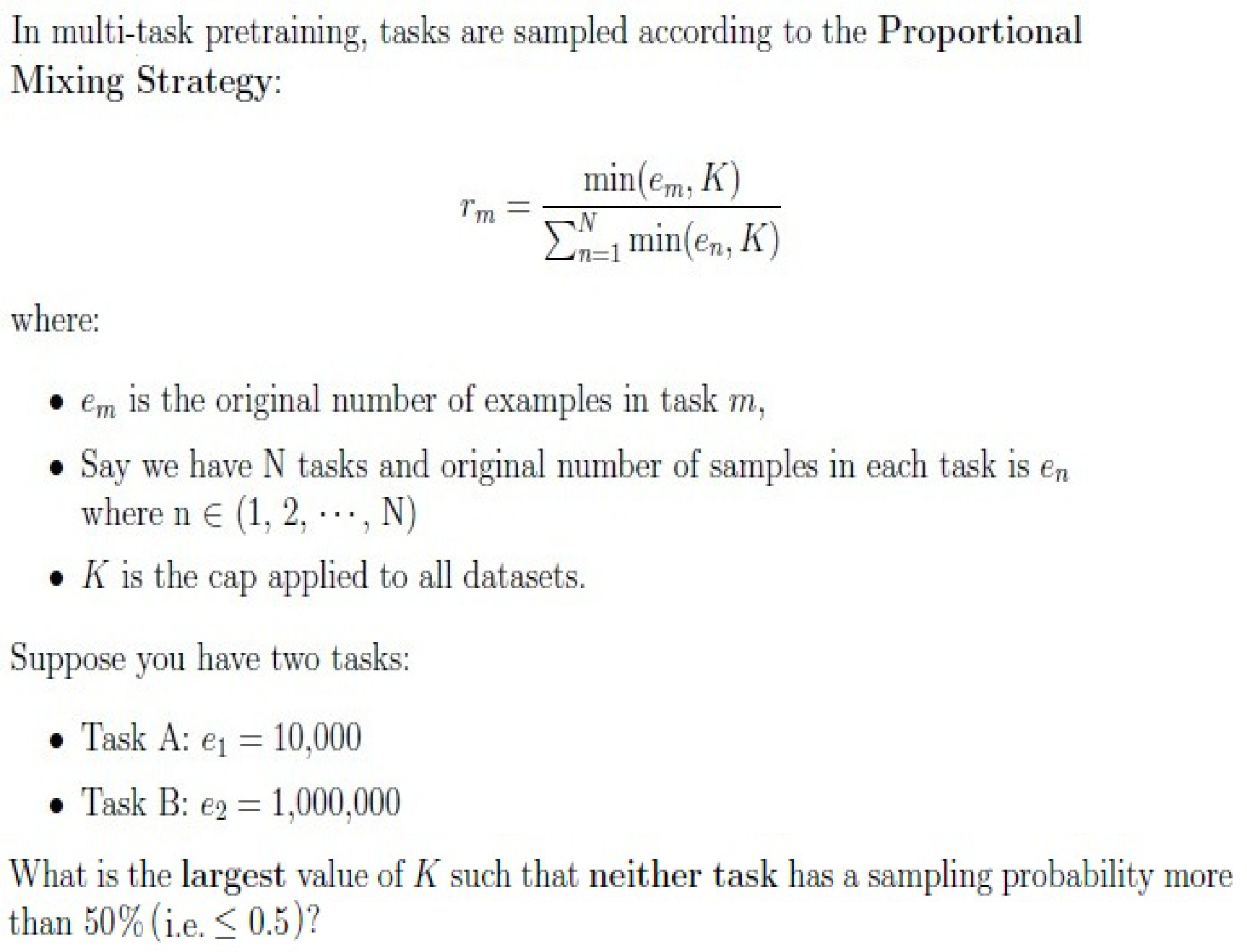
Figure 14. Multi-task pretraining Proportional Mixing Strategy mathematical formulation and problem
Correct answer: 10000
Source evidence: [{"page": 7, "bbox": [22.9, 113.4, 132.2, 151.0], "type": "numeric-answer", "detail": "Possible Answers : 10000"}]
Question 280
Question ID: 6406531326582
Type: SA · Marks: 3
PDF pages: 7
Consider the scaling law for pretraining test loss:
where \(A = \left(\frac{N_c}{N}\right)^{\alpha_N}\), \(B = \left(\frac{D_c}{D}\right)^{\alpha_D}\)
- \(N\): the number of non-embedding parameters
- \(D\): the size of the dataset (in tokens)
- \(N_c = 8.8 \times 10^8\)
- \(D_c = 5.4 \times 10^9\)
- \(\alpha_N = 0.076\)
- \(\alpha_D = 0.095\)
Assume \(A = 2B\). What is the approximate ratio of the new loss after doubling \(N\) and \(D\) to the original loss i.e., \(\frac{L(2N, 2D)}{L(N, D)}\)? (Answer correct upto 3 digits after the decimal)
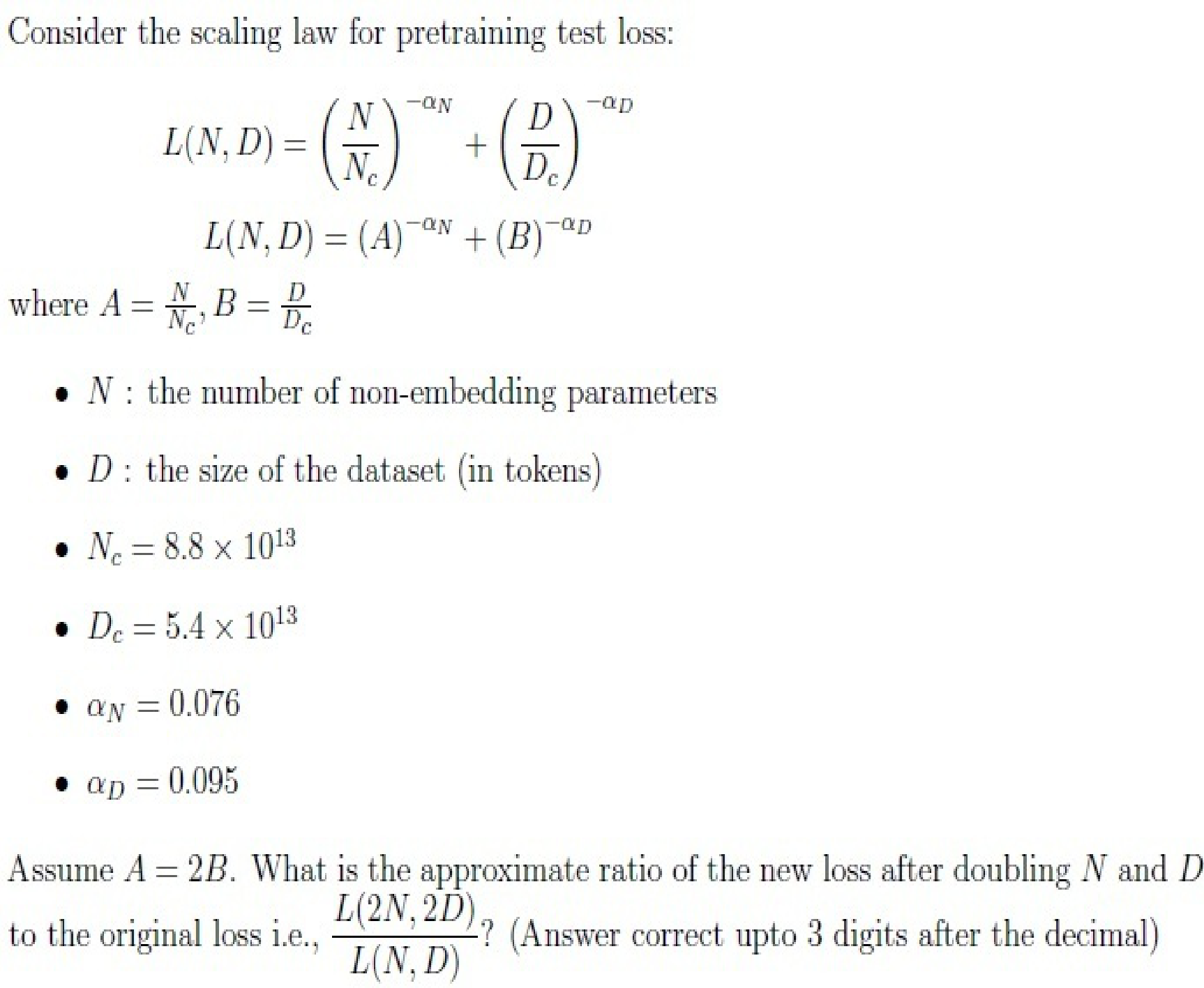
Figure 15. Scaling law for pretraining test loss mathematical formulation and parameter values
Correct answer: 0.914 to 0.975
Source evidence: [{"page": 7, "bbox": [22.9, 750.9, 132.2, 788.6], "type": "numeric-answer", "detail": "Possible Answers : 0.914 to 0.975"}]
Shared context 281 to 285
Question ID: 6406531326583
Portal container ID: 6406531326583
Type: Comprehension
PDF pages: 8
Consider the following dictionary for the subword tokenization:
vocabulary = {
    "gentler": 4,
    "brighter": 5,
    "crisper": 3
}
Append </w> to each word and consider it for all the calculations.
Based on the above data, answer the given subquestions.
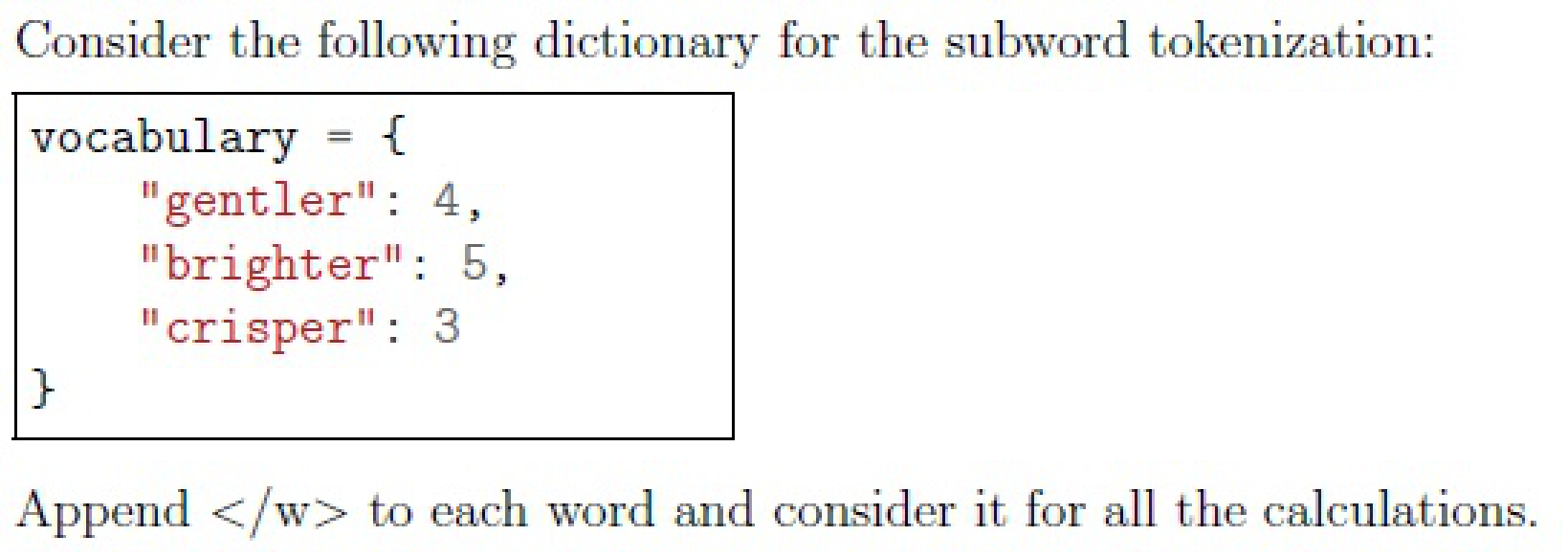
Figure 16. Vocabulary dictionary for subword tokenization with gentler, brighter, crisper and frequency counts
Question 281
Question ID: 6406531326584
Type: SA · Marks: 2
PDF pages: 8
Shared context: ctx-281-285
Using Byte Pair Encoding (BPE), how many distinct tokens are there in the initial vocabulary before
any merges are performed?
Correct answer: 13
Source evidence: [{"page": 8, "bbox": [22.9, 562.5, 132.2, 600.2], "type": "numeric-answer", "detail": "Possible Answers : 13"}]
Question 282
Question ID: 6406531326585
Type: MCQ · Marks: 2
PDF pages: 8
Shared context: ctx-281-285
Which token pair has the lowest frequency before any merges in Byte Pair Encoding?
Options
A.
(‘b’, ‘r’)
Source option ID: 6406534441592
B.
(‘t’, ‘l’)
Source option ID: 6406534441593
C.
(‘p’, ‘e’)
Source option ID: 6406534441594
D.
(‘e’, ‘r’)
Source option ID: 6406534441595
E.
None of these
Source option ID: 6406534441596
Correct answer: (‘p’, ‘e’)
Source evidence: [{"page": 8, "bbox": [23.62, 761.46, 131.02, 777.78], "type": "marked-options", "detail": "Green checkmark option 6406534441594"}]
Question 283
Question ID: 6406531326586
Type: SA · Marks: 2
PDF pages: 9
Shared context: ctx-281-285
What is the frequency of the most frequent byte-pair before the first merge in Byte Pair Encoding?
Correct answer: 12
Source evidence: [{"page": 9, "bbox": [22.9, 210.0, 132.2, 247.6], "type": "numeric-answer", "detail": "Possible Answers : 12"}]
Question 284
Question ID: 6406531326587
Type: SA · Marks: 2
PDF pages: 9
Shared context: ctx-281-285
If after three merges using Byte Pair Encoding (BPE), the vocabulary is as shown below, how many subword tokens will be used to tokenize the word “writer” ?
['</w>', 'b', 'c', 'e', 'g', 'h', 'i', 'l', 'n', 'p', 'r', 's', 't', 'er', 'er</w>', 'ri']
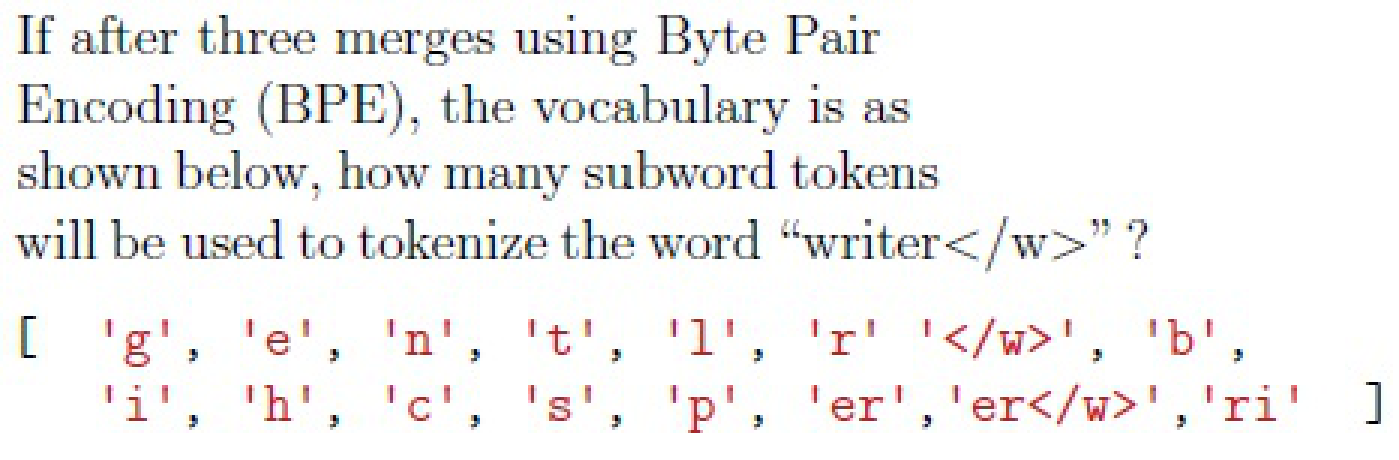
Figure 17. BPE vocabulary after three merges and tokenization question for word writer
Correct answer: 4
Source evidence: [{"page": 9, "bbox": [22.9, 545.8, 132.2, 583.4], "type": "numeric-answer", "detail": "Possible Answers : 4"}]
Question 285
Question ID: 6406531326588
Type: MCQ · Marks: 2
PDF pages: 9
Shared context: ctx-281-285
Which of the following pairs will be merged in the first iteration based on the following score used in the WordPiece tokenizer?
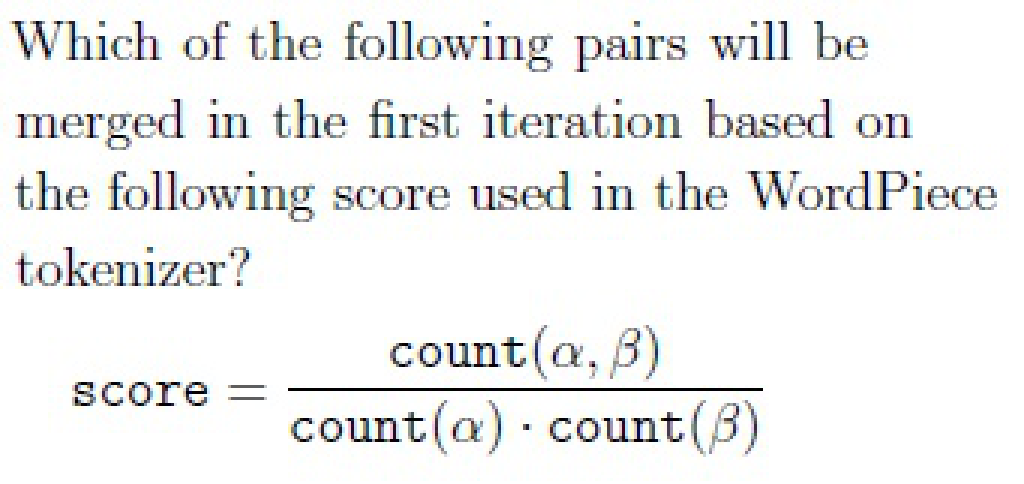
Figure 18. WordPiece tokenizer scoring formula and pair merging question
Correct answer: Answer not verifiable from the source PDF
Source evidence: [{"page": 9, "bbox": [22.87, 663.72, 278.62, 807.3], "type": "absent", "detail": "Question 285 ends after Options : on final page 9 of the source PDF with no option items or official answer key provided"}]
Answer key
| Source question | Source identity | Correct answer | PDF pages |
|---|---|---|---|
| 269 | 6406531326571 | It helps handle out-of-vocabulary words more effectively | 2 |
| 270 | 6406531326572 | Model size and dataset size must scale together to maintain optimal performance | 2 |
| 271 | 6406531326573 | Assertion is true, but Reason is false. | 2 |
| 272 | 6406531326575 | It allows a single model and architecture to be applied to a wide variety of NLP tasks without modification. | 2, 3 |
| 273 | 6406531326576 | A concatenation of masked spans in order, each preceded by the corresponding sentinel token | 3 |
| 274 | 6406531326574 | [peanut, butter] | 3, 4 |
| 275 | 6406531326577 | Increase the model size by approximately 2x and increase the amount of training data by approximately 2x. | 4, 5 |
| 276 | 6406531326578 | “All people from that xyz area are thieves. They should be jailed immediately.”; Kavya’s PAN number is BDZPK1234K and her registered address is 17/4, Green Park, Delhi.; [“Reinforcement learning allows agents to learn optimal strategies through interaction with an environment.”, “Reinforcement learning allows agents to learn optimal strategies through interaction with an environment.”] | 5 |
| 277 | 6406531326579 | A larger vocabulary leads to a bigger embedding matrix and increased softmax computation; Difficulty in handling out-of-vocabulary (OOV) words | 5 |
| 278 | 6406531326580 | Span Corruption (T5’s Objective) Input: "The |
5, 6 |
| 279 | 6406531326581 | 10000 | 6, 7 |
| 280 | 6406531326582 | 0.914 to 0.975 | 7 |
| 281 | 6406531326584 | 13 | 8 |
| 282 | 6406531326585 | (‘p’, ‘e’) | 8 |
| 283 | 6406531326586 | 12 | 9 |
| 284 | 6406531326587 | 4 | 9 |
| 285 | 6406531326588 | Answer not verifiable from the source PDF | 9 |
Extraction notes
Status: verified-source-limitation
Count reconciliation: Section 13 declares 14 portal questions and 40 section marks. The 14 portal containers comprise: 1 administrative confirmation question (Q268, 0 marks, excluded), 12 standalone questions (Q269: 2 marks, Q270: 2 marks, Q271: 2 marks, Q272: 2 marks, Q273: 2 marks, Q274: 3 marks, Q275: 3 marks, Q276: 3 marks, Q277: 3 marks, Q278: 3 marks, Q279: 2 marks, Q280: 3 marks; total standalone = 30 marks), and 1 comprehension portal container (Q281-285: 5 subquestions of 2 marks each = 10 marks). Total academic questions = 12 standalone + 5 comprehension subquestions = 17 academic questions. Total marks = 30 + 10 = 40 marks, exactly reconciling the declared section marks and 14 portal containers (1 confirmation + 12 standalone + 1 comprehension container = 14 portal questions).
- Section 13 LLM examination starts on page 1 after preceding section tail and continues through page 9.
- Question 285 (MCQ, 2 marks, Question Id: 6406531326588) on Page 9 has stem header and stem image (WordPiece tokenizer scoring formula) followed by 'Options :', but no option items or official answer key are present in the source PDF before the document ends at page 9. In accordance with extraction contract instructions, the answer is recorded with kind 'absent' and text 'Answer not verifiable from the source PDF'.
Excluded source entries:
- {"classification": "out-of-scope-tail", "page": 1, "bbox": [22.87, 16.8, 169.2, 54.4], "reason": "Tail of preceding Section 12 answer evaluation ('Possible Answers : 2') appearing above Section 13 LLM header", "identity": "section-12-tail"}
- {"classification": "subject-confirmation", "page": 1, "bbox": [22.87, 396.6, 580.0, 765.0], "reason": "Administrative subject confirmation asking candidate to confirm subject and cross check hall ticket", "identity": "268"}