LLM — da5004_2025T1_Q1_NA
Source: da5004_2025T1_Q1_NA.pdf · Academic questions: 18 · Separately counted children: 0
Provenance: Large_Language_Models/da5004_2025T1_Q1_NA.pdf · SHA-256 4019a127e45cedea3067b48841d0e0f39c576a2698c0edfdf64315da4b1b541d
Scope: Section 7: LLM (Degree Level : Large Language Models), physical pages 1 to 10. The in-scope subject starts at physical page 1 with Section Id 64065379954 at y=79.96 and terminates on physical page 10 immediately prior to Section 8: i-NLP (Section Id 64065379955) at y=234.61.
Questions
Shared context 103
Question ID: 6406531130556
Type: General Note
PDF pages: 1, 2
General Note:
- If you find the given information is insufficient in any of the Numerical Answer Type (NAT) questions, enter -1 as the answer.
- In all your calculations, take at least two digits. For example, if the intermediate result is 1.860875, then take it as 1.86 to the next step.

Figure 1. General Note specifying NAT insufficient information convention (-1) and rounding to at least two digits for intermediate calculations
Question 104
Question ID: 6406531130557
Type: Multiple Choice Question · Marks: 2
PDF pages: 2
Let \(H_e \in \mathbb{R}^{T_1 \times d_{model}}\) be the representation from the topmost encoder layer of the encoder and \(Z_d \in \mathbb{R}^{T_2 \times d_{model}}\) be the output of Multihead Masked Attention layer of one of the decoder layers. What will be the size of the attention matrix in the Multi-head Cross Attention layer of the same decoder layer? Assume \(d_k = d_q = d_v = d\) if required.
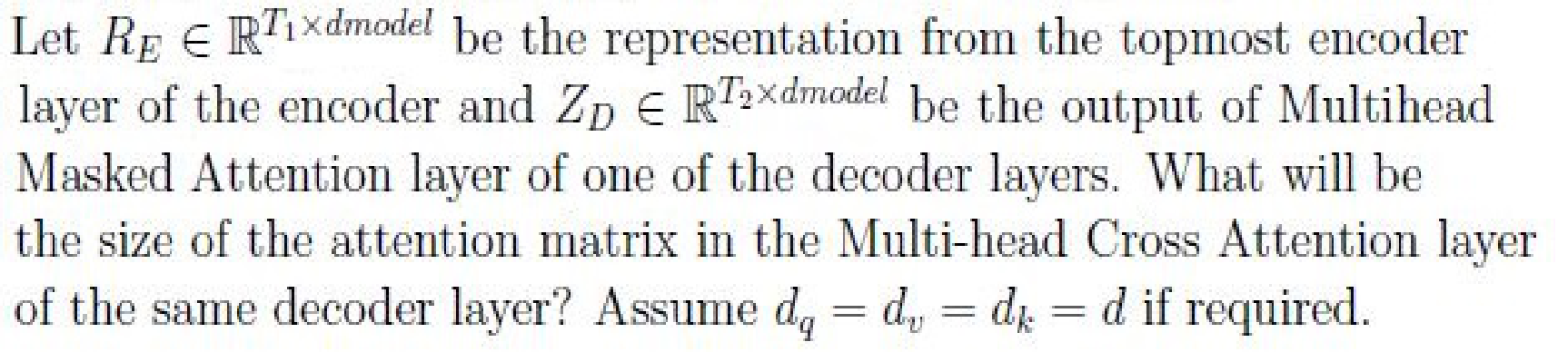
Figure 2. Topmost encoder representation R_E and decoder masked attention output Z_D dimension formulation for cross-attention matrix size
Options
A.
\(T_1 \times T_1\)
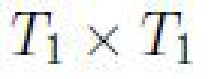
Figure 3. Option A attention matrix dimension T_1 x T_2
Source option ID: 6406533822520
B.
\(T_1 \times T_2\)
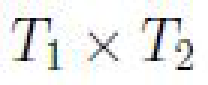
Figure 4. Option B attention matrix dimension T_2 x T_2
Source option ID: 6406533822521
C.
\(T_2 \times T_2\)
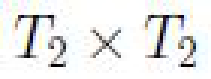
Figure 5. Option C attention matrix dimension T_1 x T_1
Source option ID: 6406533822522
D.
\(T_2 \times T_1\)
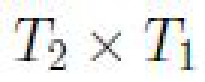
Figure 6. Option D attention matrix dimension T_2 x T_1
Source option ID: 6406533822523
Correct answer: D
Source evidence: [{"page": 2, "bbox": [23.62, 601.42, 119.02, 617.74], "type": "green source option", "detail": "Option 6406533822523 marked with green color 32768 in source PDF"}]
Question 105
Question ID: 6406531130558
Type: Multiple Choice Question · Marks: 2
PDF pages: 2, 3
Consider following assertion and reason pair:
Assertion: A transformer model cannot be trained in autogregressive mode for machine
translation task.
Reason: Teacher forcing improves the convergence rate.
Choose the correct statements
Options
A.
Assertion and Reason are both true and Reason is a correct explanation of
Assertion.
Source option ID: 6406533822524
B.
Assertion and Reason are both true and Reason is not a correct explanation of
Assertion.
Source option ID: 6406533822525
C.
Assertion is true but Reason is false.
Source option ID: 6406533822526
D.
Assertion is false but Reason is true.
Source option ID: 6406533822527
Correct answer: D
Source evidence: [{"page": 3, "bbox": [23.62, 151.24, 119.02, 167.56], "type": "green source option", "detail": "Option 6406533822527 marked with green color 32768 in source PDF"}]
Question 106
Question ID: 6406531130560
Type: Multiple Choice Question · Marks: 3
PDF pages: 3
Suppose we use a pre-trained model for text generation with the given prompt “I am going to”.
Which of the following decoding strategies can be used such that the pre-trained model generates
different text completion each time it is executed
Options
A.
Beam search with beam size 1
Source option ID: 6406533822532
B.
Greedy approach
Source option ID: 6406533822533
C.
Top-K with k = 2
Source option ID: 6406533822534
D.
None of these
Source option ID: 6406533822535
Correct answer: C
Source evidence: [{"page": 3, "bbox": [23.62, 424.73, 119.02, 441.05], "type": "green source option", "detail": "Option 6406533822534 marked with green color 32768 in source PDF"}]
Question 107
Question ID: 6406531130561
Type: Multiple Select Question · Marks: 2
PDF pages: 3
Which of the following models, in general, struggle to encode a context when translating long
sentences?
Options
A.
An RNN model
Source option ID: 6406533822536
B.
An RNN model with attention mechanism
Source option ID: 6406533822537
C.
A transformer model
Source option ID: 6406533822538
Correct answer: A
Source evidence: [{"page": 3, "bbox": [23.62, 661.08, 119.02, 677.4], "type": "green source option", "detail": "Option 6406533822536 marked with green color 32768 in source PDF"}]
Question 108
Question ID: 6406531130562
Type: Multiple Select Question · Marks: 2
PDF pages: 3, 4
Choose the correct statements
Options
A.
All the parameters of the GPT model are randomly initialized during pre-
training
Source option ID: 6406533822539
B.
The model minimizes the CLM objective during fine-tuning to improve the
performance
Source option ID: 6406533822540
C.
All parameters of the GPT model are randomly initialized during fine-tuning
Source option ID: 6406533822541
D.
In general, fine-tuning requires a dataset with labels
Source option ID: 6406533822542
Correct answer: A, D
Source evidence: [{"page": 4, "bbox": [23.62, 36.82, 119.02, 53.14], "type": "green source option", "detail": "Option 6406533822539 marked with green color 32768 in source PDF"}, {"page": 4, "bbox": [23.62, 131.92, 119.02, 148.24], "type": "green source option", "detail": "Option 6406533822542 marked with green color 32768 in source PDF"}]
Question 109
Question ID: 6406531130559
Type: Multiple Select Question · Marks: 3
PDF pages: 4
Which of the following are correct statements regarding exhaustive decoding strategy? Note: \(V\) represents the vocabulary.

Figure 7. Question 109 prompt: correct statements regarding exhaustive decoding strategy with vocabulary V
Options
A.
To generate a 10 token output, \(|V|^{10}\) possibilities will be considered.

Figure 8. Option A exhaustive decoding search space |V|^10 possibilities for 10-token output
Source option ID: 6406533822528
B.
To generate a 10 token output, \(|V|^{12}\) possibilities will be considered.

Figure 9. Option B exhaustive decoding search space |V|^12 possibilities for 10-token output
Source option ID: 6406533822529
C.
It is a deterministic approach.

Figure 10. Option C exhaustive decoding is a deterministic approach
Source option ID: 6406533822530
D.
It is a stochastic approach

Figure 11. Option D exhaustive decoding is a stochastic approach
Source option ID: 6406533822531
Correct answer: A, C
Source evidence: [{"page": 4, "bbox": [23.62, 381.23, 119.02, 397.55], "type": "green source option", "detail": "Option 6406533822528 marked with green color 32768 in source PDF"}, {"page": 4, "bbox": [23.62, 489.13, 119.02, 505.45], "type": "green source option", "detail": "Option 6406533822530 marked with green color 32768 in source PDF"}]
Question 110
Question ID: 6406531130563
Type: Multiple Select Question · Marks: 3
PDF pages: 4
Which of the following decoding strategies is (are) appropriate for machine translation tasks?
Assume we have infinite compute and the values for k ≥ 3, p > 0.35 where required.
Options
A.
Top-k sampling
Source option ID: 6406533822543
B.
Beam search with the beam size K = 2
Source option ID: 6406533822544
C.
Top-p sampling
Source option ID: 6406533822545
D.
Exhaustive search
Source option ID: 6406533822546
E.
None of these
Source option ID: 6406533822547
Correct answer: B, D
Source evidence: [{"page": 4, "bbox": [23.62, 727.69, 119.02, 744.01], "type": "green source option", "detail": "Option 6406533822544 marked with green color 32768 in source PDF"}, {"page": 4, "bbox": [23.62, 769.34, 119.02, 785.66], "type": "green source option", "detail": "Option 6406533822546 marked with green color 32768 in source PDF"}]
Shared context 111-113
Question ID: 6406531130564
Type: Comprehension
PDF pages: 5
Consider the following configuration for the Vanilla transformer architecture with one encoder layer and one decoder layer.
- Source vocabulary size = 100
- Target vocabulary size = 200
- maximum sequence length = 32
- length of context window (\(T\)) for both encoder and decoder = 32
- number of heads \(n_h = 4\)
- \(d_{ff} = 4 * d_{model}\)
- \(d_q = d_k = d_v = \frac{d_{model}}{n_h}\)
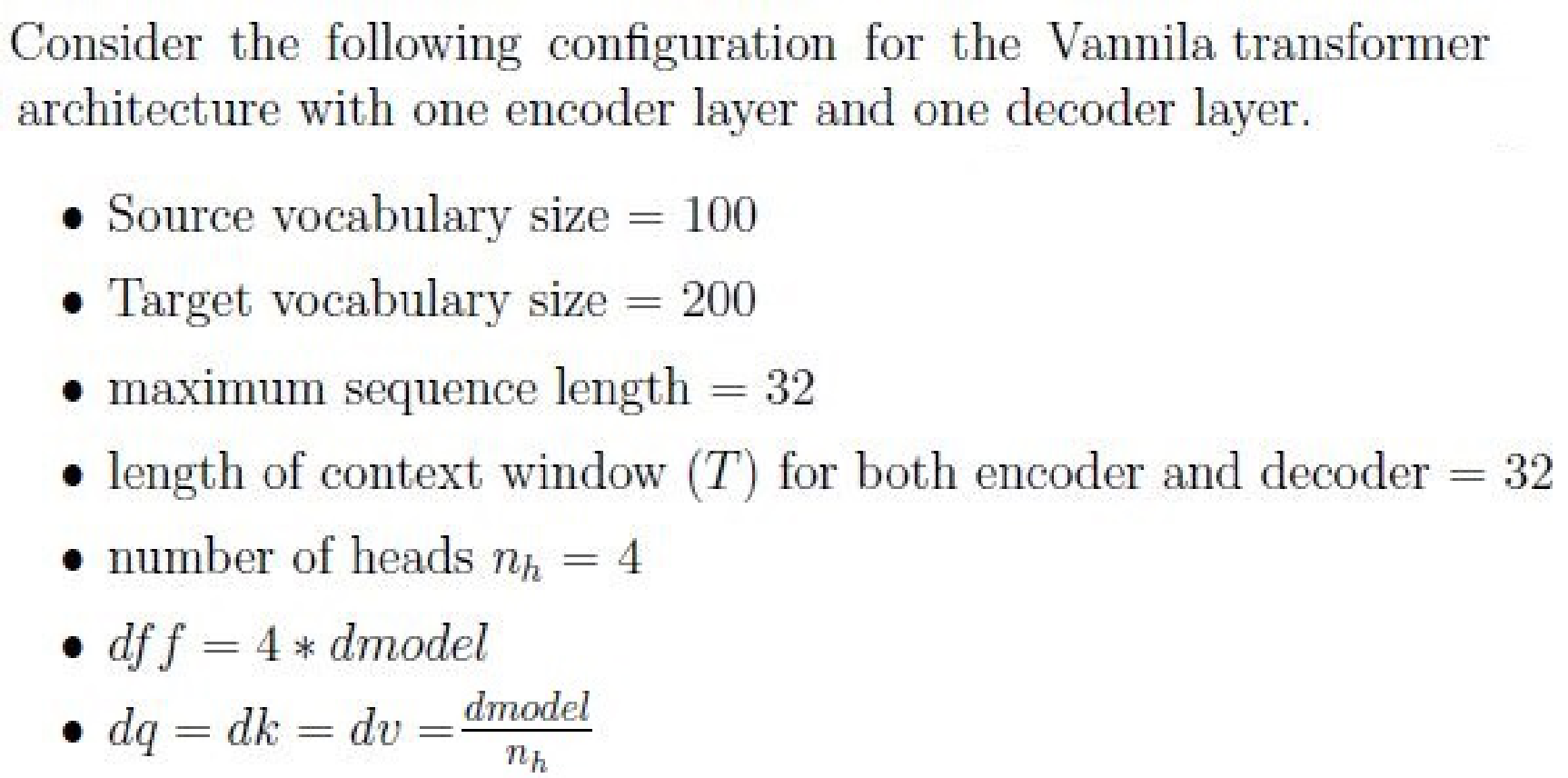
Figure 12. Vanilla transformer architecture configuration specifications for vocabulary, sequence length, context window, heads, and dimensions
Based on the above data, answer the given subquestions.
Question 111
Question ID: 6406531130565
Portal container ID: 6406531130564
Type: Short Answer Question · Marks: 2
PDF pages: 5
Shared context: ctx-111-113, ctx-103
Suppose the number of learnable parameters in the source input-embedding layer is 3200, how
many parameters are there in the positional embedding layer of the source language?
Correct answer: 1024
Source evidence: [{"page": 5, "bbox": [22.87, 664.12, 70.36, 680.44], "type": "explicit field", "detail": "Possible Answers: 1024"}]
Question 112
Question ID: 6406531130566
Portal container ID: 6406531130564
Type: Short Answer Question · Marks: 3
PDF pages: 5, 6
Shared context: ctx-111-113, ctx-103
How many parameters are there in the multi-head attention layer of the encoder (exclude the
parameters in the WO matrix used for linear transformation and FFN layer)?
Correct answer: 3072
Source evidence: [{"page": 6, "bbox": [22.87, 108.11, 70.36, 124.43], "type": "explicit field", "detail": "Possible Answers: 3072"}]
Question 113
Question ID: 6406531130567
Portal container ID: 6406531130564
Type: Short Answer Question · Marks: 3
PDF pages: 6
Shared context: ctx-111-113, ctx-103
How many parameters does the matrix WQ have in anyone head of the encoder?
Correct answer: 256
Source evidence: [{"page": 6, "bbox": [22.87, 324.94, 61.27, 341.26], "type": "explicit field", "detail": "Possible Answers: 256"}]
Shared context 114-117
Question ID: 6406531130568
Type: Comprehension
PDF pages: 6
Consider following input matrix to a single neural network layer:
It has 4 samples with 2 features each i.e. batch size is 4. Each column represents a sample. Left most column represents the first sample and topmost row represents the first feature vector.
Note: assume \(\gamma = 1\), \(\beta = 0\) and \(\epsilon = 10^{-5}\) for both batch and layer normalization, if not mentioned explicitly. Use standard scaling.
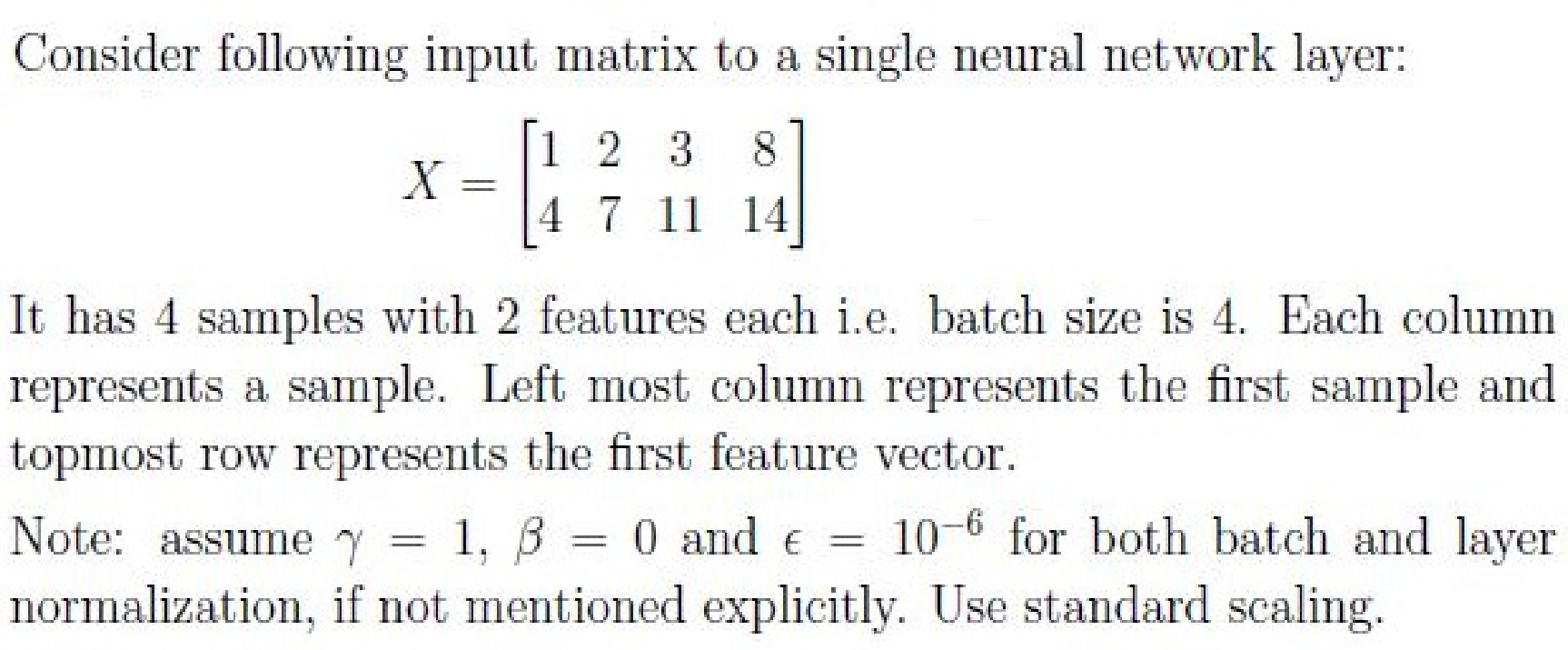
Figure 13. Input matrix X (4 samples with 2 features each) and normalization scaling parameter configurations
Based on the above data, answer the given subquestions.
Question 114
Question ID: 6406531130569
Portal container ID: 6406531130568
Type: Short Answer Question · Marks: 1
PDF pages: 6, 7
Shared context: ctx-114-117, ctx-103
Say matrix F is computed by applying batch normalization on X, what will be sum of every element
in first / topmost row of F?
Correct answer: 0 to 0.01
Source evidence: [{"page": 7, "bbox": [22.87, 182.43, 86.82, 198.75], "type": "explicit field", "detail": "Answers Type : Range, Possible Answers : 0 to 0.01"}]
Question 115
Question ID: 6406531130570
Portal container ID: 6406531130568
Type: Short Answer Question · Marks: 1
PDF pages: 7
Shared context: ctx-114-117, ctx-103
Say matrix F is computed by applying layer normalization on X, what will be sum of every element
in first / leftmost column of F?
Correct answer: 0 to 0.01
Source evidence: [{"page": 7, "bbox": [22.87, 444.24, 86.82, 460.56], "type": "explicit field", "detail": "Answers Type : Range, Possible Answers : 0 to 0.01"}]
Question 116
Question ID: 6406531130571
Portal container ID: 6406531130568
Type: Short Answer Question · Marks: 2
PDF pages: 7
Shared context: ctx-114-117, ctx-103
Say \(\sigma_i\)'s were the standard deviations used to compute batch normalization of \(X\). What is \(\sum_{i=1}^2 \sigma_i\)?
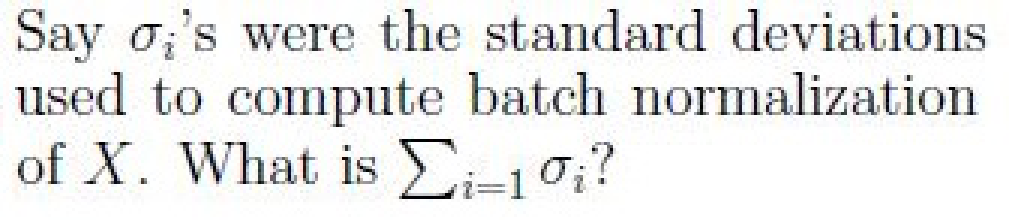
Figure 14. Question 116 prompt: sum of standard deviations sigma_i used to compute batch normalization of X
Correct answer: 10.95 to 11.05
Source evidence: [{"page": 7, "bbox": [22.87, 720.06, 122.38, 736.38], "type": "explicit field", "detail": "Answers Type : Range, Possible Answers : 10.95 to 11.05"}]
Question 117
Question ID: 6406531130572
Portal container ID: 6406531130568
Type: Short Answer Question · Marks: 2
PDF pages: 7, 8
Shared context: ctx-114-117, ctx-103
Say \(\sigma_i\)'s were the standard deviations used to compute layer normalization of \(X\). What is \(\sum_{i=1}^4 \sigma_i\)?
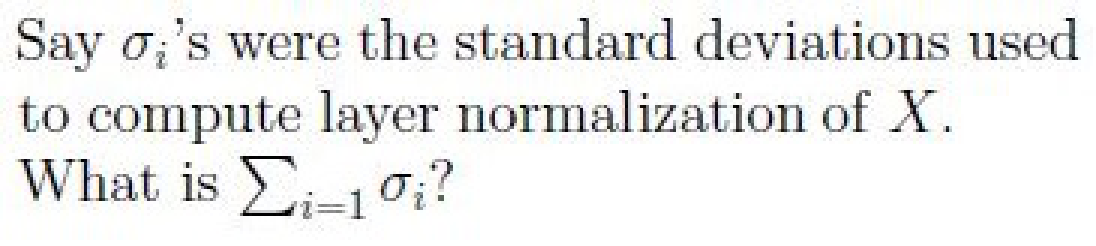
Figure 15. Question 117 prompt: sum of standard deviations sigma_i used to compute layer normalization of X
Correct answer: 6.45 to 6.55
Source evidence: [{"page": 8, "bbox": [22.87, 178.36, 107.0, 194.68], "type": "explicit field", "detail": "Answers Type : Range, Possible Answers : 6.45 to 6.55"}]
Shared context 118-121
Question ID: 6406531130573
Type: Comprehension
PDF pages: 8
Consider following corpus (in italics), which is used train a GPT like (i.e. decoder only) model for causal language modeling:
Sachin Tendulkar is called God of Cricket. Sachin has broken many records. Sachin has highest number of centuries.
Sachin Pilgaonkar is a famous actor in Marathi cinema. Sachin has acted in, directed and produced numerous films. Sachin has broken many stereotypes.
Assume each word in the above corpus is a token. Tokens are case insensitive i.e. “The” is same as “the”. Ignore special characters (e.g. period (.), semi colon (;), etc.)
Note: Estimate the joint probabilities using the Bayesian approach (no independence assumption) for the given corpus.
\(x_i\) represents \(i^{\text{th}}\) token from left to right. Tokens appear in italics.
Answer the given sub questions:
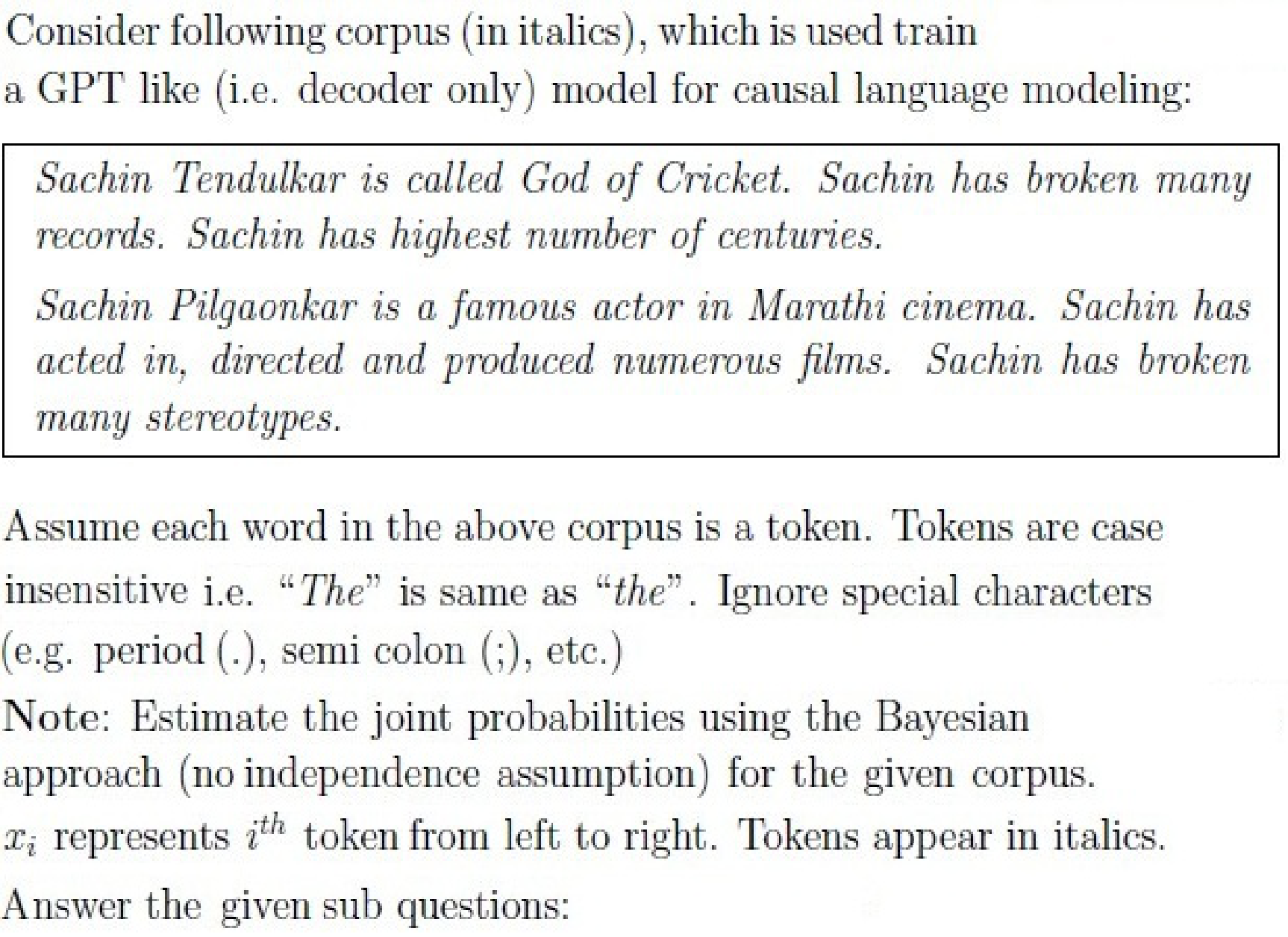
Figure 16. Causal language modeling training corpus text regarding Sachin Tendulkar and Sachin Pilgaonkar
Question 118
Question ID: 6406531130574
Portal container ID: 6406531130573
Type: Short Answer Question · Marks: 2
PDF pages: 8, 9
Shared context: ctx-118-121, ctx-103
What is the value of \(10 \times P(\text{Sachin})\)?
Note: \(x_1 = \text{Sachin}\)

Figure 17. Question 118 prompt: value of 10 x P(Sachin) using Bayesian estimation on the given corpus
Correct answer: 1.37 to 1.47
Source evidence: [{"page": 9, "bbox": [22.87, 173.68, 107.0, 190.0], "type": "explicit field", "detail": "Answers Type : Range, Possible Answers : 1.37 to 1.47"}]
Question 119
Question ID: 6406531130575
Portal container ID: 6406531130573
Type: Short Answer Question · Marks: 2
PDF pages: 9
Shared context: ctx-118-121, ctx-103
What is the value of \(100 \times P(\text{Sachin}, \text{Tendulkar})\)?
Note: \(x_1 = \text{Sachin}\) and \(x_2 = \text{Tendulkar}\)
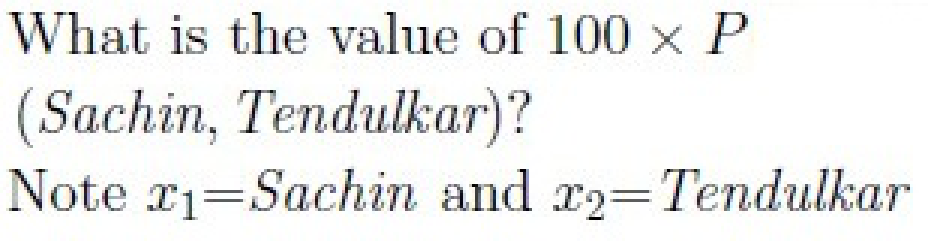
Figure 18. Question 119 prompt: value of 100 x P(Sachin, Tendulkar) using Bayesian estimation on the given corpus
Correct answer: 2.33 to 2.43
Source evidence: [{"page": 9, "bbox": [22.87, 454.74, 107.0, 471.06], "type": "explicit field", "detail": "Answers Type : Range, Possible Answers : 2.33 to 2.43"}]
Question 120
Question ID: 6406531130576
Portal container ID: 6406531130573
Type: Short Answer Question · Marks: 3
PDF pages: 9
Shared context: ctx-118-121, ctx-103
What is the value of the following expression \(100 \times P(\text{Sachin}, \text{has}, \text{broken}, \text{many}, \text{records})\)?
Note: \(x_1 = \text{Sachin}\), \(x_2 = \text{has}\), and so on.
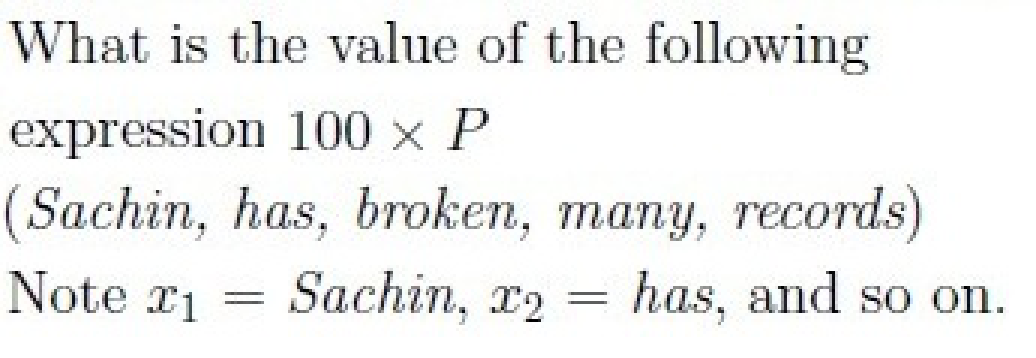
Figure 19. Question 120 prompt: value of 100 x P(Sachin, has, broken, many, records) using Bayesian estimation on the given corpus
Correct answer: 2.33 to 2.43
Source evidence: [{"page": 9, "bbox": [22.87, 764.88, 107.0, 781.2], "type": "explicit field", "detail": "Answers Type : Range, Possible Answers : 2.33 to 2.43"}]
Question 121
Question ID: 6406531130577
Portal container ID: 6406531130573
Type: Multiple Choice Question · Marks: 2
PDF pages: 10
Shared context: ctx-118-121
Once the model is sufficiently trained, which of the following tokens will have the highest
probability to be the next token, if the input is “Sachin has”:
Options
A.
broken
Source option ID: 6406533822558
B.
acted
Source option ID: 6406533822559
C.
highest
Source option ID: 6406533822560
D.
None of these
Source option ID: 6406533822561
Correct answer: A
Source evidence: [{"page": 10, "bbox": [23.62, 130.45, 119.02, 146.77], "type": "green source option", "detail": "Option 6406533822558 marked with green color 32768 in source PDF"}]
Answer key
| Source question | Source identity | Correct answer | PDF pages |
|---|---|---|---|
| 104 | 6406531130557 | D | 2 |
| 105 | 6406531130558 | D | 2, 3 |
| 106 | 6406531130560 | C | 3 |
| 107 | 6406531130561 | A | 3 |
| 108 | 6406531130562 | A, D | 3, 4 |
| 109 | 6406531130559 | A, C | 4 |
| 110 | 6406531130563 | B, D | 4 |
| 111 | 6406531130565 | 1024 | 5 |
| 112 | 6406531130566 | 3072 | 5, 6 |
| 113 | 6406531130567 | 256 | 6 |
| 114 | 6406531130569 | 0 to 0.01 | 6, 7 |
| 115 | 6406531130570 | 0 to 0.01 | 7 |
| 116 | 6406531130571 | 10.95 to 11.05 | 7 |
| 117 | 6406531130572 | 6.45 to 6.55 | 7, 8 |
| 118 | 6406531130574 | 1.37 to 1.47 | 8, 9 |
| 119 | 6406531130575 | 2.33 to 2.43 | 9 |
| 120 | 6406531130576 | 2.33 to 2.43 | 9 |
| 121 | 6406531130577 | A | 10 |
Extraction notes
Status: verified-source-limitation
Count reconciliation: The portal declared 12 questions and 40 marks for Section 7 (LLM). The 40 marks reconcile exactly across the 18 academic questions: Q104 (2) + Q105 (2) + Q106 (3) + Q107 (2) + Q108 (2) + Q109 (3) + Q110 (3) + Comprehension 111-113 subquestions Q111 (2) + Q112 (3) + Q113 (3) + Comprehension 114-117 subquestions Q114 (1) + Q115 (1) + Q116 (2) + Q117 (2) + Comprehension 118-121 subquestions Q118 (2) + Q119 (2) + Q120 (3) + Q121 (2) = 40 marks. The source PDF contains 8 portal sub-sections, 1 administrative confirmation entry (Q102, 0 marks), 1 shared-context calculation note entry (ctx-103, 0 marks), 3 comprehension passages (ctx-111-113, ctx-114-117, ctx-118-121), and 18 academic questions (Q104-Q121). The declared count of 12 questions in the portal header corresponds to the 12 top-level portal question items (Q102, Q103, Q104, Q105, Q106, Q107, Q108, Q109, Q110, plus 3 comprehension containers); when counting the 18 individual academic questions (excluding administrative items Q102 and Q103), this represents a known portal container aggregation pattern and is preserved as a verified source limitation.
- Questions 104, 109, 116, 117, 118, 119, 120 and comprehension passages contain raster-rendered mathematical expressions; high-resolution 288 DPI crops are retained and transcribed with mathematical fidelity.
- Portal declared count of 12 questions differs from observed count of 18 academic questions; this reflects portal container grouping where 3 multi-question comprehension passages enclose 11 subquestions.
Excluded source entries:
- {"classification": "preceding-subject-options", "page": 1, "bbox": [23.62, 17.5, 384.94, 53.14], "reason": "Out-of-scope options 6406533822514 and 6406533822515 ('I have written answers on the answer sheets', 'Not applicable') belonging to preceding subject section prior to LLM Section 7 start", "identity": "Preceding section options"}
- {"classification": "subject-confirmation", "page": 1, "bbox": [22.87, 512.16, 569.03, 798.88], "reason": "Administrative subject confirmation asking candidate to confirm subject and cross check hall ticket", "identity": "102"}
- {"classification": "administrative-acknowledgment-options", "page": 2, "bbox": [23.62, 140.0, 510.0, 220.0], "reason": "Administrative acknowledgment options (Instructions has been mentioned above / This Instructions is just for a reference & not for an evaluation) excluded semantically while preserving General Note calculation instructions as shared context", "identity": "103"}
- {"classification": "following-subject-heading", "page": 10, "bbox": [20.62, 234.61, 595.3, 841.9], "reason": "Out-of-scope heading and confirmation question 122 for subsequent Section 8: i-NLP (Section Id 64065379955)", "identity": "Section 8"}