LLM — da5004_2026T2_ET_AN
Source: da5004_2026T2_ET_AN.pdf · Academic questions: 20 · Separately counted children: 0
Provenance: Large_Language_Models/da5004_2026T2_ET_AN.pdf · SHA-256 e7fe622cad19cf4c6d286992acfedc8d017495948fab96db6485b5c03f6b16bf
Scope: LLM (Degree Level : Large Language Models (Computer Based Exam)), physical pages 1 to 14. Section LLM (Section Id: 640653148704, Marks: 50) begins on physical page 1 and extends through physical page 14.
Questions
Question 2
Question ID: 6406532280206
Type: MCQ · Marks: 2
PDF pages: 2
Consider the following Assertion (A) and Reason (R) about the Transformer encoder.
Assertion (A): In a Transformer encoder, each token can attend to every other token in the input sequence through self-attention.
Reason (R): The encoder's self-attention mechanism uses a causal mask to prevent each token from attending to tokens that appear later in the sequence.
Choose the correct option:
Options
A.
Both Assertion (A) and Reason (R) are true, and Reason (R) is the correct explanation of Assertion (A).
Source option ID: 6406537408066
B.
Both Assertion (A) and Reason (R) are true, but Reason (R) is not the correct explanation of Assertion (A).
Source option ID: 6406537408067
C.
Assertion (A) is true, but Reason (R) is false.
Source option ID: 6406537408068
D.
Assertion (A) is false, but Reason (R) is true
Source option ID: 6406537408069
E.
Both Assertion (A) and Reason (R) are false.
Source option ID: 6406537408070
Correct answer: Assertion (A) is true, but Reason (R) is false.
Source evidence: [{"page": 2, "bbox": [23.62, 530.0, 119.02, 546.3], "type": "green source option", "detail": "Option 6406537408068 rendered in green (color 32768) in CBT portal"}]
Question 3
Question ID: 6406532280208
Type: MCQ · Marks: 2
PDF pages: 2, 3
Which of the following statements regarding one-hot positional encoding and sinusoidal positional encoding is incorrect?
Options
A.
The dot product between two sinusoidal positional encoding vectors strictly increases as the relative distance between their positions increases, taking values in the range \([0, \infty)\)
Source option ID: 6406537408072
B.
The squared Euclidean norm of a sinusoidal positional encoding vector is a constant value independent of the position index
Source option ID: 6406537408073
C.
For any two distinct positions, the dot product of their corresponding one-hot encoded vectors is zero, and the Euclidean distance between them is strictly constant
Source option ID: 6406537408074
D.
One-hot positional encoding is incapable of mathematically representing relative distance between tokens
Source option ID: 6406537408075
Correct answer: The dot product between two sinusoidal positional encoding vectors strictly increases as the relative distance between their positions increases, taking values in the range \([0, \infty)\)
Source evidence: [{"page": 2, "bbox": [23.62, 729.16, 119.02, 745.48], "type": "green source option", "detail": "Option 6406537408072 rendered in green (color 32768) in CBT portal"}]
Question 4
Question ID: 6406532280212
Type: MCQ · Marks: 2
PDF pages: 3
You are designing an LLM to translate a sentence from English to Spanish with low computational complexity. The system has to consider a few possible sequences of words rather than committing to the single highest-probability word at every step. Which of the following decoding strategies is the most appropriate?
Options
A.
Beam search
Source option ID: 6406537408078
B.
Exhaustive search
Source option ID: 6406537408079
C.
Top-p sampling with p = 0.85
Source option ID: 6406537408080
D.
Greedy decoding
Source option ID: 6406537408081
Correct answer: Beam search
Source evidence: [{"page": 3, "bbox": [23.62, 298.3, 119.02, 314.6], "type": "green source option", "detail": "Option 6406537408078 rendered in green (color 32768) in CBT portal"}]
Question 5
Question ID: 6406532280213
Type: MCQ · Marks: 2
PDF pages: 3
In the Next Sentence Prediction task, how are the two input sentences distinguished by the BERT architecture?
Options
A.
By utilizing separate transformer encoders for each sentence and concatenating the outputs.
Source option ID: 6406537408082
B.
By adding learnable segment embeddings to the token and positional embeddings of the respective sentences.
Source option ID: 6406537408083
C.
By inserting a [MASK] token between the two sentences.
Source option ID: 6406537408084
D.
By ensuring two different heads in the Multi-Head Attention setup attend to the specific sentences.
Source option ID: 6406537408085
Correct answer: By adding learnable segment embeddings to the token and positional embeddings of the respective sentences.
Source evidence: [{"page": 3, "bbox": [23.62, 555.5, 119.02, 571.8], "type": "green source option", "detail": "Option 6406537408083 rendered in green (color 32768) in CBT portal"}]
Question 6
Question ID: 6406532280207
Type: SA · Marks: 3
PDF pages: 3, 4
Consider a mini-batch of 3 samples, each with 2 features. The input matrix X is given below, where
rows represent individual samples and columns represent features:
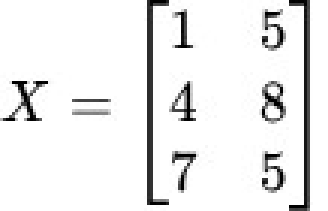
Figure 1. Input matrix X of 3 samples with 2 features
Layer Normalization is applied on this with a learned scale parameter \(\gamma = 2\) and a shift parameter \(\beta = 1\).
What is the final output value of the first feature for the third sample?
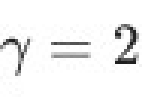
Figure 2. Learned scale parameter gamma = 2
Shift parameter \(\beta = 1\):
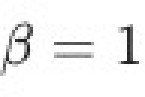
Figure 3. Learned shift parameter beta = 1
Correct answer: 3
Source evidence: [{"page": 4, "bbox": [22.87, 240.0, 120.0, 260.0], "type": "explicit field", "detail": "Possible Answers: 3 in CBT portal"}]
Question 7
Question ID: 6406532280217
Type: SA · Marks: 3
PDF pages: 4, 5
Consider a tokenizer processing the word "lion".
The vocabulary contains the following tokens along with the assigned log-probabilities.
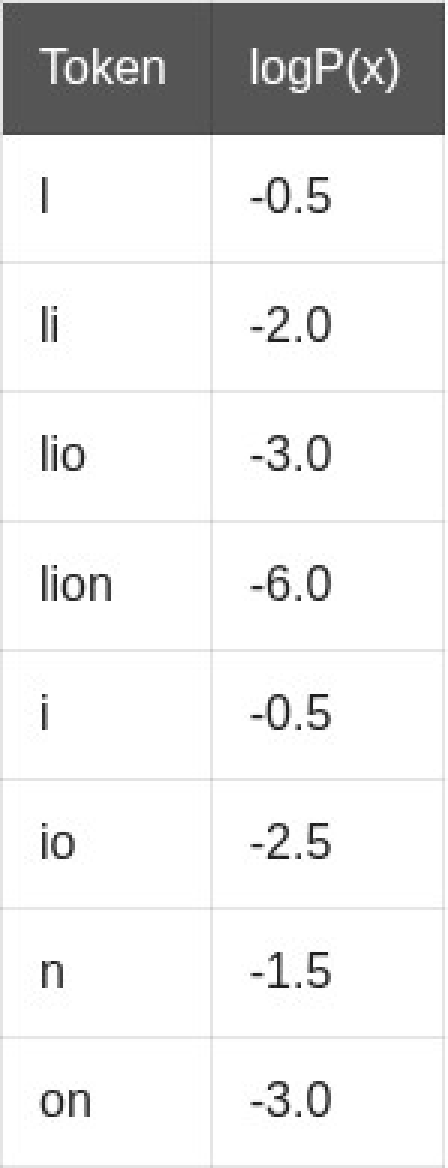
Figure 4. Vocabulary tokens with assigned log-probabilities for lion
To determine the optimal tokenization, the tokenizer uses the forward decoding algorithm (Viterbi
approach). Determine the most likely tokenization for the word "lion" using the algorithm.
Instructions: Enter your answer as a lowercase string with the segments separated by a comma.
For example, if the word is whereby and the answer has two segments where and by, enter the answer as where,by
NOTE: Enter the exact answer without any extra space in the beginning or at the end.
Correct answer: l,i,on
Source evidence: [{"page": 5, "bbox": [22.87, 240.0, 120.0, 260.0], "type": "explicit field", "detail": "Possible Answers: l,i,on in CBT portal"}]
Question 8
Question ID: 6406532280222
Type: SA · Marks: 3
PDF pages: 5
Suppose the relative position between two tokens at positions \(i\) and \(j\) is defined as \(r = i - j\).
To limit the range of relative positions, clipping is applied using \(c(r) = \max(-k, \min(r, k))\), where \(k = 16\).
For a sequence of length \(T = 128\), how many pairwise relative-position values are modified by the clipping operation?

Figure 5. Relative position clipping function c(r) = max(-k, min(r, k))
Correct answer: 12432
Source evidence: [{"page": 5, "bbox": [22.87, 650.0, 120.0, 670.0], "type": "explicit field", "detail": "Possible Answers: 12432 in CBT portal"}]
Shared context 9 to 10
Portal container ID: 6406532280209
Type: COMPREHENSION
PDF pages: 6
Consider an LLM operating on a vocabulary consisting of 5 tokens. For a given context, the model produces the following logits:
| Token | Logit |
|---|---|
| token 1 | 2.5 |
| token 2 | 1.8 |
| token 3 | 1.2 |
| token 4 | 0.5 |
| token 5 | -0.2 |
To obtain the next token during generation, the model uses top-p sampling with \(p = 0.80\).
Based on the above data, answer the given subquestions.
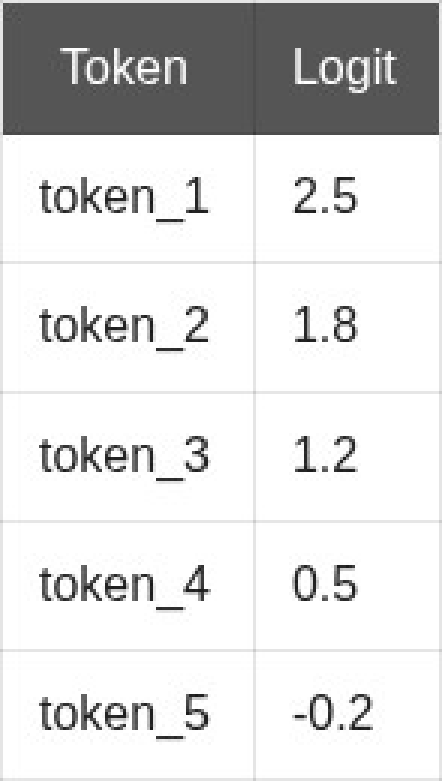
Figure 6. Logits produced by the model for vocabulary of 5 tokens
Question 9
Question ID: 6406532280210
Portal container ID: 6406532280209
Type: SA · Marks: 2
PDF pages: 6
Shared context: ctx-9-10
How many tokens are selected as candidate tokens?
Correct answer: 3
Source evidence: [{"page": 6, "bbox": [22.87, 590.0, 120.0, 610.0], "type": "explicit field", "detail": "Possible Answers: 3 in CBT portal"}]
Question 10
Question ID: 6406532280211
Portal container ID: 6406532280209
Type: SA · Marks: 2
PDF pages: 6, 7
Shared context: ctx-9-10
After renormalization of the probabilities, what is the highest probability value among those? (Round off to three decimal places)
Correct answer: 0.54 to 0.58
Source evidence: [{"page": 7, "bbox": [22.87, 70.0, 120.0, 90.0], "type": "explicit field", "detail": "Possible Answers: 0.54 to 0.58 in CBT portal"}]
Question 11
Question ID: 6406532280214
Type: MCQ · Marks: 3
PDF pages: 7
How did the GPT-2 model initially demonstrate "zero-shot domain transfer" capabilities on complex tasks like summarization and translation?
Options
A.
By utilizing specialized adapter layers trained explicitly for translation and summarization datasets.
Source option ID: 6406537408086
B.
By formatting the raw input text with natural language prompts to induce task-specific outputs without updating model weights.
Source option ID: 6406537408087
C.
By executing a secondary pre-training phase exclusively on Wikipedia and BookCorpus.
Source option ID: 6406537408088
D.
By modifying the decoder architecture into a bidirectional encoder for specific tasks.
Source option ID: 6406537408089
Correct answer: By formatting the raw input text with natural language prompts to induce task-specific outputs without updating model weights.
Source evidence: [{"page": 7, "bbox": [23.62, 367.3, 119.02, 383.6], "type": "green source option", "detail": "Option 6406537408087 rendered in green (color 32768) in CBT portal"}]
Question 12
Question ID: 6406532280215
Type: MCQ · Marks: 3
PDF pages: 7, 8
Match the following unsupervised objectives (I,II,III) to their corresponding Target output structures (A,B,C) based on the following:
I. Prefix Language Modelling
II. Masked Seq-to-Seq pretraining
III. Random spans
A. Interleaved sentinel tokens and missing text
B. The entire original text sequence
C. The suffix of the original text
Options
A.
I-A, II-B, III-C
Source option ID: 6406537408090
B.
I-B, II-C, III-A
Source option ID: 6406537408091
C.
I-C, II-A, III-B
Source option ID: 6406537408092
D.
I-C, II-B, III-A
Source option ID: 6406537408093
E.
I-B, II-A, III-C
Source option ID: 6406537408094
Correct answer: I-C, II-B, III-A
Source evidence: [{"page": 8, "bbox": [23.62, 17.5, 119.02, 33.8], "type": "green source option", "detail": "Option 6406537408093 rendered in green (color 32768) in CBT portal"}]
Question 13
Question ID: 6406532280216
Type: MCQ · Marks: 3
PDF pages: 8
Consider the original text "The quick brown fox jumps over the lazy dog". If the input for a prefix language modelling objective is "The quick brown fox", what will the target be?
Options
A.
The quick brown fox jumps over the lazy dog

Figure 7. Option A target: The quick brown fox jumps over the lazy dog
Source option ID: 6406537408095
B.
jumps over the lazy dog

Figure 8. Option B target: jumps over the lazy dog
Source option ID: 6406537408096
C.

Figure 9. Option C target:
Source option ID: 6406537408097
D.
None of these

Figure 10. Option D target: None of these
Source option ID: 6406537408098
Correct answer: jumps over the lazy dog
Source evidence: [{"page": 8, "bbox": [23.62, 250.1, 119.02, 266.5], "type": "green source option", "detail": "Option 6406537408096 rendered in green (color 32768) in CBT portal"}]
Question 14
Question ID: 6406532280219
Type: MCQ · Marks: 3
PDF pages: 8
Consider a transformer model that uses strided local attention with a fixed window size \(c\). If the sequence length \(T\) is doubled, by what factor does the computational time complexity of the attention mechanism change?
Options
A.
1
Source option ID: 6406537408101
B.
2
Source option ID: 6406537408102
C.
4
Source option ID: 6406537408103
D.
8
Source option ID: 6406537408104
Correct answer: 2
Source evidence: [{"page": 8, "bbox": [23.62, 544.3, 119.02, 560.6], "type": "green source option", "detail": "Option 6406537408102 rendered in green (color 32768) in CBT portal"}]
Question 15
Question ID: 6406532280220
Type: MCQ · Marks: 3
PDF pages: 8
What is the primary trade-off made by utilizing KV Cache during autoregressive decoding?
Options
A.
It reduces inference latency but utilizes smaller batch size
Source option ID: 6406537408105
B.
It increases generation speed but reduces model accuracy
Source option ID: 6406537408106
C.
It reduces computational overhead but increases memory usage
Source option ID: 6406537408107
D.
It reduces training time by storing intermediate token representations
Source option ID: 6406537408108
Correct answer: It reduces computational overhead but increases memory usage
Source evidence: [{"page": 8, "bbox": [23.62, 768.8, 119.02, 785.1], "type": "green source option", "detail": "Option 6406537408107 rendered in green (color 32768) in CBT portal"}]
Question 16
Question ID: 6406532280218
Type: SA · Marks: 4
PDF pages: 9
A Large Language model uses Grouped Query Attention with a KV cache during inference.
Consider the following model configuration:
• Precision: FP16 (16-bit floating point)
• Number of Transformer layers : 32
• Number of Query attention heads : 32
• Number of Key attention heads : 8
• Number of Value attention heads : 8
• Head dimension : 128
• Batch size : 4
• Maximum sequence length per request : 1024 tokens
Assume 2 bytes per FP16 value and 1 MB = 1048576 bytes
calculate the total memory required for the KV cache expressed in MB. Enter the value rounded to the nearest integer
Correct answer: 512
Source evidence: [{"page": 9, "bbox": [22.87, 590.0, 120.0, 610.0], "type": "explicit field", "detail": "Possible Answers: 512 in CBT portal"}]
Question 17
Question ID: 6406532280221
Type: MSQ · Marks: 3
PDF pages: 9, 10
Which of the following statements about length generalization in Large Language Models (LLMs) are correct?
Options
A.
Length generalization is the ability of an LLM to maintain effective performance on sequences longer than the sequence lengths predominantly used during training.
Source option ID: 6406537408109
B.
Length generalization refers specifically to improving computational efficiency
when processing longer sequences.
Source option ID: 6406537408110
C.
Length generalization can depend on the model architecture, positional encoding scheme, training procedure, and the nature of the task.
Source option ID: 6406537408111
D.
Exposure to a wider range of sequence lengths during training can improve an LLM's ability to generalize to longer sequences.
Source option ID: 6406537408112
Correct answer: Length generalization is the ability of an LLM to maintain effective performance on sequences longer than the sequence lengths predominantly used during training.; Length generalization can depend on the model architecture, positional encoding scheme, training procedure, and the nature of the task.; Exposure to a wider range of sequence lengths during training can improve an LLM's ability to generalize to longer sequences.
Source evidence: [{"page": 9, "bbox": [23.62, 748.8, 119.02, 765.2], "type": "green source option", "detail": "Option 6406537408109 rendered in green (color 32768) in CBT portal"}, {"page": 10, "bbox": [23.62, 38.3, 119.02, 54.6], "type": "green source option", "detail": "Option 6406537408111 rendered in green (color 32768) in CBT portal"}, {"page": 10, "bbox": [23.62, 75.5, 119.02, 91.8], "type": "green source option", "detail": "Option 6406537408112 rendered in green (color 32768) in CBT portal"}]
Shared context 18 to 21
Portal container ID: 6406532280223
Type: COMPREHENSION
PDF pages: 10, 11, 12
Consider the following matrices for Transformer architechture.
The token representations at positions \(m = 1\) and \(n = 3\) are:
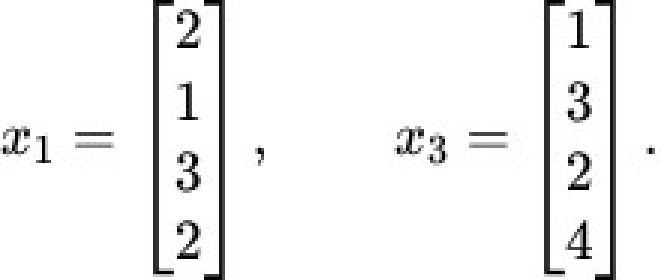
Figure 11. Token representations x_m and x_n
The query and key projection matrices are:
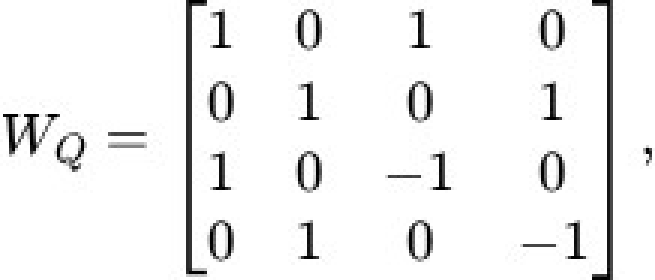
Figure 12. Query projection matrix W_Q
and key projection matrix \(W_K\):
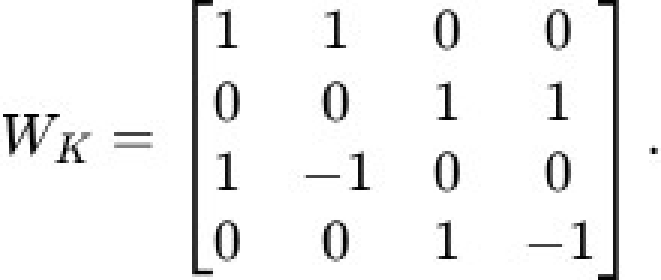
Figure 13. Key projection matrix W_K
RoPE Frequency
For RoPE, use the frequency formula \(\theta_i = 10000^{-2(i-1)/d}\) for \(i = 1, 2, \dots, d/2\).
All angles are measured in radians.

Figure 14. RoPE frequency formula theta_i = 10000^(-2(i-1)/d)
RoPE Rotation Matrix
For position \(p\), define the RoPE rotation matrix as:
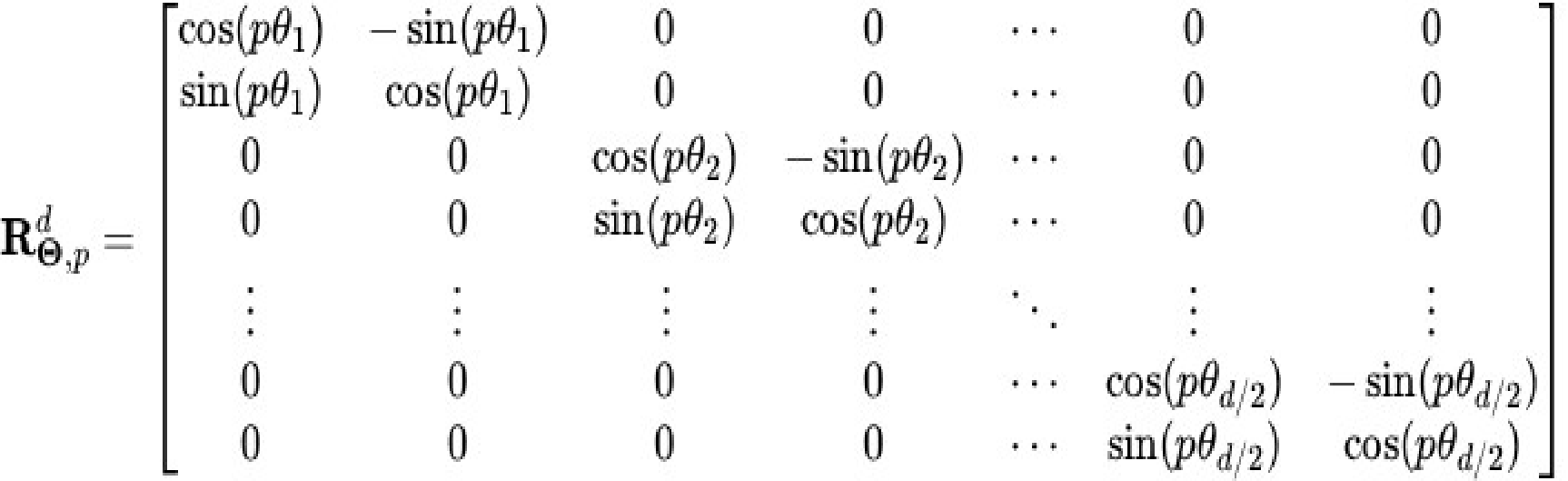
Figure 15. RoPE rotation matrix R_{Theta, p}^d definition
The position-dependent query and key vectors are \(q_m = R_{\Theta, m}^d W_Q x_m\) and \(k_n = R_{\Theta, n}^d W_K x_n\):
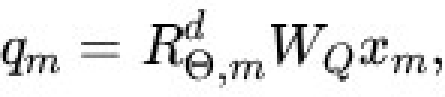
Figure 16. Position-dependent query vector q_m formula
Key vector \(k_n\) formula:
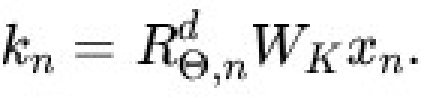
Figure 17. Position-dependent key vector k_n formula
Attention score formula:

Figure 18. Unnormalized attention score q_m^T k_n expansion
Using the property \((R_{\Theta, m}^d)^T R_{\Theta, n}^d = R_{\Theta, n-m}^d\), the attention score can be expressed using the relative position:

Figure 19. Property (R_{Theta, m}^d)^T R_{Theta, n}^d = R_{Theta, n-m}^d
Relative position attention score formula:

Figure 20. Attention score expressed using relative position rotation matrix
Question 18
Question ID: 6406532280224
Portal container ID: 6406532280223
Type: MCQ · Marks: 1
PDF pages: 12
Shared context: ctx-18-21
Compute \(W_Q x_m\) and select the correct option
Options
A.
\([4, 13, 1, -1]^T\)
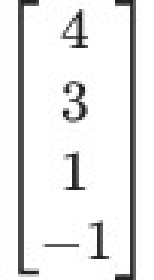
Figure 21. Option A vector [4, 13, 1, -1]^T
Source option ID: 6406537408114
B.
\([5, 4, -1, 2]^T\)
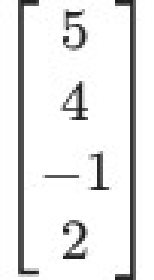
Figure 22. Option B vector [5, 4, -1, 2]^T
Source option ID: 6406537408115
C.
\([5, 13, -1, -1]^T\)
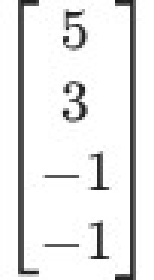
Figure 23. Option C vector [5, 13, -1, -1]^T
Source option ID: 6406537408116
D.
\([3, 15, -2, 1]^T\)
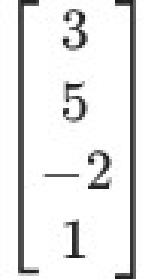
Figure 24. Option D vector [3, 15, -2, 1]^T
Source option ID: 6406537408117
Correct answer: \([5, 13, -1, -1]^T\)
Source evidence: [{"page": 12, "bbox": [23.62, 524.1, 119.02, 540.4], "type": "green source option", "detail": "Option 6406537408116 rendered in green (color 32768) in CBT portal"}]
Question 19
Question ID: 6406532280225
Portal container ID: 6406532280223
Type: MCQ · Marks: 1
PDF pages: 12, 13
Shared context: ctx-18-21
Compute \(W_K x_n\) and select the correct option
Options
A.
\([3, 16, -1, -2]^T\)
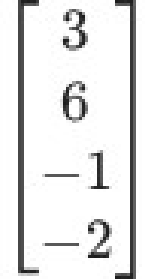
Figure 25. Option A vector [3, 16, -1, -2]^T
Source option ID: 6406537408118
B.
\([4, 16, -2, -2]^T\)
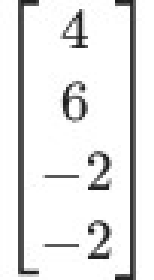
Figure 26. Option B vector [4, 16, -2, -2]^T
Source option ID: 6406537408119
C.
\([5, 4, 2, -1]^T\)
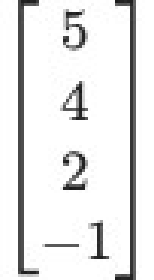
Figure 27. Option C vector [5, 4, 2, -1]^T
Source option ID: 6406537408120
D.
\([2, 16, -2, 2]^T\)
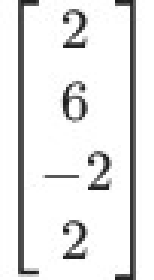
Figure 28. Option D vector [2, 16, -2, 2]^T
Source option ID: 6406537408121
Correct answer: \([4, 16, -2, -2]^T\)
Source evidence: [{"page": 13, "bbox": [23.62, 168.5, 119.02, 184.8], "type": "green source option", "detail": "Option 6406537408119 rendered in green (color 32768) in CBT portal"}]
Question 20
Question ID: 6406532280226
Portal container ID: 6406532280223
Type: SA · Marks: 2
PDF pages: 13
Shared context: ctx-18-21
Construct the corresponding RoPE rotation matrix (\(R_{\Theta, n-m}^d\)) and submit the maximum value in it. (correct upto 2 decimal places)
All angles are measured in radians.
Correct answer: 0.98 to 1
Source evidence: [{"page": 13, "bbox": [22.87, 650.0, 120.0, 670.0], "type": "explicit field", "detail": "Possible Answers: 0.98 to 1 in CBT portal"}]
Question 21
Question ID: 6406532280227
Portal container ID: 6406532280223
Type: SA · Marks: 3
PDF pages: 13, 14
Shared context: ctx-18-21
Computing the final dot product \(q_m^T k_n\). (correct upto 2 decimal places)
Correct answer: -22 to -19
Source evidence: [{"page": 14, "bbox": [22.87, 180.0, 120.0, 200.0], "type": "explicit field", "detail": "Possible Answers: -22 to -19 in CBT portal"}]
Answer key
| Source question | Source identity | Correct answer | PDF pages |
|---|---|---|---|
| 2 | 6406532280206 | Assertion (A) is true, but Reason (R) is false. | 2 |
| 3 | 6406532280208 | The dot product between two sinusoidal positional encoding vectors strictly increases as the relative distance between their positions increases, taking values in the range \([0, \infty)\) | 2, 3 |
| 4 | 6406532280212 | Beam search | 3 |
| 5 | 6406532280213 | By adding learnable segment embeddings to the token and positional embeddings of the respective sentences. | 3 |
| 6 | 6406532280207 | 3 | 3, 4 |
| 7 | 6406532280217 | l,i,on | 4, 5 |
| 8 | 6406532280222 | 12432 | 5 |
| 9 | 6406532280210 | 3 | 6 |
| 10 | 6406532280211 | 0.54 to 0.58 | 6, 7 |
| 11 | 6406532280214 | By formatting the raw input text with natural language prompts to induce task-specific outputs without updating model weights. | 7 |
| 12 | 6406532280215 | I-C, II-B, III-A | 7, 8 |
| 13 | 6406532280216 | jumps over the lazy dog | 8 |
| 14 | 6406532280219 | 2 | 8 |
| 15 | 6406532280220 | It reduces computational overhead but increases memory usage | 8 |
| 16 | 6406532280218 | 512 | 9 |
| 17 | 6406532280221 | Length generalization is the ability of an LLM to maintain effective performance on sequences longer than the sequence lengths predominantly used during training.; Length generalization can depend on the model architecture, positional encoding scheme, training procedure, and the nature of the task.; Exposure to a wider range of sequence lengths during training can improve an LLM's ability to generalize to longer sequences. | 9, 10 |
| 18 | 6406532280224 | \([5, 13, -1, -1]^T\) | 12 |
| 19 | 6406532280225 | \([4, 16, -2, -2]^T\) | 12, 13 |
| 20 | 6406532280226 | 0.98 to 1 | 13 |
| 21 | 6406532280227 | -22 to -19 | 13, 14 |
Extraction notes
Status: verified
Count reconciliation: Section LLM (Section Id 640653148704) declares 17 portal question containers and 50 section marks. The 17 portal containers comprise: 1 administrative confirmation question (Question 1, 0 marks, excluded), 14 standalone questions (Q2-Q8, Q11-Q17), and 2 comprehension portal containers (Question Id 6406532280209 containing Q9-Q10 for 4 marks; Question Id 6406532280223 containing Q18-Q21 for 7 marks). Total academic questions = 14 standalone + 6 comprehension subquestions = 20 academic questions. Total marks = 8 (Q2-Q5) + 9 (Q6-Q8) + 4 (Q9-Q10) + 15 (Q11-Q15) + 4 (Q16) + 3 (Q17) + 7 (Q18-Q21) = 50 marks, exactly reconciling the 17 declared containers and 50 section marks without discrepancies.
Excluded source entries:
- {"classification": "subject-confirmation", "page": 1, "bbox": [22.87, 55.39, 569.03, 842.0], "reason": "Administrative subject confirmation asking candidate to confirm subject DEGREE LEVEL : LARGE LANGUAGE MODELS (COMPUTER BASED EXAM) and cross check hall ticket", "identity": "6406532280205"}