LLM — da5004_2025T3_ET_AN
Source: da5004_2025T3_ET_AN.pdf · Academic questions: 25 · Separately counted children: 0
Provenance: Large_Language_Models/da5004_2025T3_ET_AN.pdf · SHA-256 6bc0cc06ab867e0b2566fc2d47d2f4e1761a9cd7420f5fa7b9c4d2ee2769f5fb
Scope: LLM (Degree Level : Large Language Models (Computer Based Exam)), physical pages 1 to 13. The in-scope exam content starts on physical page 1 with Subject Confirmation and Section LLM (Section Id: 640653124555) and terminates on physical page 13 after Question 26.
Questions
Shared context 23-26
Question ID: 6406531859519
Type: Comprehension
PDF pages: 12
A team is developing a new large language model (LLM) for code generation, focusing on an autoregressive (AR) approach using the Causal Language Modeling (CLM) objective. They implement a standard Transformer decoder-only architecture. The team is training the model on a sequence of tokens \(x = (x_1, x_2, \dots, x_T)\), where \(T\) is the total length. The CLM objective aims to maximize the following log-likelihood:
During training, they strictly enforce teacher forcing, meaning the ground-truth previous tokens are always provided as input to predict the current token. Based on the above setup, answer the given subquestions.
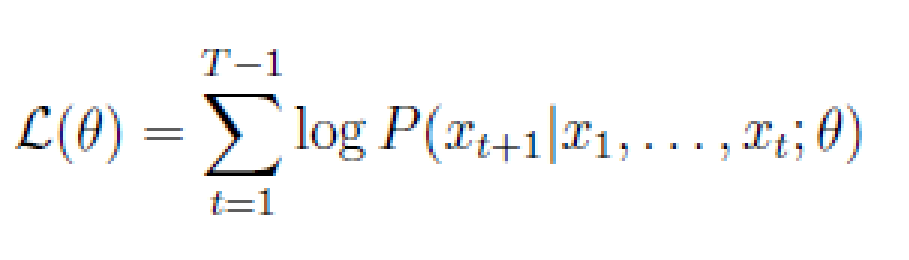
Figure 1. Causal language modeling objective log-likelihood formula over token sequence
Question 2
Question ID: 6406531859498
Type: Multiple Choice Question · Marks: 2
PDF pages: 2
A language model produces the following logits for the next token:
{apple : 2.1, banana : 1.8, grape : 0.4, orange : 0.3, melon : -1.0}
Before sampling, the model applies:
• Temperature scaling with \(T = 0.5\)
• Top-K sampling with \(K = 2\)
Which tokens are eligible to be sampled?

Figure 2. Language model next-token logit values for apple, banana, grape, orange, and melon
Options
A.
Only ''apple''
Source option ID: 6406536025082
B.
"apple'' or ''banana''
Source option ID: 6406536025083
C.
"apple'', ''banana'' or ''grape''
Source option ID: 6406536025084
D.
"apple''or ''grape''
Source option ID: 6406536025085
Correct answer: "apple'' or ''banana''
Source evidence: [{"page": 2, "bbox": [23.62, 267.73, 119.02, 284.05], "type": "green source option", "detail": "Option ID 6406536025083 marked in green (#008000)"}]
Question 3
Question ID: 6406531859499
Type: Multiple Choice Question · Marks: 2
PDF pages: 2
A neural network layer produces activations of hidden dimension \(H = 512\).
You consider two normalization strategies:
- Batch Normalization
- Layer Normalization
Which option correctly states the number of trainable parameters added by each normalization method?
Options
A.
BatchNorm adds 512 parameters, LayerNorm adds 512 parameters
Source option ID: 6406536025086
B.
BatchNorm adds 1024 parameters, LayerNorm adds 1024 parameters
Source option ID: 6406536025087
C.
BatchNorm adds 1024 parameters, LayerNorm adds 512 parameters
Source option ID: 6406536025088
D.
BatchNorm adds 512 parameters, LayerNorm adds 1024 parameters
Source option ID: 6406536025089
E.
Both add 0 trainable parameters
Source option ID: 6406536025090
Correct answer: BatchNorm adds 1024 parameters, LayerNorm adds 1024 parameters
Source evidence: [{"page": 2, "bbox": [23.62, 586.4, 119.02, 602.72], "type": "green source option", "detail": "Option ID 6406536025087 marked in green (#008000)"}]
Question 4
Question ID: 6406531859500
Type: Multiple Choice Question · Marks: 2
PDF pages: 3
A sub-word vocabulary is being constructed using the WordPiece algorithm. The following tokens and their frequencies are extracted:
• replay (frequency = 100)
• replus (frequency = 3)
The current vocabulary includes the tokens:
{re, play, plus, ##play, ##plus}
Two candidate merges are under consideration:
• Merge A: re + play -> replay
• Merge B: re + plus -> replus
Which of the above merges are most possible based on the WordPiece tokenizer?
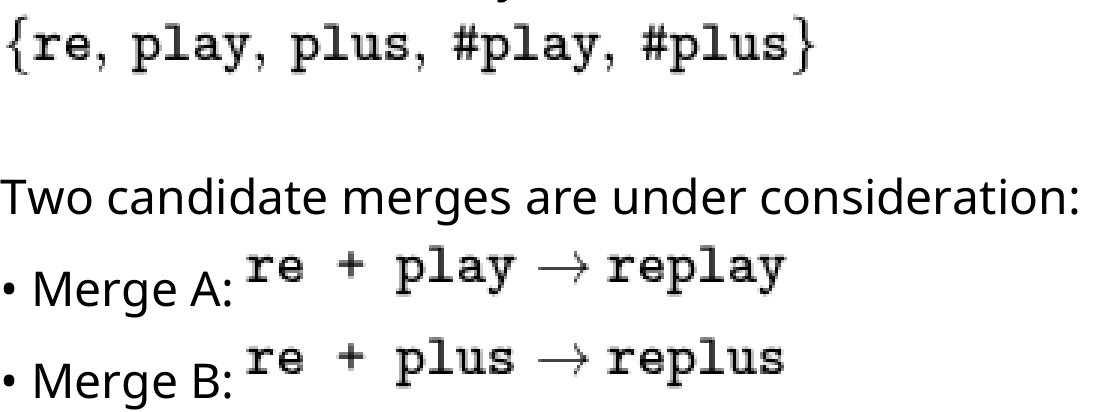
Figure 3. WordPiece current sub-word vocabulary and candidate merges A and B
Options
A.
Merge re + play
Source option ID: 6406536025091
B.
Merge re + plus
Source option ID: 6406536025092
C.
Insufficient information to determine
Source option ID: 6406536025093
Correct answer: Insufficient information to determine
Source evidence: [{"page": 3, "bbox": [23.62, 401.32, 119.02, 417.64], "type": "green source option", "detail": "Option ID 6406536025093 marked in green (#008000)"}]
Question 5
Question ID: 6406531859501
Type: Multiple Choice Question · Marks: 2
PDF pages: 3
For a 4-category classification task, how would you use BERT's output?
Options
A.
Use all token embeddings and average them.
Source option ID: 6406536025094
B.
Use the [CLS] token embedding as input to a classification layer.
Source option ID: 6406536025095
C.
Use only the [SEP] token
Source option ID: 6406536025096
D.
Use the [MASK] token predictions.
Source option ID: 6406536025097
Correct answer: Use the [CLS] token embedding as input to a classification layer.
Source evidence: [{"page": 3, "bbox": [23.62, 563.38, 119.02, 579.7], "type": "green source option", "detail": "Option ID 6406536025095 marked in green (#008000)"}]
Question 6
Question ID: 6406531859502
Type: Multiple Choice Question · Marks: 2
PDF pages: 4
A hospital wants to extract disease mentions and treatment plans from unstructured clinical
notes. Notes use heavy abbreviations like ``pt dx w/ CAD, rx aspirin''
For extracting specific disease names from text, which task should you fine-tune BERT for?
Options
A.
Masked Language Modeling
Source option ID: 6406536025098
B.
Next Sentence Prediction
Source option ID: 6406536025099
C.
Named Entity Recognition
Source option ID: 6406536025100
D.
Text generation
Source option ID: 6406536025101
Correct answer: Named Entity Recognition
Source evidence: [{"page": 4, "bbox": [23.62, 188.38, 119.02, 204.7], "type": "green source option", "detail": "Option ID 6406536025100 marked in green (#008000)"}]
Question 7
Question ID: 6406531859503
Type: Multiple Choice Question · Marks: 2
PDF pages: 4
Consider a sequence of length \(T\) and a local block attention mechanism with \(n\) blocks. If the attention matrix is restricted to only the main diagonal blocks (non-overlapping), what is the computational complexity of the self-attention operation for one layer (ignoring linear projections)? Assume \(d\) be the model dimension.
Options
A.
\(O((T/n)^2 \cdot d)\)
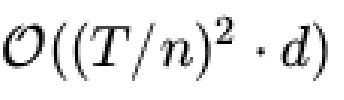
Figure 4. Option A computational complexity O((T/n)^2 * d)
Source option ID: 6406536025102
B.
\(O(T \cdot d^2)\)
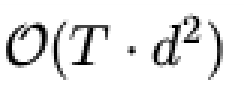
Figure 5. Option B computational complexity O(T * d^2)
Source option ID: 6406536025103
C.
\(O(T^2 \cdot d)\)
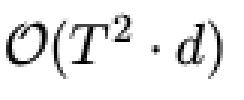
Figure 6. Option C computational complexity O(T^2 * d)
Source option ID: 6406536025104
D.
\(O((T^2/n) \cdot d)\)
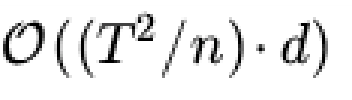
Figure 7. Option D computational complexity O((T^2/n) * d)
Source option ID: 6406536025105
Correct answer: \(O((T^2/n) \cdot d)\)
Source evidence: [{"page": 4, "bbox": [23.62, 550.92, 119.02, 567.24], "type": "green source option", "detail": "Option ID 6406536025105 marked in green (#008000)"}]
Question 8
Question ID: 6406531859504
Type: Multiple Choice Question · Marks: 3
PDF pages: 5
Match the positional encoding method (Column A) with its property/behavior (Column B).
Column A (Methods)
- APE
- RPE
- RoPE
- ALiBi
- NoPE
Column B (Properties / Observations)
A. Works even on sequence lengths far beyond training length without retraining, because attention bias grows proportionally to token distance.
B. Even if the model sees sequences only up to length 512 during training, it fails badly at length 1024, because positions above 512 have never had embeddings learned.
C. Creates an implicit rotation such that the attention score between positions \(i\) and \(j\) depends only on the difference \(i - j\), not the positions themselves.
D. Uses a fixed-size bank of distance embeddings such that two attention pairs \((i, j)\) and \((k, l)\) with the same distance use the same embedding.
E. The model becomes permutation-invariant, meaning it treats ''cat sat mat'' the same as ``mat cat sat''.
Options
A.
1 -> B, 2 -> D, 3 -> C, 4 -> A, 5 -> E
Source option ID: 6406536025106
B.
1 -> D, 2 -> A, 3 -> B, 4 -> C, 5 -> E
Source option ID: 6406536025107
C.
1 -> B, 2 -> C, 3 -> A, 4 -> D, 5 -> E
Source option ID: 6406536025108
D.
1 -> E, 2 -> D, 3 -> A, 4 -> C, 5 -> B
Source option ID: 6406536025109
Correct answer: 1 -> B, 2 -> D, 3 -> C, 4 -> A, 5 -> E
Source evidence: [{"page": 5, "bbox": [23.62, 416.77, 119.02, 433.09], "type": "green source option", "detail": "Option ID 6406536025106 marked in green (#008000)"}]
Question 9
Question ID: 6406531859505
Type: Multiple Choice Question · Marks: 2
PDF pages: 6
A 2D vector \([4, 0]^T\) is rotated by \(90^\circ\) using RoPE. What is the resulting vector?
Options
A.
\([0, 4]^T\)
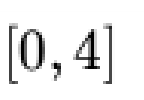
Figure 8. Option A resulting vector [0, 4]
Source option ID: 6406536025110
B.
\([4, 0]^T\)
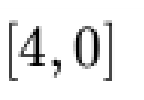
Figure 9. Option B resulting vector [4, 0]
Source option ID: 6406536025111
C.
\([0, -4]^T\)
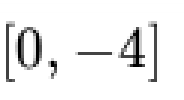
Figure 10. Option C resulting vector [0, -4]
Source option ID: 6406536025112
D.
\([-4, 0]^T\)
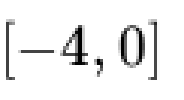
Figure 11. Option D resulting vector [-4, 0]
Source option ID: 6406536025113
Correct answer: \([0, 4]^T\)
Source evidence: [{"page": 6, "bbox": [23.62, 124.46, 119.02, 140.78], "type": "green source option", "detail": "Option ID 6406536025110 marked in green (#008000)"}]
Question 10
Question ID: 6406531859506
Type: Multiple Choice Question · Marks: 2
PDF pages: 6
If a model uses RoPE, increasing the sequence length from 100 to 1000 requires:
Options
A.
900 more positional vectors
Source option ID: 6406536025114
B.
\(2 \times 1000 - 1\) RPE matrices
Source option ID: 6406536025115
C.
No new parameters
Source option ID: 6406536025116
D.
A new embedding matrix
Source option ID: 6406536025117
Correct answer: No new parameters
Source evidence: [{"page": 6, "bbox": [23.62, 472.14, 119.02, 488.46], "type": "green source option", "detail": "Option ID 6406536025116 marked in green (#008000)"}]
Question 11
Question ID: 6406531859507
Type: Multiple Choice Question · Marks: 2
PDF pages: 6
In a sequence of length \(T = 6\), how many different attention pairs produce a distance of \(+1\)?
Options
A.
1

Figure 12. Option A attention pair count 1
Source option ID: 6406536025118
B.
3

Figure 13. Option B attention pair count 3
Source option ID: 6406536025119
C.
5

Figure 14. Option C attention pair count 5
Source option ID: 6406536025120
D.
6

Figure 15. Option D attention pair count 6
Source option ID: 6406536025121
Correct answer: 5
Source evidence: [{"page": 6, "bbox": [23.62, 730.72, 119.02, 747.04], "type": "green source option", "detail": "Option ID 6406536025120 marked in green (#008000)"}]
Question 12
Question ID: 6406531859508
Type: Multiple Choice Question · Marks: 2
PDF pages: 7
For a sequence of length \(T = 6\), how many Absolute Positional Encoding (APE) vectors are needed, and how many Relative Positional Encoding (RPE) vectors are required?
Options
A.
APE = 6, RPE = 11
Source option ID: 6406536025122
B.
APE = 6, RPE = 6
Source option ID: 6406536025123
C.
APE = 12, RPE = 11
Source option ID: 6406536025124
D.
APE = 5, RPE = 12
Source option ID: 6406536025125
Correct answer: APE = 6, RPE = 11
Source evidence: [{"page": 7, "bbox": [23.62, 156.42, 119.02, 172.74], "type": "green source option", "detail": "Option ID 6406536025122 marked in green (#008000)"}]
Question 13
Question ID: 6406531859509
Type: Multiple Choice Question · Marks: 2
PDF pages: 7
A model with positional encoding crashes when the input length exceeds the training max length.
Which encoding is it most likely using?
Options
A.
ALiBi
Source option ID: 6406536025126
B.
APE
Source option ID: 6406536025127
C.
RoPE
Source option ID: 6406536025128
D.
RPE
Source option ID: 6406536025129
Correct answer: APE
Source evidence: [{"page": 7, "bbox": [23.62, 397.26, 119.02, 413.58], "type": "green source option", "detail": "Option ID 6406536025127 marked in green (#008000)"}]
Question 14
Question ID: 6406531859510
Type: Multiple Choice Question · Marks: 3
PDF pages: 7
If the unmodified attention score is \(q_i k_j^T\), then ALiBi changes it to:
Options
A.
\(q_i k_j^T + \text{bias}_{ij}\) where bias is a learnable parameter.
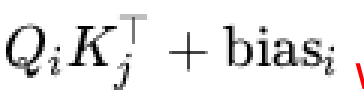
Figure 16. Option A ALiBi modified attention score with learnable bias
Source option ID: 6406536025130
B.
\(q_i k_j^T + B(i+j)\)
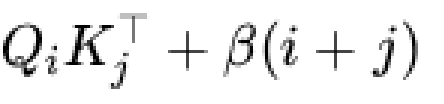
Figure 17. Option B ALiBi modified attention score with B(i+j)
Source option ID: 6406536025131
C.
\(q_i k_j^T - \gamma \cdot d\)
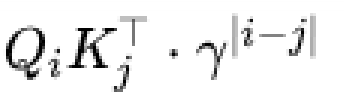
Figure 18. Option C ALiBi modified attention score with gamma * d penalty
Source option ID: 6406536025132
D.
\(q_i k_j^T - m|i - j|\)
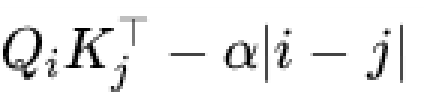
Figure 19. Option D ALiBi modified attention score with slope m * |i - j| penalty
Source option ID: 6406536025133
Correct answer: \(q_i k_j^T - m|i - j|\)
Source evidence: [{"page": 7, "bbox": [23.62, 724.98, 119.02, 741.3], "type": "green source option", "detail": "Option ID 6406536025133 marked in green (#008000)"}]
Question 15
Question ID: 6406531859511
Type: Multiple Select Question · Marks: 3
PDF pages: 8
Which of the following decoding method(s) can generate a different output every time you run the
model with the same prompt?
Options
A.
Greedy decoding
Source option ID: 6406536025134
B.
Beam search with beam width = 1
Source option ID: 6406536025135
C.
Top-p sampling with temperature T = 1
Source option ID: 6406536025136
D.
Top-p sampling with temperature T > 1
Source option ID: 6406536025137
E.
Beam search with beam width < 1
Source option ID: 6406536025138
Correct answer: Top-p sampling with temperature T = 1; Top-p sampling with temperature T > 1
Source evidence: [{"page": 8, "bbox": [23.62, 172.06, 119.02, 188.38], "type": "green source option", "detail": "Option ID 6406536025136 marked in green (#008000)"}, {"page": 8, "bbox": [23.62, 198.06, 119.02, 214.38], "type": "green source option", "detail": "Option ID 6406536025137 marked in green (#008000)"}]
Question 16
Question ID: 6406531859512
Type: Multiple Select Question · Marks: 2
PDF pages: 8
Which of the following methods modifies/modify the attention scores AFTER computing \(QK^T\)?
Options
A.
RoPE
Source option ID: 6406536025139
B.
APE
Source option ID: 6406536025140
C.
ALiBi
Source option ID: 6406536025141
D.
None of these
Source option ID: 6406536025142
Correct answer: ALiBi
Source evidence: [{"page": 8, "bbox": [23.62, 446.27, 119.02, 462.59], "type": "green source option", "detail": "Option ID 6406536025141 marked in green (#008000)"}]
Question 17
Question ID: 6406531859513
Type: Multiple Select Question · Marks: 3
PDF pages: 9
Consider a BART encoder with sequence length \(L\) and hidden size \(d_{model}\) (fixed).
Now suppose the sequence length is doubled from \(L\) to \(2L\), keeping all other parameters unchanged.
Which of the following statements are true?
Options
A.
Self-attention FLOPs increase by a factor of 2.
Source option ID: 6406536025143
B.
Self-attention FLOPs increase by a factor of 4.
Source option ID: 6406536025144
C.
FFN FLOPs increase by a factor of 2.
Source option ID: 6406536025145
D.
FFN FLOPs increase by a factor of 4.
Source option ID: 6406536025146
Correct answer: Self-attention FLOPs increase by a factor of 4.; FFN FLOPs increase by a factor of 2.
Source evidence: [{"page": 9, "bbox": [23.62, 223.93, 119.02, 240.25], "type": "green source option", "detail": "Option ID 6406536025144 marked in green (#008000)"}, {"page": 9, "bbox": [23.62, 266.26, 119.02, 282.58], "type": "green source option", "detail": "Option ID 6406536025145 marked in green (#008000)"}]
Question 18
Question ID: 6406531859514
Type: Short Answer Question · Marks: 2
PDF pages: 9
You are implementing a custom Block Sparse Attention kernel. Given a sequence length \(T = 1024\) and block size \(B = 64\), you decide to compute the main diagonal blocks plus one random off-diagonal block for each block-row. How many total \(B \times B\) block computations are performed?
Correct answer: 32
Source evidence: [{"page": 9, "bbox": [22.9, 605.0, 132.2, 642.7], "type": "explicit field", "detail": "Possible Answers: 32"}]
Question 19
Question ID: 6406531859515
Type: Multiple Select Question · Marks: 2
PDF pages: 10
Which of the following statements accurately describes the properties and computational
complexities of the various sparse and block attention mechanisms?
Options
A.
Strided Local Attention reduces the computational complexity from quadratic to linear, specifically \(O(cTd)\) where \(c\) is the window size.
Source option ID: 6406536025148
B.
Dilated Attention increases the computational complexity significantly
compared to standard Strided Local Attention because it covers a wider receptive field.
Source option ID: 6406536025149
C.
Global, Random, and Local Window attention patterns handle long sequences
well.
Source option ID: 6406536025150
D.
Empirical observations suggest that random permutations of blocks are
significantly more important for performance than the identity permutation.
Source option ID: 6406536025151
Correct answer: Strided Local Attention reduces the computational complexity from quadratic to linear, specifically \(O(cTd)\) where \(c\) is the window size.; Global, Random, and Local Window attention patterns handle long sequences well.
Source evidence: [{"page": 10, "bbox": [23.62, 130.42, 119.02, 146.74], "type": "green source option", "detail": "Option ID 6406536025148 marked in green (#008000)"}, {"page": 10, "bbox": [23.62, 227.7, 119.02, 244.02], "type": "green source option", "detail": "Option ID 6406536025150 marked in green (#008000)"}]
Question 20
Question ID: 6406531859516
Type: Short Answer Question · Marks: 2
PDF pages: 10
In the standard Transformer with 6 Encoder Layers, how many distinct sets of transformation weight matrices (\(W_Q, W_K, W_V\)) are learned in the entire Encoder stack, assuming 8 heads per layer?
Correct answer: 144
Source evidence: [{"page": 10, "bbox": [22.9, 538.3, 132.2, 575.9], "type": "explicit field", "detail": "Possible Answers: 144"}]
Question 21
Question ID: 6406531859517
Type: Short Answer Question · Marks: 2
PDF pages: 11
Suppose you are working on prefix language modeling. The sequence length is 10 and the first
two tokens represent the task-specific prefix. How many non-infinity elements are there in the
mask for computing attention scores?
Correct answer: 56
Source evidence: [{"page": 11, "bbox": [22.9, 223.3, 132.2, 261.0], "type": "explicit field", "detail": "Possible Answers: 56"}]
Question 22
Question ID: 6406531859518
Type: Short Answer Question · Marks: 2
PDF pages: 11
You are configuring a Large Language Model (LLM) for inference and need to estimate the memory footprint of the KV Cache. Calculate the KV cache memory required per token (in Bytes) given the following model architecture:
• Number of Layers (\(L\)): 32
• Number of Heads (\(H\)): 16
• Head Dimension (\(d_{head}\)): 128
• Precision: 2 Bytes (FP16)
Correct answer: 262144
Source evidence: [{"page": 11, "bbox": [22.9, 579.6, 132.2, 617.3], "type": "explicit field", "detail": "Possible Answers: 262144"}]
Question 23
Question ID: 6406531859520
Type: Multiple Choice Question · Marks: 1
PDF pages: 12
Shared context: ctx-23-26
Which of the following describes the fundamental training mechanism of this model?
Options
A.
The model predicts the entire sequence \(x\) simultaneously without considering dependencies.
Source option ID: 6406536025155
B.
The model predicts the token \(x_{t+1}\) based only on the tokens \(x_1\) up to \(x_t\).
Source option ID: 6406536025156
C.
The model predicts a masked token \(x_t\) based on both the left and right context tokens.
Source option ID: 6406536025157
Correct answer: The model predicts the token \(x_{t+1}\) based only on the tokens \(x_1\) up to \(x_t\).
Source evidence: [{"page": 12, "bbox": [23.62, 522.73, 119.02, 539.05], "type": "green source option", "detail": "Option ID 6406536025156 marked in green (#008000)"}]
Question 24
Question ID: 6406531859521
Type: Multiple Choice Question · Marks: 1
PDF pages: 12, 13
Shared context: ctx-23-26
During the training phase on a sequence \(x\) of length \(T\), how does the teacher forcing mechanism specifically relate to the calculation of the loss function \(\mathcal{L}(\theta)\)?
Options
A.
It means the model uses its own previous predictions \((\hat{x}_1, \dots, \hat{x}_t)\) as input to predict \(x_{t+1}\).
Source option ID: 6406536025158
B.
It dictates that the loss is only calculated for tokens that were incorrectly
predicted.
Source option ID: 6406536025159
C.
It ensures that for every prediction \(P(x_{t+1} \mid \dots)\), the model is conditioned on the ground-truth sequence \((x_1, \dots, x_t)\).
Source option ID: 6406536025160
D.
It allows the model to see future tokens \((x_{t+2}, \dots, x_T)\) when predicting \(x_{t+1}\).
Source option ID: 6406536025161
Correct answer: It ensures that for every prediction \(P(x_{t+1} \mid \dots)\), the model is conditioned on the ground-truth sequence \((x_1, \dots, x_t)\).
Source evidence: [{"page": 13, "bbox": [23.62, 82.14, 119.02, 98.46], "type": "green source option", "detail": "Option ID 6406536025160 marked in green (#008000)"}]
Question 25
Question ID: 6406531859522
Type: Multiple Choice Question · Marks: 1
PDF pages: 13
Shared context: ctx-23-26
In the inference phase (when the model is used for generation), why is the teacher forcing
technique not used, and what is the primary challenge this introduces?
Options
A.
Teacher forcing is used, but only with a small probability.
Source option ID: 6406536025162
B.
It's not used because the ground-truth sequence is unknown; this introduces
the exposure bias problem, where the model is unfamiliar with its own prediction errors.
Source option ID: 6406536025163
C.
It's not used because it drastically slows down the inference speed.
Source option ID: 6406536025164
D.
It's not used; the challenge is the need for a separate encoder-decoder
architecture.
Source option ID: 6406536025165
Correct answer: It's not used because the ground-truth sequence is unknown; this introduces
the exposure bias problem, where the model is unfamiliar with its own prediction errors.
Source evidence: [{"page": 13, "bbox": [23.62, 339.17, 119.02, 355.49], "type": "green source option", "detail": "Option ID 6406536025163 marked in green (#008000)"}]
Question 26
Question ID: 6406531859523
Type: Multiple Choice Question · Marks: 1
PDF pages: 13
Shared context: ctx-23-26
Which component of the Transformer decoder is essential for enforcing the Causal Language
Modeling constraint?
Options
A.
The Feed-Forward Network layer.
Source option ID: 6406536025166
B.
The Positional Encoding layer.
Source option ID: 6406536025167
C.
The masked Self-Attention layer.
Source option ID: 6406536025168
D.
The Cross-Attention layer.
Source option ID: 6406536025169
Correct answer: The masked Self-Attention layer.
Source evidence: [{"page": 13, "bbox": [23.62, 608.15, 119.02, 624.47], "type": "green source option", "detail": "Option ID 6406536025168 marked in green (#008000)"}]
Answer key
| Source question | Source identity | Correct answer | PDF pages |
|---|---|---|---|
| 2 | 6406531859498 | "apple'' or ''banana'' | 2 |
| 3 | 6406531859499 | BatchNorm adds 1024 parameters, LayerNorm adds 1024 parameters | 2 |
| 4 | 6406531859500 | Insufficient information to determine | 3 |
| 5 | 6406531859501 | Use the [CLS] token embedding as input to a classification layer. | 3 |
| 6 | 6406531859502 | Named Entity Recognition | 4 |
| 7 | 6406531859503 | \(O((T^2/n) \cdot d)\) | 4 |
| 8 | 6406531859504 | 1 -> B, 2 -> D, 3 -> C, 4 -> A, 5 -> E | 5 |
| 9 | 6406531859505 | \([0, 4]^T\) | 6 |
| 10 | 6406531859506 | No new parameters | 6 |
| 11 | 6406531859507 | 5 | 6 |
| 12 | 6406531859508 | APE = 6, RPE = 11 | 7 |
| 13 | 6406531859509 | APE | 7 |
| 14 | 6406531859510 | \(q_i k_j^T - m\|i - j\|\) | 7 |
| 15 | 6406531859511 | Top-p sampling with temperature T = 1; Top-p sampling with temperature T > 1 | 8 |
| 16 | 6406531859512 | ALiBi | 8 |
| 17 | 6406531859513 | Self-attention FLOPs increase by a factor of 4.; FFN FLOPs increase by a factor of 2. | 9 |
| 18 | 6406531859514 | 32 | 9 |
| 19 | 6406531859515 | Strided Local Attention reduces the computational complexity from quadratic to linear, specifically \(O(cTd)\) where \(c\) is the window size.; Global, Random, and Local Window attention patterns handle long sequences well. | 10 |
| 20 | 6406531859516 | 144 | 10 |
| 21 | 6406531859517 | 56 | 11 |
| 22 | 6406531859518 | 262144 | 11 |
| 23 | 6406531859520 | The model predicts the token \(x_{t+1}\) based only on the tokens \(x_1\) up to \(x_t\). | 12 |
| 24 | 6406531859521 | It ensures that for every prediction \(P(x_{t+1} \mid \dots)\), the model is conditioned on the ground-truth sequence \((x_1, \dots, x_t)\). | 12, 13 |
| 25 | 6406531859522 | It's not used because the ground-truth sequence is unknown; this introduces the exposure bias problem, where the model is unfamiliar with its own prediction errors. | 13 |
| 26 | 6406531859523 | The masked Self-Attention layer. | 13 |
Extraction notes
Status: verified
Count reconciliation: The portal header on physical page 1 declares 23 questions and 50 marks for Section LLM (Section Id: 640653124555). The 50 marks reconcile exactly across the 25 academic questions: Q2 (2) + Q3 (2) + Q4 (2) + Q5 (2) + Q6 (2) + Q7 (2) + Q8 (3) + Q9 (2) + Q10 (2) + Q11 (2) + Q12 (2) + Q13 (2) + Q14 (3) + Q15 (3) + Q16 (2) + Q17 (3) + Q18 (2) + Q19 (2) + Q20 (2) + Q21 (2) + Q22 (2) + Comprehension subquestions Q23 (1) + Q24 (1) + Q25 (1) + Q26 (1) = 50 marks. The declared portal count of 23 questions represents 1 administrative confirmation question (Q1), 21 standalone academic questions (Q2-Q22), and 1 comprehension portal container (Id: 6406531859519) enclosing 4 academic subquestions (Q23-Q26), yielding 1 + 21 + 1 = 23 portal questions and 25 total academic questions.
- Portal Question 1 is an administrative subject confirmation and is excluded from academic counts.
- Comprehension passage (Question Id 6406531859519) provides shared context for academic questions Q23 to Q26.
- Declared portal question count of 23 reflects 1 administrative question, 21 standalone questions, and 1 comprehension group containing 4 questions, totaling 25 academic questions.
Excluded source entries:
- {"classification": "confirmation", "page": 1, "bbox": [22.87, 55.39, 569.03, 246.16], "reason": "Administrative subject confirmation asking candidate to verify hall ticket for DEGREE LEVEL : LARGE LANGUAGE MODELS (COMPUTER BASED EXAM)", "identity": "6406531859497"}