LLM — da5004_2026T2_Q1_NA
Source: da5004_2026T2_Q1_NA.pdf · Academic questions: 16 · Separately counted children: 0
Provenance: Large_Language_Models/da5004_2026T2_Q1_NA.pdf · SHA-256 7ca18a647a21b6dba359c95e4275ab1a3ff1ea251ef5388e72916cbc5e104049
Scope: Section 1: LLM (Degree Level : Large Language Models), physical pages 1 to 10. The in-scope subject starts on physical page 1 with Section Id 640653141358 and terminates on physical page 10 after Question 17.
Questions
Question 2
Question ID: 6406532166233
Type: MSQ · Marks: 4
PDF pages: 2
Which statements are true about traditional attention used in sequence-to-sequence models?
Options
A.
The decoder decides which encoder states are important.
Source option ID: 6406537043567
B.
Attention weights are computed over all decoder hidden states.
Source option ID: 6406537043568
C.
The context vector is a weighted sum of encoder states.
Source option ID: 6406537043569
D.
Encoder hidden states are ignored after encoding.
Source option ID: 6406537043570
Correct answer: A, C
Source evidence: [{"page": 2, "bbox": [23.62, 374.08, 119.02, 390.4], "type": "green source option", "detail": "Option 6406537043567 is marked in green with color 32768"}, {"page": 2, "bbox": [23.62, 415.72, 119.02, 432.04], "type": "green source option", "detail": "Option 6406537043569 is marked in green with color 32768"}]
Shared context 3 to 4
Question ID: 6406532166234
Type: COMPREHENSION
PDF pages: 2, 3
Consider the text "learn easy math", consisting of three tokens: {learn,easy,math}.
The token embeddings are arranged in the input matrix \(X\):
The query, key, and value projection matrices are given by:
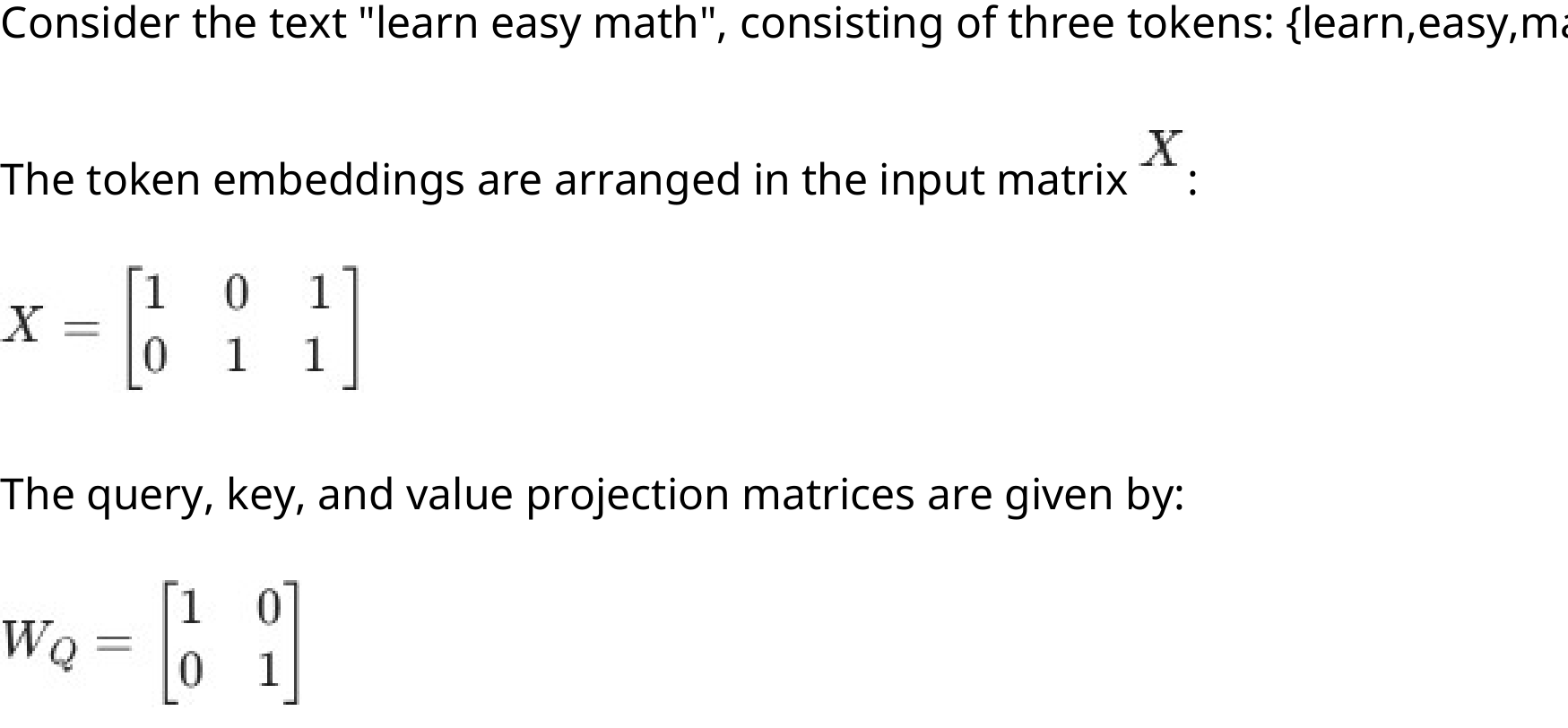
Figure 1. Input matrix X and query projection matrix W_Q for text learn easy math
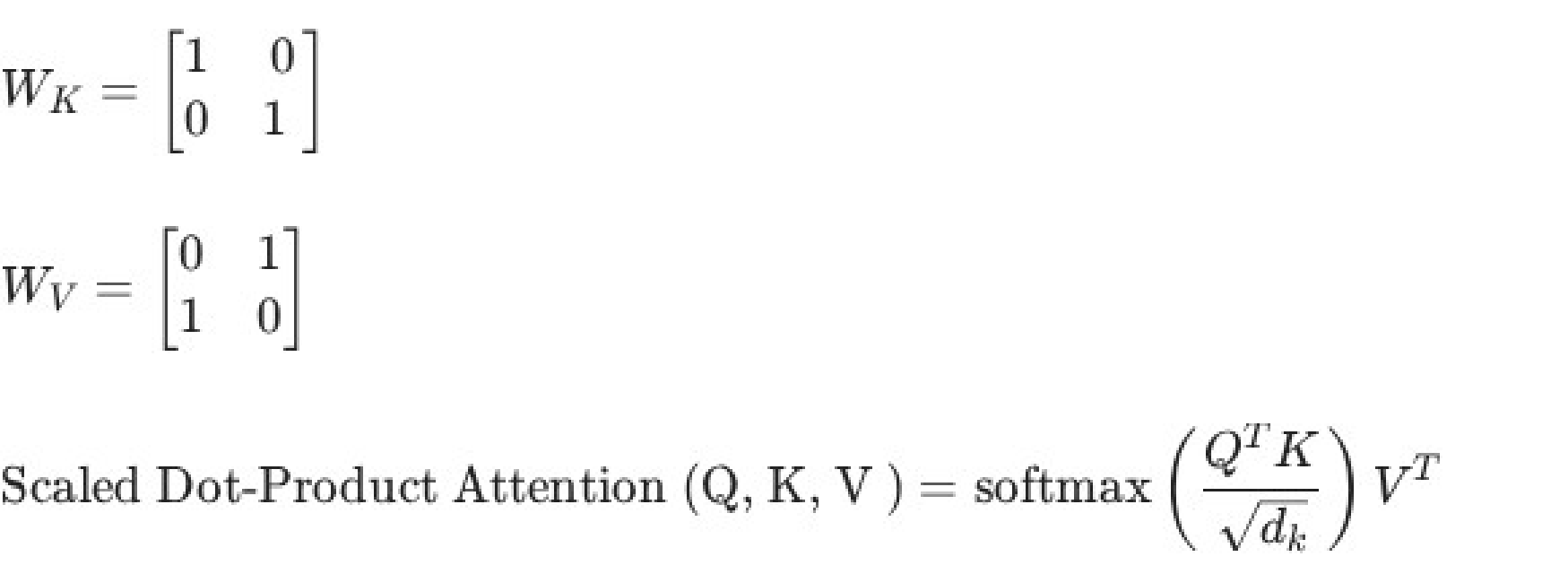
Figure 2. Key projection matrix W_K, value projection matrix W_V, and Scaled Dot-Product Attention formulation
Based on the above data, answer the given subquestions.
Question 3
Question ID: 6406532166235
Type: SA · Marks: 3
PDF pages: 3
Shared context: ctx-3-4
Compute the \((Q K^T)\) of the final scaled dot-product attention and submit the sum of the diagonal elements of \((Q K^T)\) matrix.

Figure 3. Question 3 prompt: Compute the (Q K^T) of the final scaled dot-product attention and sum of diagonal elements
Correct answer: 4
Source evidence: [{"page": 3, "bbox": [22.87, 506.0, 119.02, 530.0], "type": "explicit field", "detail": "Official Possible Answers: 4"}]
Question 4
Question ID: 6406532166236
Type: MCQ · Marks: 3
PDF pages: 3
Shared context: ctx-3-4
Choose the token pair with the least attention score.
Options
A.
{"learn", "easy"}
Source option ID: 6406537043572
B.
{"learn", "math"}
Source option ID: 6406537043573
C.
{"easy", "math"}
Source option ID: 6406537043574
D.
{"learn", "learn"}
Source option ID: 6406537043575
E.
{"easy" , "easy"}
Source option ID: 6406537043576
Correct answer: A
Source evidence: [{"page": 3, "bbox": [23.62, 643.24, 119.02, 659.56], "type": "green source option", "detail": "Option 6406537043572 is marked in green with color 32768"}]
Question 5
Question ID: 6406532166237
Type: SA · Marks: 4
PDF pages: 4
A Transformer model processes a sequence containing 6 tokens using Multi-Head Attention. The model initially uses 4 attention heads. If the number of attention heads is doubled to 8, while the sequence length remains unchanged, how many additional attention scores are computed across all heads?
Correct answer: 144
Source evidence: [{"page": 4, "bbox": [22.87, 240.0, 119.02, 260.0], "type": "explicit field", "detail": "Official Possible Answers: 144"}]
Question 6
Question ID: 6406532166238
Type: SA · Marks: 4
PDF pages: 4
A batch of 8 sentences is passed through a Transformer Encoder consisting of 6 encoder layers and 8 attention heads. After padding, each sentence has a maximum length of 32 tokens. The model uses an embedding dimension of \(d_{model} = 128\). What is the total number of elements (volume) in the output tensor produced by the final encoder layer for the entire batch?
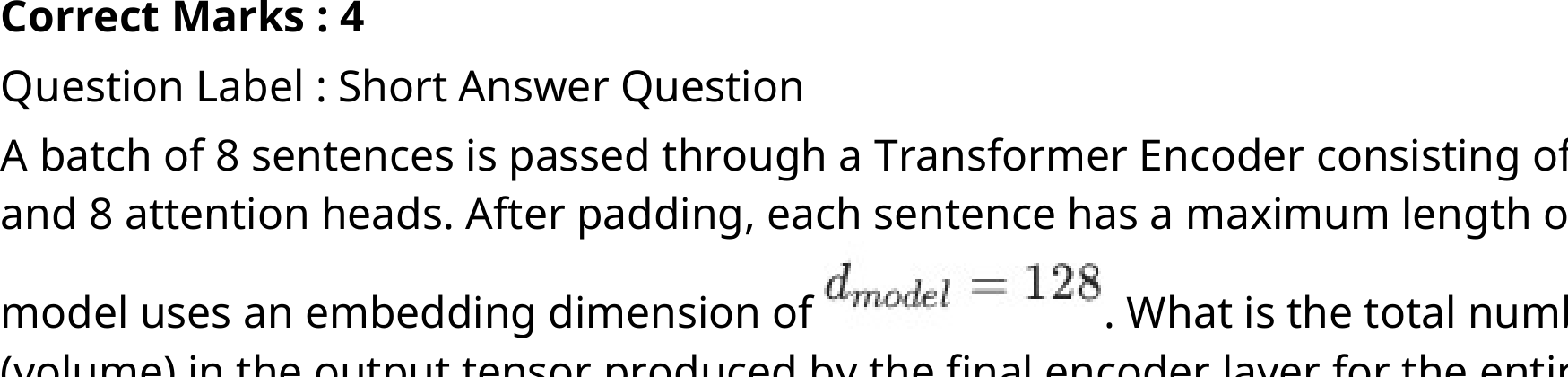
Figure 4. Question 6 prompt: Transformer encoder output tensor volume calculation with embedding dimension d_model = 128
Correct answer: 32768
Source evidence: [{"page": 4, "bbox": [22.87, 560.0, 119.02, 580.0], "type": "explicit field", "detail": "Official Possible Answers: 32768"}]
Question 7
Question ID: 6406532166239
Type: SA · Marks: 4
PDF pages: 4, 5
Consider a masked multi-head attention layer in a transformer decoder. The source vocabulary is of size \(V_s = 1000\), \(d_{model} = 64\) and context length \(T = 128\). To enforce autoregressive generation, a causal mask is applied to the raw attention score before applying softmax. How many entries in the causal mask are set to \(-\infty\) ?
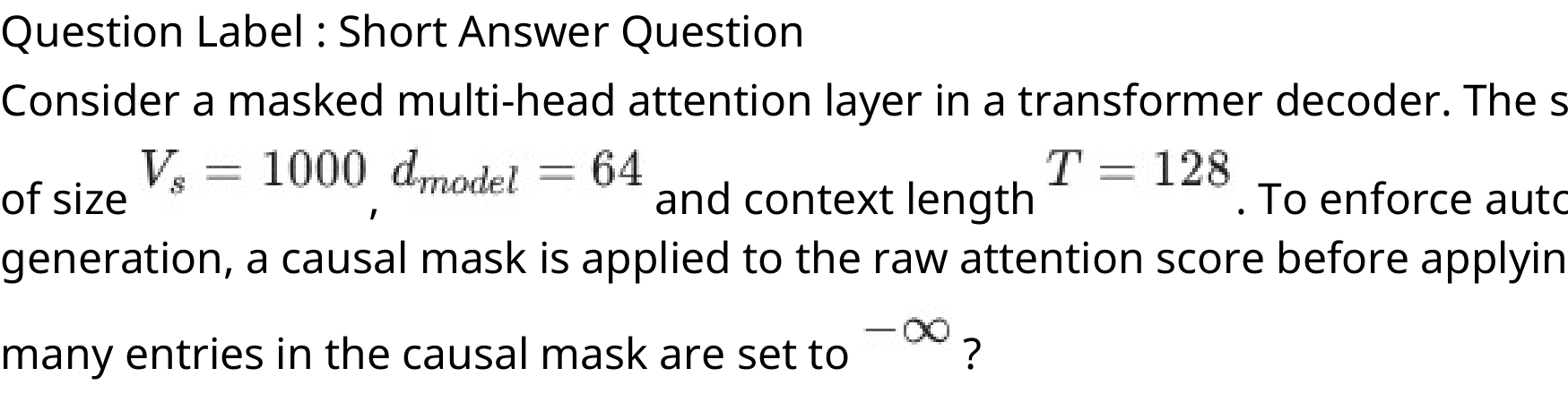
Figure 5. Question 7 prompt: Causal mask entries set to -infinity with vocabulary size V_s = 1000, d_model = 64, and context length T = 128
Correct answer: 8128
Source evidence: [{"page": 5, "bbox": [22.87, 95.0, 119.02, 115.0], "type": "explicit field", "detail": "Official Possible Answers: 8128"}]
Question 8
Question ID: 6406532166240
Type: SA · Marks: 4
PDF pages: 5
Consider a Transformer model with a hidden state dimension \(d_{model} = 512\). The positional encoding for a given position, \(pos\) and dimension \(i\) is defined by:
Compute the squared euclidean norm for the vector corresponding to \(pos = 3\) and enter the value.
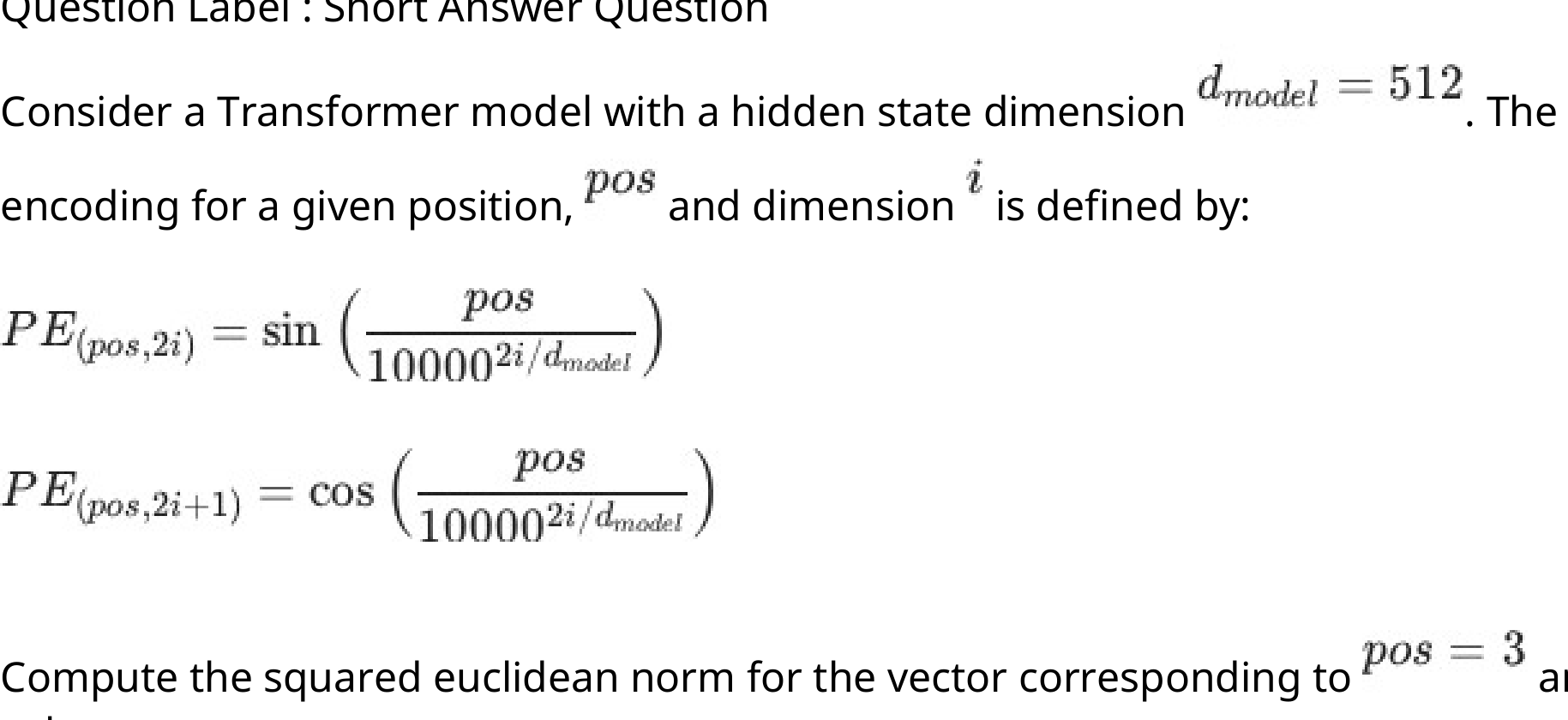
Figure 6. Question 8 prompt: Sinusoidal positional encoding formulation for hidden state dimension d_model = 512 and squared Euclidean norm computation
Correct answer: 256
Source evidence: [{"page": 5, "bbox": [22.87, 530.0, 119.02, 550.0], "type": "explicit field", "detail": "Official Possible Answers: 256"}]
Question 9
Question ID: 6406532166241
Type: MCQ · Marks: 4
PDF pages: 5, 6
Consider the following statements regarding the use of Teacher Forcing while training
autoregressive sequence-to-sequence models and select the appropriate option:
Statement 1: Teacher Forcing involves passing the input token to a larger Teacher model whose
output is then input as the next token
Statement 2: Teacher Forcing helps to prevent compounding of early incorrect predictions that
can destabilize training
Options
A.
Statement 1 is True but Statement 2 is False
Source option ID: 6406537043581
B.
Statement 1 is False but Statement 2 is True
Source option ID: 6406537043582
C.
Both the statements are True
Source option ID: 6406537043583
D.
Both the statements are False
Source option ID: 6406537043584
Correct answer: B
Source evidence: [{"page": 6, "bbox": [23.62, 93.28, 119.02, 109.6], "type": "green source option", "detail": "Option 6406537043582 is marked in green with color 32768"}]
Shared context 10 to 12
Question ID: 6406532166242
Type: COMPREHENSION
PDF pages: 6
Consider the following language model that generates a sentence of three word tokens after the special
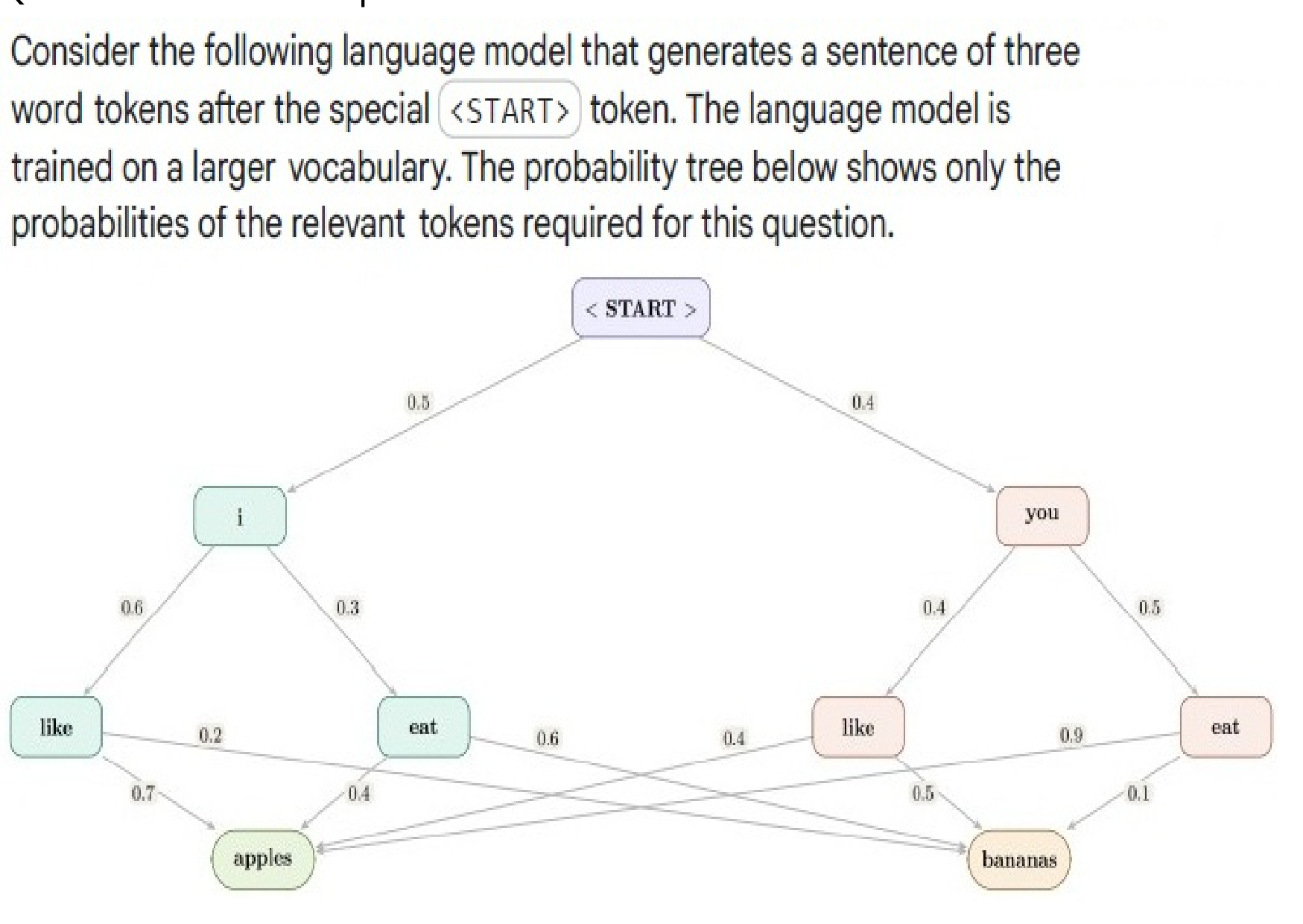
Figure 7. Probability tree of three-token sentences following START token for bigram/trigram language model
Based on the above data, answer the given subquestions.
Question 10
Question ID: 6406532166243
Type: SA · Marks: 3
PDF pages: 6, 7
Shared context: ctx-10-12
Compute the joint probability of the sentence : "You eat apples"
(Provide answer correct upto 2 digits after the decimal)

Figure 8. Question 10 prompt: Joint probability computation for the sentence You eat apples
Correct answer: 0.17 to 0.19
Source evidence: [{"page": 7, "bbox": [22.87, 130.0, 119.02, 150.0], "type": "explicit field", "detail": "Official Possible Answers: 0.17 to 0.19"}]
Question 11
Question ID: 6406532166244
Type: MCQ · Marks: 3
PDF pages: 7
Shared context: ctx-10-12
Choose the option corresponding to the sentence with the highest joint probability under the given language model.
Options
A.
"i eat apples"
Source option ID: 6406537043586
B.
"apples like You"
Source option ID: 6406537043587
C.
"i eat bananas"
Source option ID: 6406537043588
D.
"you like bananas
Source option ID: 6406537043589
E.
"you like apples
Source option ID: 6406537043590
Correct answer: C
Source evidence: [{"page": 7, "bbox": [23.62, 364.3, 119.02, 380.62], "type": "green source option", "detail": "Option 6406537043588 is marked in green with color 32768"}]
Question 12
Question ID: 6406532166245
Type: SA · Marks: 2
PDF pages: 7
Shared context: ctx-10-12
Using the given probability tree calculate the conditional probability of predicting "apples" given "like" [i.e P(apples | like)]. (Submit -1 if the provided information is insufficient)
Correct answer: -1
Source evidence: [{"page": 7, "bbox": [22.87, 595.0, 119.02, 615.0], "type": "explicit field", "detail": "Official Possible Answers: -1"}]
Question 13
Question ID: 6406532166246
Type: MSQ · Marks: 3
PDF pages: 7, 8
Which of the following are components found within a GPT decoder layer?
Options
A.
Causal (Masked) Multi-Head Self-Attention
Source option ID: 6406537043592
B.
Position-wise Feed-Forward Network
Source option ID: 6406537043593
C.
Multi Head (Cross) Attention
Source option ID: 6406537043594
D.
Recurrent Neural Network (RNN) Layer
Source option ID: 6406537043595
E.
Add & Norm Layer
Source option ID: 6406537043596
Correct answer: A, B, E
Source evidence: [{"page": 8, "bbox": [23.62, 75.46, 119.02, 91.78], "type": "green source option", "detail": "Option 6406537043592 is marked in green with color 32768"}, {"page": 8, "bbox": [23.62, 96.28, 119.02, 112.6], "type": "green source option", "detail": "Option 6406537043593 is marked in green with color 32768"}, {"page": 8, "bbox": [23.62, 158.74, 119.02, 175.06], "type": "green source option", "detail": "Option 6406537043596 is marked in green with color 32768"}]
Shared context 14 to 17
Question ID: 6406532166247
Type: COMPREHENSION
PDF pages: 8
The table below represents the conditional probability distribution over the vocabulary. Each column corresponds to a decoding timestep and the values represent the conditional probability of selecting a token at the timestep given the previously generated tokens
| Token | \(t = 1\) | \(t = 2\) | \(t = 3\) | \(t = 4\) | \(t = 5\) | \(t = 6\) |
|---|---|---|---|---|---|---|
| abandoned | 0.12 | 0.05 | 0.05 | 0.30 | 0.10 | 0.40 |
| but | 0.05 | 0.05 | 0.10 | 0.07 | 0.45 | 0.20 |
| castle | 0.05 | 0.40 | 0.10 | 0.02 | 0.05 | 0.05 |
| historic | 0.38 | 0.30 | 0.10 | 0.20 | 0.15 | 0.15 |
| majestic | 0.05 | 0.05 | 0.10 | 0.35 | 0.10 | 0.10 |
| the | 0.30 | 0.05 | 0.05 | 0.03 | 0.05 | 0.05 |
| was | 0.05 | 0.10 | 0.50 | 0.03 | 0.10 | 0.05 |
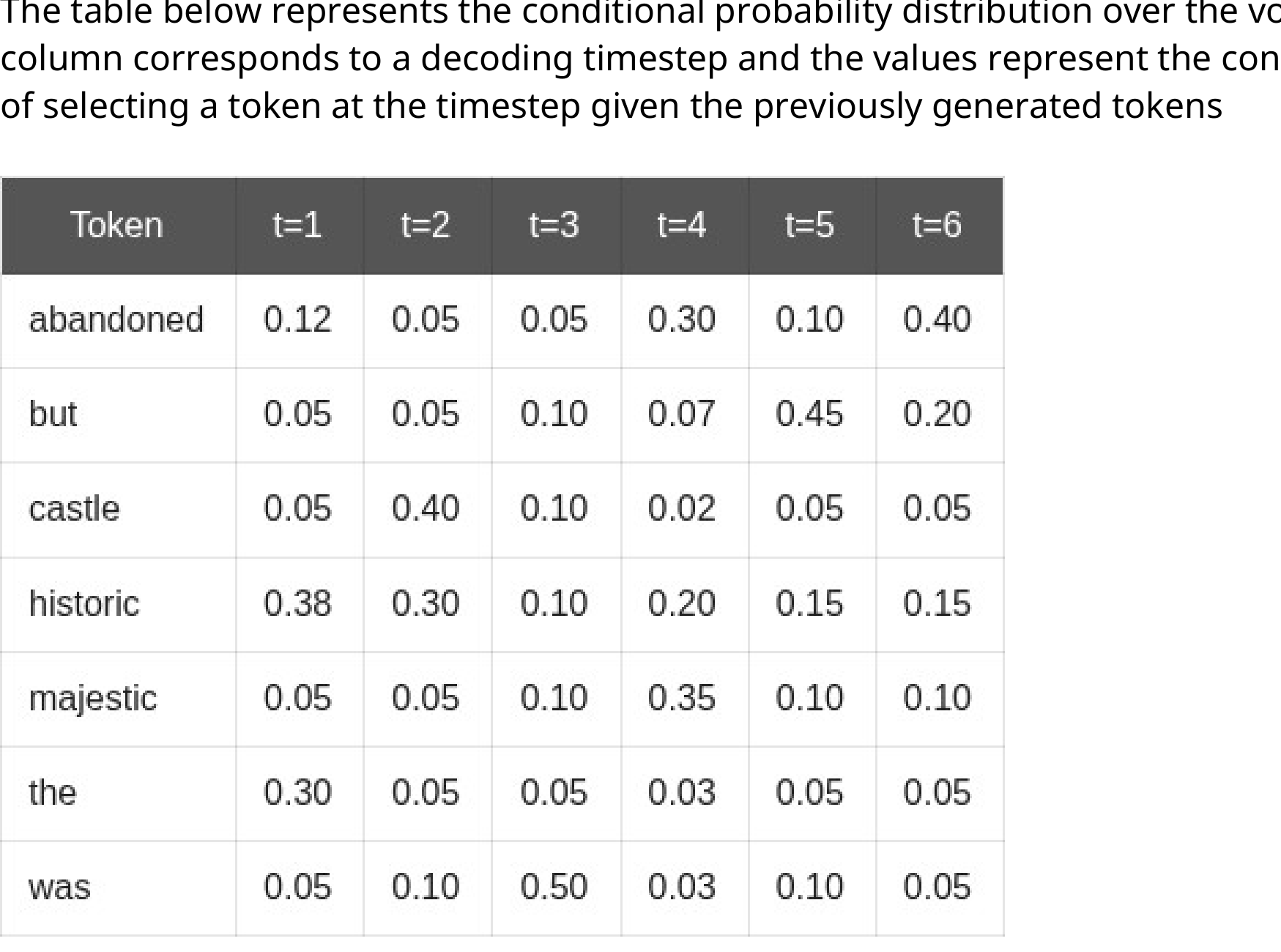
Figure 9. Table representing conditional probability distribution over 7 vocabulary tokens across timesteps t=1 to t=6
For all calculations, consider only the tokens mentioned in the first column as the Vocabulary
Based on the above data, answer the given subquestions.
Question 14
Question ID: 6406532166248
Type: SA · Marks: 2
PDF pages: 8, 9
Shared context: ctx-14-17
Use greedy decoding to determine the most likely sequence of 6 tokens and compute the probability of generating that sequence. Enter the value rounded off to 3 decimal places
Correct answer: 0.004 to 0.0055
Source evidence: [{"page": 9, "bbox": [22.87, 160.0, 119.02, 180.0], "type": "explicit field", "detail": "Official Possible Answers: 0.004 to 0.0055"}]
Question 15
Question ID: 6406532166249
Type: SA · Marks: 2
PDF pages: 9
Shared context: ctx-14-17
Use exhaustive search strategy to identify the most probable sequence consisting of 4 tokens. How many decoder runs are required in total to identify the most probable sequence containing 4 tokens?
Correct answer: 400
Source evidence: [{"page": 9, "bbox": [22.87, 420.0, 119.02, 440.0], "type": "explicit field", "detail": "Official Possible Answers: 400"}]
Question 16
Question ID: 6406532166250
Type: SA · Marks: 3
PDF pages: 9
Shared context: ctx-14-17
Use Top-k sampling at timestep t = 4 and k = 3. Compute the renormalized probability of the most probable token from the candidate tokens and enter the value rounded off to three decimal places
Correct answer: 0.410 to 0.414
Source evidence: [{"page": 9, "bbox": [22.87, 680.0, 119.02, 700.0], "type": "explicit field", "detail": "Official Possible Answers: 0.410 to 0.414"}]
Question 17
Question ID: 6406532166251
Type: SA · Marks: 2
PDF pages: 9, 10
Shared context: ctx-14-17
Consider the sequence "the castle was abandoned". What is the minimum beam width required to guarantee that this sequence is retained during beam search at timestep t = 4 ?
Correct answer: 5
Source evidence: [{"page": 10, "bbox": [22.87, 160.0, 119.02, 180.0], "type": "explicit field", "detail": "Official Possible Answers: 5"}]
Answer key
| Source question | Source identity | Correct answer | PDF pages |
|---|---|---|---|
| 2 | 6406532166233 | A, C | 2 |
| 3 | 6406532166235 | 4 | 3 |
| 4 | 6406532166236 | A | 3 |
| 5 | 6406532166237 | 144 | 4 |
| 6 | 6406532166238 | 32768 | 4 |
| 7 | 6406532166239 | 8128 | 4, 5 |
| 8 | 6406532166240 | 256 | 5 |
| 9 | 6406532166241 | B | 5, 6 |
| 10 | 6406532166243 | 0.17 to 0.19 | 6, 7 |
| 11 | 6406532166244 | C | 7 |
| 12 | 6406532166245 | -1 | 7 |
| 13 | 6406532166246 | A, B, E | 7, 8 |
| 14 | 6406532166248 | 0.004 to 0.0055 | 8, 9 |
| 15 | 6406532166249 | 400 | 9 |
| 16 | 6406532166250 | 0.410 to 0.414 | 9 |
| 17 | 6406532166251 | 5 | 9, 10 |
Extraction notes
Status: verified
Count reconciliation: Section 1 (LLM) declares 11 questions and 50 marks. The 11 portal containers comprise 1 administrative subject-confirmation entry (Question 1, 0 marks, excluded), 7 standalone academic questions (Question 2: 4 marks, Question 5: 4 marks, Question 6: 4 marks, Question 7: 4 marks, Question 8: 4 marks, Question 9: 4 marks, Question 13: 3 marks; total standalone = 27 marks), and 3 comprehension portal containers (Comprehension 6406532166234 covering Q3: 3 marks, Q4: 3 marks; Comprehension 6406532166242 covering Q10: 3 marks, Q11: 3 marks, Q12: 2 marks; Comprehension 6406532166247 covering Q14: 2 marks, Q15: 2 marks, Q16: 3 marks, Q17: 2 marks; total comprehension = 6 + 8 + 9 = 23 marks). The total academic questions reconcile to exactly 16 (7 standalone + 9 comprehension subquestions). The marks sum to 27 + 23 = 50 marks, exactly reconciling the declared Section Marks of 50. The 11 declared questions correspond exactly to the 11 portal containers (1 confirmation + 7 standalone + 3 comprehension blocks).
- Exam section 1 LLM runs from physical page 1 to page 10.
- Comprehension passages ctx-3-4, ctx-10-12, and ctx-14-17 provide shared context for subquestions (3 to 4), (10 to 12), and (14 to 17) respectively.
- All formulas, projection matrices, probability tree diagrams, and vocabulary decoding tables were verified against source rasters with high-resolution crops at 288 DPI.
Excluded source entries:
- {"classification": "subject-confirmation", "page": 1, "bbox": [22.87, 750.0, 580.0, 841.9], "reason": "Administrative subject confirmation asking candidate to confirm subject and cross check hall ticket", "identity": "1"}