LLM — da5004_2025T2_Q1_NA
Source: da5004_2025T2_Q1_NA.pdf · Academic questions: 21 · Separately counted children: 0
Provenance: Large_Language_Models/da5004_2025T2_Q1_NA.pdf · SHA-256 a8f64888d57debe8682701d05682f6028b33f9120ac354ab933639265a872afa
Scope: Section 8: LLM (Degree Level : Large Language Models (Computer Based Exam)), physical pages 1 to 15. The in-scope subject begins on physical page 1 with Section 8 header (Section Id 64065391701) at y=491.39 and terminates on physical page 15 immediately preceding Section 9: DL(CV) (Section Id 64065391702) at y=406.50.
Questions
Question 135
Question ID: 6406531279474
Type: Multiple Choice Question · Marks: 2
PDF pages: 2
Transformers process input tokens:
Options
A.
One at a time (sequentially)
Source option ID: 6406534313782
B.
In reverse order
Source option ID: 6406534313783
C.
All at once (in parallel)
Source option ID: 6406534313784
D.
Only after seeing the full input
Source option ID: 6406534313785
Correct answer: All at once (in parallel)
Source evidence: [{"page": 2, "bbox": [23.62, 586.6, 119.02, 602.92], "type": "green source option", "detail": "Option 6406534313784 is rendered in green (color 32768)"}]
Question 136
Question ID: 6406531279475
Type: Multiple Choice Question · Marks: 2
PDF pages: 3
What is the purpose of the softmax function in the attention mechanism?
Options
A.
Normalize attention scores to a probability distribution
Source option ID: 6406534313786
B.
Add non-linearity to the model
Source option ID: 6406534313787
C.
To predict the correct class for the loss function
Source option ID: 6406534313788
D.
Remove redundant features from the input
Source option ID: 6406534313789
Correct answer: Normalize attention scores to a probability distribution
Source evidence: [{"page": 3, "bbox": [23.62, 114.1, 119.02, 130.42], "type": "green source option", "detail": "Option 6406534313786 is rendered in green (color 32768)"}]
Question 137
Question ID: 6406531279476
Type: Multiple Choice Question · Marks: 2
PDF pages: 3
What is the main difference between GPT and BERT pre-training objectives?
Options
A.
GPT uses Masked Language Modeling, BERT uses Causal Language Modeling
Source option ID: 6406534313790
B.
GPT uses Causal Language Modeling, BERT uses Masked Language Modeling
Source option ID: 6406534313791
C.
Both use Masked Language Modeling
Source option ID: 6406534313792
D.
Both use Causal Language Modeling
Source option ID: 6406534313793
Correct answer: GPT uses Causal Language Modeling, BERT uses Masked Language Modeling
Source evidence: [{"page": 3, "bbox": [23.62, 338.62, 119.02, 354.94], "type": "green source option", "detail": "Option 6406534313791 is rendered in green (color 32768)"}]
Question 138
Question ID: 6406531279477
Type: Multiple Choice Question · Marks: 2
PDF pages: 3
In Top-K sampling for language generation, increasing the value of K typically has which of the following effects?
Options
A.
It makes the output more deterministic and repetitive.
Source option ID: 6406534313794
B.
It reduces the probability of selecting high-frequency words.
Source option ID: 6406534313795
C.
It increases the diversity of the generated text but may reduce coherence if K is too large.
Source option ID: 6406534313796
D.
It guarantees grammatical correctness by focusing on top-ranked tokens only.
Source option ID: 6406534313797
Correct answer: It increases the diversity of the generated text but may reduce coherence if K is too large.
Source evidence: [{"page": 3, "bbox": [23.62, 579.46, 119.02, 595.78], "type": "green source option", "detail": "Option 6406534313796 is rendered in green (color 32768)"}]
Question 139
Question ID: 6406531279478
Type: Multiple Choice Question · Marks: 2
PDF pages: 4
Why are residual connections important in transformer architectures?
Options
A.
They reduce memory consumption.
Source option ID: 6406534313798
B.
They add extra cost of compute by adding batch normalization.
Source option ID: 6406534313799
C.
They help in training deep networks by enabling gradient flow.
Source option ID: 6406534313800
D.
They remove the need for layer normalization.
Source option ID: 6406534313801
Correct answer: They help in training deep networks by enabling gradient flow.
Source evidence: [{"page": 4, "bbox": [23.62, 155.74, 119.02, 172.06], "type": "green source option", "detail": "Option 6406534313800 is rendered in green (color 32768)"}]
Question 140
Question ID: 6406531279479
Type: Multiple Select Question · Marks: 3
PDF pages: 4
Which of the following statements are true regarding causal language modeling (CLM)?
Options
A.
The model only attends to past and current tokens during training.
Source option ID: 6406534313802
B.
The model is trained by predicting the next token in a sequence.
Source option ID: 6406534313803
C.
The model uses bidirectional context.
Source option ID: 6406534313804
D.
The CLM objective is commonly used for encoder-only models.
Source option ID: 6406534313805
Correct answer: The model only attends to past and current tokens during training.; The model is trained by predicting the next token in a sequence.
Source evidence: [{"page": 4, "bbox": [23.62, 375.76, 119.02, 392.08], "type": "green source option", "detail": "Option 6406534313802 is rendered in green (color 32768)"}, {"page": 4, "bbox": [23.62, 396.58, 119.02, 412.9], "type": "green source option", "detail": "Option 6406534313803 is rendered in green (color 32768)"}]
Question 141
Question ID: 6406531279480
Type: Multiple Select Question · Marks: 3
PDF pages: 4
Which of the following are valid reasons why transformer-based large language models are widely used in natural language processing?
Options
A.
Transformers process input sequences in parallel, enabling faster training.
Source option ID: 6406534313806
B.
They use recurrence to remember long-term dependencies more effectively than LSTMs.
Source option ID: 6406534313807
C.
Transformers are limited to short text inputs due to their architecture.
Source option ID: 6406534313808
D.
Large transformer models can be fine-tuned for various NLP tasks using a single pre-trained model.
Source option ID: 6406534313809
Correct answer: Transformers process input sequences in parallel, enabling faster training.; Large transformer models can be fine-tuned for various NLP tasks using a single pre-trained model.
Source evidence: [{"page": 4, "bbox": [23.62, 595.78, 119.02, 612.1], "type": "green source option", "detail": "Option 6406534313806 is rendered in green (color 32768)"}, {"page": 4, "bbox": [23.62, 674.56, 119.02, 690.88], "type": "green source option", "detail": "Option 6406534313809 is rendered in green (color 32768)"}]
Question 142
Question ID: 6406531279481
Type: Multiple Select Question · Marks: 3
PDF pages: 5
Which elements are included in BERT’s input representation for Next Sentence Prediction?
Options
A.
[CLS] token at the beginning of input.

Figure 1. [CLS] token at the beginning of input option block
Source option ID: 6406534313810
B.
[SEP] token to separate sentence A and sentence B.

Figure 2. [SEP] token to separate sentence A and sentence B option block
Source option ID: 6406534313811
C.
Segment embeddings to distinguish sentence A and sentence B.

Figure 3. Segment embeddings to distinguish sentence A and sentence B option block
Source option ID: 6406534313812
D.
Position embeddings are not required for Next Sentence Prediction.

Figure 4. Position embeddings are not required for Next Sentence Prediction option block
Source option ID: 6406534313813
Correct answer: [CLS] token at the beginning of input.; [SEP] token to separate sentence A and sentence B.; Segment embeddings to distinguish sentence A and sentence B.
Source evidence: [{"page": 5, "bbox": [23.62, 120.03, 119.02, 136.35], "type": "green source option", "detail": "Option 6406534313810 is rendered in green (color 32768)"}, {"page": 5, "bbox": [23.62, 161.6, 119.02, 177.92], "type": "green source option", "detail": "Option 6406534313811 is rendered in green (color 32768)"}, {"page": 5, "bbox": [23.62, 203.93, 119.02, 220.25], "type": "green source option", "detail": "Option 6406534313812 is rendered in green (color 32768)"}]
Question 143
Question ID: 6406531279482
Type: Multiple Select Question · Marks: 3
PDF pages: 5
How does Top-p (nucleus) sampling differ from Top-K sampling in language generation?
Options
A.
It samples only from a fixed number of tokens at each step.
Source option ID: 6406534313814
B.
It samples from the smallest set of tokens whose cumulative probability exceeds p.
Source option ID: 6406534313815
C.
It always selects the top-p tokens with equal probability.
Source option ID: 6406534313816
D.
It guarantees diversity by selecting all low-probability tokens.
Source option ID: 6406534313817
Correct answer: It samples from the smallest set of tokens whose cumulative probability exceeds p.
Source evidence: [{"page": 5, "bbox": [23.62, 424.63, 119.02, 440.95], "type": "green source option", "detail": "Option 6406534313815 is rendered in green (color 32768)"}]
Question 144
Question ID: 6406531279483
Type: Short Answer Question · Marks: 3
PDF pages: 6
Consider the embedding vector for a word, \(x = [0.5, -0.4, 0.3, -0.2]^T\). Suppose the word is at position 3 in the given sentence. Add the corresponding position embedding \(p\) to the word embedding to get \(h\), i.e. the sum of the elements in \(h = x + p\). Use the fixed sinusoidal position embedding vector calculated using the formula given below:
What is the value of \(h[0] - h[1]\) i.e. substract second element from the first element of \(h\) vector ? (Answer correct up to 2 values after the decimal)
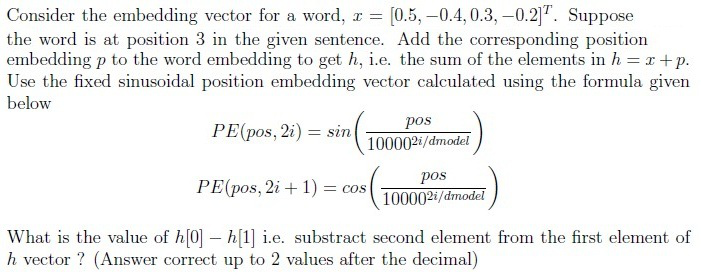
Figure 5. Sinusoidal positional embedding formulation and question parameters for token position 3
Correct answer: 1.98 to 2.08
Source evidence: [{"page": 6, "bbox": [22.87, 404.1, 180.0, 422.5], "type": "explicit field", "detail": "Possible Answers: 1.98 to 2.08"}]
Question 145
Question ID: 6406531279484
Type: Short Answer Question · Marks: 3
PDF pages: 7
Suppose a language model outputs the following logits for a vocabulary of size 4:
| Token | Logit |
|---|---|
| the | 2.0 |
| sky | 1.0 |
| is | 0.5 |
| blue | -1.0 |
You apply temperature scaling with temperature \(T = 0.5\). After applying the softmax on the temperature-scaled logits, what is the probability assigned to the token “the”? (Give your answer up to 2 decimal places)
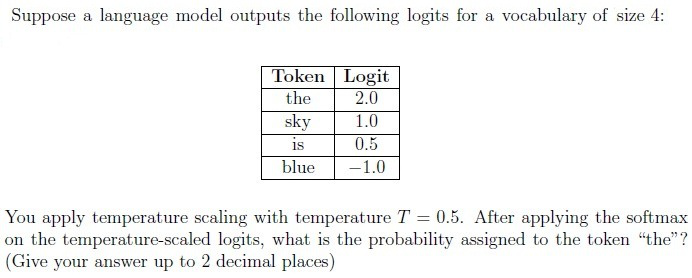
Figure 6. Vocabulary token logits table and temperature scaling parameter T=0.5 for softmax probability calculation
Correct answer: 0.81 to 0.87
Source evidence: [{"page": 7, "bbox": [22.87, 405.6, 180.0, 424.0], "type": "explicit field", "detail": "Possible Answers: 0.81 to 0.87"}]
Question 146
Question ID: 6406531279485
Type: Short Answer Question · Marks: 3
PDF pages: 7
A transformer generates the following attention weights for a token over four positions: (0.1, 0.2, 0.5, 0.2). The corresponding value vectors are:
Compute the output vector from the attention mechanism by taking the weighted sum of the value vectors, and return the first element of the resulting vector. (Round to 2 decimal places)
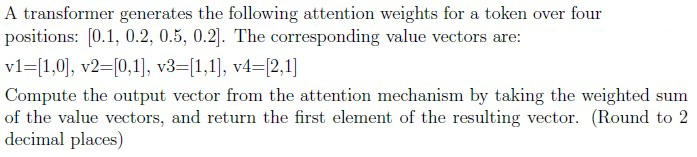
Figure 7. Attention weights and value vectors v1, v2, v3, v4 for weighted sum output vector calculation
Correct answer: 0.9 to 1.1
Source evidence: [{"page": 7, "bbox": [22.87, 749.0, 180.0, 767.3], "type": "explicit field", "detail": "Possible Answers: 0.9 to 1.1"}]
Shared context 147 to 149
Question ID: 6406531279486
Type: Comprehension
PDF pages: 9
Question Description
- Embedding dimension : \(d_{\text{model}} = 4\)
- Input sequence (sequence length = 2, \(d_{\text{model}} = 4\)) :
$\(X = \begin{bmatrix} 1 & 0 & 1 & 0 \\ 0 & 2 & 0 & 2 \end{bmatrix}\)$ - Number of heads: 2 (each head operates on 2 dimensions)
- For both the heads \(d_K = d_Q = d_V = 2\)
- Weight matrices for \(W_Q, W_K, W_V\) first head :
$\(W_Q^1, W_K^1, W_V^1 = \begin{bmatrix} 1 & 0 \\ 0 & 1 \\ 1 & 0 \\ 0 & 1 \end{bmatrix}\)$ - Weight matrices for \(W_Q, W_K, W_V\) second head :
$\(W_Q^2, W_K^2, W_V^2 = \begin{bmatrix} 0 & 1 \\ 1 & 0 \\ 0 & 1 \\ 1 & 0 \end{bmatrix}\)$ - The output from both heads are concatenated, then projected by:
$\(W_O = \begin{bmatrix} 0.5 & 0 & 0 & 0 \\ 0 & 0.5 & 0 & 0 \\ 0 & 0 & 0.5 & 0 \\ 0 & 0 & 0 & 0.5 \end{bmatrix}\)$
$\(\text{Scaled Dot-Product Attention}(Q, K, V) = \text{softmax}\left(\frac{Q K^T}{\sqrt{d_K}}\right) V\)$
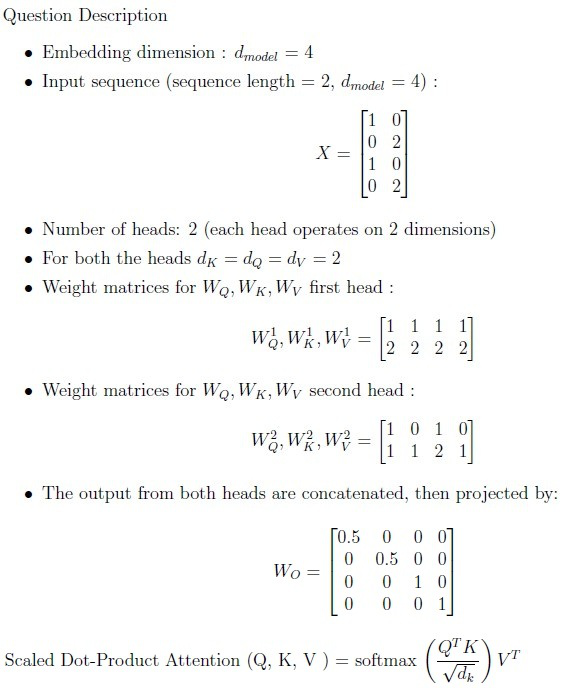
Figure 8. Comprehension data: embedding dimensions, input sequence matrix X, projection matrices WQ, WK, WV, WO, and attention formula
Based on the above data, answer the given subquestions.
Question 147
Question ID: 6406531279487
Type: Multiple Choice Question · Marks: 3
PDF pages: 9, 10
Shared context: ctx-147-149
Select the scaled dot-product attention for the first head:
Options
A.

Figure 9. Candidate attention matrix for head 1 option A
Source option ID: 6406534313821
B.

Figure 10. Candidate attention matrix for head 1 option B
Source option ID: 6406534313822
C.

Figure 11. Candidate attention matrix for head 1 option C
Source option ID: 6406534313823
D.

Figure 12. Candidate attention matrix for head 1 option D
Source option ID: 6406534313824
Correct answer: $\(\begin{bmatrix} 0 & 0 \\ 6 & 12 \end{bmatrix}\)$
Source evidence: [{"page": 10, "bbox": [23.62, 101.75, 119.02, 118.07], "type": "green source option", "detail": "Option 6406534313822 is rendered in green (color 32768)"}]
Question 148
Question ID: 6406531279488
Type: Multiple Choice Question · Marks: 3
PDF pages: 10
Shared context: ctx-147-149
Select the scaled dot-product attention for the second head:
Options
A.

Figure 13. Candidate attention matrix for head 2 option A
Source option ID: 6406534313825
B.

Figure 14. Candidate attention matrix for head 2 option B
Source option ID: 6406534313826
C.

Figure 15. Candidate attention matrix for head 2 option C
Source option ID: 6406534313827
D.

Figure 16. Candidate attention matrix for head 2 option D
Source option ID: 6406534313828
Correct answer: $\(\begin{bmatrix} 1.34 & 2.23 \\ 0.66 & 4.77 \end{bmatrix}\)$
Source evidence: [{"page": 10, "bbox": [23.62, 401.65, 119.02, 417.97], "type": "green source option", "detail": "Option 6406534313825 is rendered in green (color 32768)"}]
Question 149
Question ID: 6406531279489
Type: Multiple Choice Question · Marks: 2
PDF pages: 10, 11
Shared context: ctx-147-149
Concatenate the outputs from both the attention heads, then apply the output projection matrix Wo to produce the final output of the multi-head attention mechanism. Select the correct result of this operation.
Options
A.

Figure 17. Candidate multi-head attention projection matrix option A
Source option ID: 6406534313829
B.

Figure 18. Candidate multi-head attention projection matrix option B
Source option ID: 6406534313830
C.

Figure 19. Candidate multi-head attention projection matrix option C
Source option ID: 6406534313831
D.

Figure 20. Candidate multi-head attention projection matrix option D
Source option ID: 6406534313832
Correct answer: $\(\begin{bmatrix} 0.00 & 0.00 \\ 3.00 & 6.00 \\ 1.34 & 2.23 \\ 0.66 & 4.77 \end{bmatrix}\)$
Source evidence: [{"page": 11, "bbox": [23.62, 355.9, 119.02, 372.22], "type": "green source option", "detail": "Option 6406534313832 is rendered in green (color 32768)"}]
Shared context 150 to 152
Question ID: 6406531279490
Type: Comprehension
PDF pages: 12
Apply “add and norm” layer to the output of the multihead attention in which :
- Input sequence (sequence length = 2, \(d_{\text{model}} = 4\)) to Multihead Attention:
$\(X = \begin{bmatrix} 1 & 2 & 3 & 4 \\ 2 & 1 & 3 & 4 \end{bmatrix}\)$ - Multi head Attention Output :
$\(\text{MHA}(X) = \begin{bmatrix} 2 & 3 & 1 & 2 \\ 5 & 4 & 1 & 2 \end{bmatrix}\)$
$\(\text{LayerNorm}(x) = \frac{x - \mu}{\sigma} \odot \gamma + \beta\)$
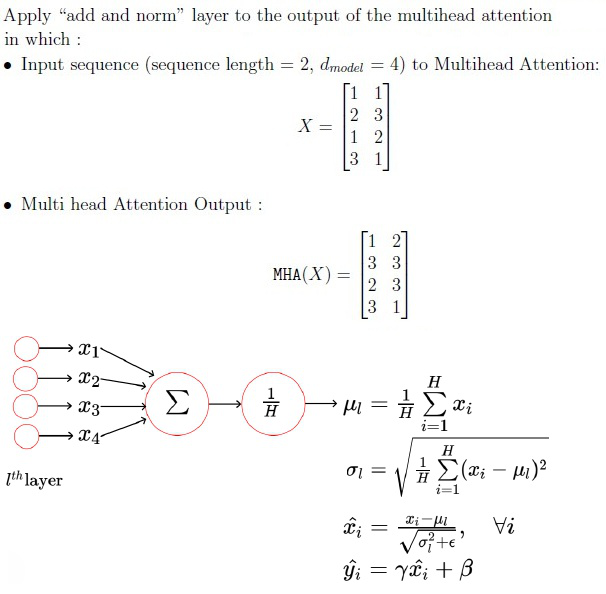
Figure 21. Comprehension data: Add and Norm layer instructions, input sequence matrix X, and multi-head attention output matrix MHA(X)
Based on the above data, answer the given subquestions.
Question 150
Question ID: 6406531279491
Type: Short Answer Question · Marks: 1
PDF pages: 12, 13
Shared context: ctx-150-152
For the given input matrix X and multihead attention output MHA(X), apply a residual connection and store the result in matrix R, and finally compute the sum of all elements in matrix R.
Correct answer: 36
Source evidence: [{"page": 13, "bbox": [22.87, 16.8, 180.0, 35.1], "type": "explicit field", "detail": "Possible Answers: 36"}]
Question 151
Question ID: 6406531279492
Type: Short Answer Question · Marks: 2
PDF pages: 13
Shared context: ctx-150-152
To apply the layer normalization on the matrix R. How many learning parameters (\(\theta\)) will be required ?
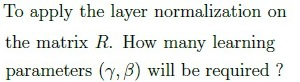
Figure 22. Question stem: Layer normalization learnable parameters count calculation for matrix R
Correct answer: 8
Source evidence: [{"page": 13, "bbox": [22.87, 299.3, 180.0, 317.7], "type": "explicit field", "detail": "Possible Answers: 8"}]
Question 152
Question ID: 6406531279493
Type: Short Answer Question · Marks: 3
PDF pages: 13
Shared context: ctx-150-152
Initialize \(\gamma = 2, \beta = 1\) and use \(\epsilon = 0\) and apply the layer normalization on the matrix R and sum of all the elements of the final output.
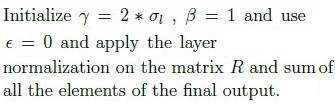
Figure 23. Question stem: Layer normalization initialization parameters gamma=2, beta=1, epsilon=0 and output sum calculation
Correct answer: 8
Source evidence: [{"page": 13, "bbox": [22.87, 598.4, 180.0, 616.7], "type": "explicit field", "detail": "Possible Answers: 8"}]
Shared context 153 to 155
Question ID: 6406531279494
Type: Comprehension
PDF pages: 14
The table presents the conditional probability distribution over vocabulary tokens at each timestep during sequence generation. Each column corresponds to a timestep (from 1 to 5), and the values represent the probability of selecting each token given the tokens chosen in all previous timesteps. For timestep t, the values in the column represent:
| timesteps | 1 | 2 | 3 | 4 | 5 |
|---|---|---|---|---|---|
| the | 0.07 | 0.19 | 0.20 | 0.42 | 0.08 |
| is | 0.04 | 0.13 | 0.12 | 0.26 | 0.08 |
| sky | 0.23 | 0.12 | 0.35 | 0.05 | 0.15 |
| [other] | 0.03 | 0.18 | 0.16 | 0.16 | 0.46 |
| very | 0.22 | 0.01 | 0.07 | 0.11 | 0.15 |
| blue | 0.33 | 0.25 | 0.08 | 0.05 | 0.08 |
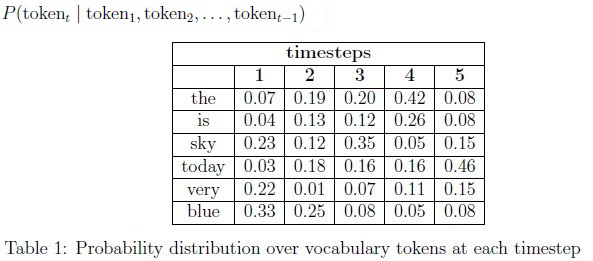
Figure 24. Table 1: Probability distribution over vocabulary tokens across timesteps 1 to 5
Based on the above data, answer the given subquestions.
Question 153
Question ID: 6406531279495
Type: Short Answer Question · Marks: 2
PDF pages: 14
Shared context: ctx-153-155
In exhaustive search, at timestep t=1, we run the decoder once to obtain probability distributions over all tokens in the vocabulary. Given the 6 tokens available in the table in the main question, how many times must we run the decoder at timestep t=4?
Correct answer: 216
Source evidence: [{"page": 14, "bbox": [22.87, 672.0, 180.0, 690.4], "type": "explicit field", "detail": "Possible Answers: 216"}]
Question 154
Question ID: 6406531279496
Type: Short Answer Question · Marks: 1
PDF pages: 14, 15
Shared context: ctx-153-155
How many total sequences of exactly length 5 are possible according to exhaustive search?
Correct answer: 7776
Source evidence: [{"page": 15, "bbox": [22.87, 113.4, 180.0, 131.7], "type": "explicit field", "detail": "Possible Answers: 7776"}]
Question 155
Question ID: 6406531279497
Type: Short Answer Question · Marks: 2
PDF pages: 15
Shared context: ctx-153-155
If we use top-k sampling with k=2 at timestep 1, what is the normalized probability of selecting token “sky” at the timestep=1?
Correct answer: 0.41
Source evidence: [{"page": 15, "bbox": [22.87, 363.6, 180.0, 381.9], "type": "explicit field", "detail": "Possible Answers: 0.41"}]
Answer key
| Source question | Source identity | Correct answer | PDF pages |
|---|---|---|---|
| 135 | 6406531279474 | All at once (in parallel) | 2 |
| 136 | 6406531279475 | Normalize attention scores to a probability distribution | 3 |
| 137 | 6406531279476 | GPT uses Causal Language Modeling, BERT uses Masked Language Modeling | 3 |
| 138 | 6406531279477 | It increases the diversity of the generated text but may reduce coherence if K is too large. | 3 |
| 139 | 6406531279478 | They help in training deep networks by enabling gradient flow. | 4 |
| 140 | 6406531279479 | The model only attends to past and current tokens during training.; The model is trained by predicting the next token in a sequence. | 4 |
| 141 | 6406531279480 | Transformers process input sequences in parallel, enabling faster training.; Large transformer models can be fine-tuned for various NLP tasks using a single pre-trained model. | 4 |
| 142 | 6406531279481 | [CLS] token at the beginning of input.; [SEP] token to separate sentence A and sentence B.; Segment embeddings to distinguish sentence A and sentence B. | 5 |
| 143 | 6406531279482 | It samples from the smallest set of tokens whose cumulative probability exceeds p. | 5 |
| 144 | 6406531279483 | 1.98 to 2.08 | 6 |
| 145 | 6406531279484 | 0.81 to 0.87 | 7 |
| 146 | 6406531279485 | 0.9 to 1.1 | 7 |
| 147 | 6406531279487 | $\(\begin{bmatrix} 0 & 0 \\ 6 & 12 \end{bmatrix}\)$ | 9, 10 |
| 148 | 6406531279488 | $\(\begin{bmatrix} 1.34 & 2.23 \\ 0.66 & 4.77 \end{bmatrix}\)$ | 10 |
| 149 | 6406531279489 | $\(\begin{bmatrix} 0.00 & 0.00 \\ 3.00 & 6.00 \\ 1.34 & 2.23 \\ 0.66 & 4.77 \end{bmatrix}\)$ | 10, 11 |
| 150 | 6406531279491 | 36 | 12, 13 |
| 151 | 6406531279492 | 8 | 13 |
| 152 | 6406531279493 | 8 | 13 |
| 153 | 6406531279495 | 216 | 14 |
| 154 | 6406531279496 | 7776 | 14, 15 |
| 155 | 6406531279497 | 0.41 | 15 |
Extraction notes
Status: verified
Count reconciliation: Section 8 declares 16 questions and 50 marks. The 16 portal question units correspond to 1 administrative subject-confirmation question (Question 134, 0 marks), 12 standalone academic questions (Questions 135-139 [5 MCQs x 2 = 10 marks], Questions 140-143 [4 MSQs x 3 = 12 marks], Questions 144-146 [3 SAs x 3 = 9 marks]), and 3 comprehension blocks (Questions 147-149 [3+3+2 = 8 marks], Questions 150-152 [1+2+3 = 6 marks], and Questions 153-155 [2+1+2 = 5 marks]). Total academic questions reconcile to exactly 21 (12 standalone + 9 comprehension subquestions). Marks sum to 10 + 12 + 9 + 8 + 6 + 5 = 50, matching the declared Section Marks of 50.
Excluded source entries:
- {"classification": "out-of-scope-section", "page": 1, "bbox": [0.0, 0.0, 595.3, 491.39], "reason": "Preceding section exam content (options 6406534313773 to 6406534313775, and Question 133) prior to Section 8 LLM header", "identity": "preceding-section"}
- {"classification": "subject-confirmation", "page": 2, "bbox": [22.87, 80.0, 580.0, 280.0], "reason": "Administrative subject confirmation asking candidate to confirm subject and cross check hall ticket", "identity": "134"}
- {"classification": "out-of-scope-section", "page": 15, "bbox": [0.0, 406.5, 595.3, 841.9], "reason": "Subsequent Section 9 DL(CV) exam header terminating LLM section", "identity": "following-section-9"}