LLM — da5004_2026T1_Q1_NA
Source: da5004_2026T1_Q1_NA.pdf · Academic questions: 19 · Separately counted children: 0
Provenance: Large_Language_Models/da5004_2026T1_Q1_NA.pdf · SHA-256 36b97be09a59b1a1d661caf11a5b7479012b91bdd61a2a7aeddcf627eb7196c0
Scope: Section 1: LLM (Degree Level : Large Language Models), physical pages 2 to 12. The in-scope subject starts at physical page 2 with Section Id 640653129729 at y=515.54 and terminates on physical page 12 at y=168.0.
Questions
Question 2
Question ID: 6406531961494
Type: Multiple Choice Question · Marks: 2
PDF pages: 3
In a self-attention mechanism, let the input be a matrix \(X \in \mathbb{R}^{T \times d_{model}}\), where \(T\) is the sequence length. If the dimension of the query projection matrix is \(W_Q \in \mathbb{R}^{d_{model} \times d_k}\), what is the dimension of the Query matrix \(Q\)?

Figure 1. Question 2 prompt: self-attention query matrix dimension formulation with input X and query projection matrix W_Q
Options
A.
\(d_{model} \times T\)
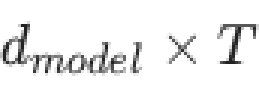
Figure 2. Option A dimension d_model x T
Source option ID: 6406536373621
B.
\(d_k \times T\)
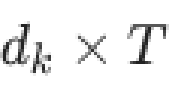
Figure 3. Option B dimension d_k x T
Source option ID: 6406536373622
C.
\(T \times d_k\)
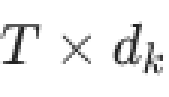
Figure 4. Option C dimension T x d_k
Source option ID: 6406536373623
D.
\(T \times d_{model}\)
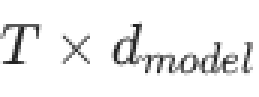
Figure 5. Option D dimension T x d_model
Source option ID: 6406536373624
Correct answer: C
Source evidence: [{"page": 3, "bbox": [23.62, 605.31, 119.02, 621.63], "type": "green source option", "detail": "Option 6406536373623 marked with green color 32768 in source PDF"}]
Question 3
Question ID: 6406531961495
Type: Multiple Choice Question · Marks: 2
PDF pages: 3, 4
In the scaled dot-product attention equation \(\text{Attention}(Q, K, V) = \text{softmax}\left(\frac{QK^T}{\sqrt{d_k}}\right) V\), what is the primary reason for dividing the dot product by \(\sqrt{d_k}\)?

Figure 6. Question 3 prompt: scaled dot-product attention formulation and scaling factor division
Options
A.
To ensure the matrix dimensions match for multiplication with \(V\)
Source option ID: 6406536373625
B.
To reduce the number of trainable parameters in the model
Source option ID: 6406536373626
C.
To prevent the dot product values from growing too large, which would push the softmax function into regions with extremely small gradients
Source option ID: 6406536373627
D.
To normalize the embedding vectors to have a unit length
Source option ID: 6406536373628
Correct answer: C
Source evidence: [{"page": 4, "bbox": [23.62, 135.71, 119.02, 152.03], "type": "green source option", "detail": "Option 6406536373627 marked with green color 32768 in source PDF"}]
Question 4
Question ID: 6406531961496
Type: Multiple Choice Question · Marks: 2
PDF pages: 4
Consider a Transformer Encoder stack consisting of \(N = 6\) identical layers. If the input to the first layer is a sequence of word embeddings of shape \(T \times d_{model}\) (where \(T = 50\) and \(d_{model} = 512\)), what is the shape of the output of the final (6th) layer?

Figure 7. Question 4 prompt: Transformer Encoder stack specifications with N=6 layers and sequence shape T x d_model
Options
A.
\(1 \times 512\) (A single context vector)
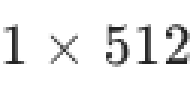
Figure 8. Option A shape 1 x 512 single context vector
Source option ID: 6406536373629
B.
\(6 \times 512\) (One vector per layer)
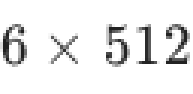
Figure 9. Option B shape 6 x 512 one vector per layer
Source option ID: 6406536373630
C.
\(50 \times 512\) (One vector per token, preserving sequence length)
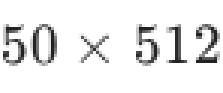
Figure 10. Option C shape 50 x 512 one vector per token
Source option ID: 6406536373631
D.
\(300 \times 512\) (Concatenation of all token vectors across layers)
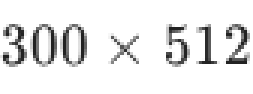
Figure 11. Option D shape 300 x 512 concatenation across layers
Source option ID: 6406536373632
Correct answer: C
Source evidence: [{"page": 4, "bbox": [23.62, 474.68, 119.02, 491.0], "type": "green source option", "detail": "Option 6406536373631 marked with green color 32768 in source PDF"}]
Question 5
Question ID: 6406531961500
Type: Multiple Choice Question · Marks: 2
PDF pages: 4
In a standard Transformer encoder-decoder architecture, is masking typically applied in the cross-attention layer?
Options
A.
Yes, both causal masking and padding masking are applied to prevent the decoder from attending to future encoder positions
Source option ID: 6406536373645
B.
Yes, only causal masking is applied to maintain the autoregressive property
Source option ID: 6406536373646
C.
No causal masking is needed, but padding masking may be applied to ignore padded positions in the source sequence
Source option ID: 6406536373647
D.
No masking is ever applied in cross-attention since the encoder processes the complete input sequence
Source option ID: 6406536373648
Correct answer: C
Source evidence: [{"page": 4, "bbox": [23.62, 754.1, 119.02, 770.42], "type": "green source option", "detail": "Option 6406536373647 marked with green color 32768 in source PDF"}]
Question 6
Question ID: 6406531961512
Type: Multiple Choice Question · Marks: 2
PDF pages: 5
Consider the BERT architecture. During pre-training, it uses segment embeddings (\(E_A, E_B\)) to distinguish between sentences. However, during fine-tuning for a single-sentence classification task (e.g., Sentiment Analysis), how are these segment embeddings typically utilized?
Options
A.
Segment embeddings are not used; the embedding layer is disabled for single-sentence tasks.
Source option ID: 6406536373673
B.
All tokens in the input sequence are assigned the same segment embedding (e.g., \(E_A\)).
Source option ID: 6406536373674
C.
The first half of the sentence gets \(E_A\) and the second half gets \(E_B\) to maintain symmetry.
Source option ID: 6406536373675
D.
Segment embeddings are randomly initialized for every new single-sentence input.
Source option ID: 6406536373676
Correct answer: B
Source evidence: [{"page": 5, "bbox": [23.62, 214.38, 119.02, 230.7], "type": "green source option", "detail": "Option 6406536373674 marked with green color 32768 in source PDF"}]
Question 7
Question ID: 6406531961513
Type: Multiple Choice Question · Marks: 2
PDF pages: 5
Consider a decoding step in a language model where the logits for the next token are \(z = [2.0, 1.0, 0.5]\). We apply a temperature scaling \(z/T\) before the softmax. As \(T \to 0\) (approaches zero), what does the resulting probability distribution \(P(x)\) look like?
Options
A.
It approaches a uniform distribution where all tokens have equal probability.
Source option ID: 6406536373677
B.
It approaches a "one-hot" distribution where the token with the highest logit has probability 1.0 (Greedy Search).
Source option ID: 6406536373678
C.
It remains unchanged from the original softmax distribution.
Source option ID: 6406536373679
D.
It causes numerical instability and results in NaNs.
Source option ID: 6406536373680
Correct answer: B
Source evidence: [{"page": 5, "bbox": [23.62, 577.06, 119.02, 593.38], "type": "green source option", "detail": "Option 6406536373678 marked with green color 32768 in source PDF"}]
Question 8
Question ID: 6406531961514
Type: Multiple Choice Question · Marks: 2
PDF pages: 5, 6
You are fine-tuning a pre-trained BERT model for a spam classification task. The input sequence is: [CLS] Win a free iPhone now [SEP]. Which vector from the final layer output is typically passed to the classification head (\(W_v\))?
Options
A.
The average pooling of all token vectors.
Source option ID: 6406536373681
B.
The final hidden state vector corresponding to the [SEP] token (\(h_{sep}\)).
Source option ID: 6406536373682
C.
The final hidden state vector corresponding to the [CLS] token (\(h_{cls}\)).
Source option ID: 6406536373683
D.
The concatenation of all hidden state vectors.
Source option ID: 6406536373684
Correct answer: C
Source evidence: [{"page": 6, "bbox": [23.62, 97.82, 119.02, 114.14], "type": "green source option", "detail": "Option 6406536373683 marked with green color 32768 in source PDF"}]
Question 9
Question ID: 6406531961497
Type: Multiple Select Question · Marks: 3
PDF pages: 6
Select all statements that correctly describe the motivation and behavior of Multi-Head Attention as compared to single-head attention.
Options
A.
It allows the model to jointly attend to information from different representation subspaces at different positions.
Source option ID: 6406536373633
B.
It is mathematically similar to having multiple filters/kernels in a CNN to capture different features.
Source option ID: 6406536373634
C.
It reduces the total number of parameters required compared to a single head with the same total dimension.
Source option ID: 6406536373635
D.
Each head can theoretically learn to capture different linguistic relationships (e.g., one head links "it" to "animal", another links "it" to "tired").
Source option ID: 6406536373636
Correct answer: A, B, D
Source evidence: [{"page": 6, "bbox": [23.62, 350.48, 119.02, 366.8], "type": "green source option", "detail": "Option 6406536373633 marked with green color 32768 in source PDF"}, {"page": 6, "bbox": [23.62, 387.62, 119.02, 403.94], "type": "green source option", "detail": "Option 6406536373634 marked with green color 32768 in source PDF"}, {"page": 6, "bbox": [23.62, 461.9, 119.02, 478.22], "type": "green source option", "detail": "Option 6406536373636 marked with green color 32768 in source PDF"}]
Question 10
Question ID: 6406531961498
Type: Multiple Select Question · Marks: 3
PDF pages: 6, 7
Given the vectorized self-attention calculation \(\text{Attention}(Q, K, V) = \text{softmax}\left(\frac{QK^T}{\sqrt{d_k}}\right) V\), select all true statements regarding the matrix dimensions and operations. Assume \(Q, K, V \in \mathbb{R}^{T \times d_k}, T > d_k\).

Figure 12. Question 10 prompt: vectorized self-attention equation and matrix dimension conditions
Options
A.
The matrix resulting from \(QK^T\) has dimensions \(T \times T\).
Source option ID: 6406536373637
B.
The softmax operation is applied to the entire matrix at once (globally), not row-wise.
Source option ID: 6406536373638
C.
The final output \(Z\) has dimensions \(T \times d_v\).
Source option ID: 6406536373639
D.
The matrix \(QK^T\) represents the raw affinity/score between every pair of tokens in the sequence.
Source option ID: 6406536373640
Correct answer: A, C, D
Source evidence: [{"page": 6, "bbox": [23.62, 688.09, 119.02, 704.41], "type": "green source option", "detail": "Option 6406536373637 marked with green color 32768 in source PDF"}, {"page": 6, "bbox": [23.62, 773.55, 119.02, 789.87], "type": "green source option", "detail": "Option 6406536373639 marked with green color 32768 in source PDF"}, {"page": 7, "bbox": [23.62, 28.68, 119.02, 45.0], "type": "green source option", "detail": "Option 6406536373640 marked with green color 32768 in source PDF"}]
Question 11
Question ID: 6406531961499
Type: Multiple Select Question · Marks: 2
PDF pages: 7
In the context of the Transformer architecture, which of the following statements correctly describe the source of the Query (\(Q\)), Key (\(K\)), and Value (\(V\)) vectors during the Cross-Attention (Encoder-Decoder Attention) mechanism?
Options
A.
The Keys (\(K\)) and Values (\(V\)) are derived from the output of the Decoder.
Source option ID: 6406536373641
B.
The Queries (\(Q\)) are generated from the previous hidden states of the Decoder.
Source option ID: 6406536373642
C.
The Queries (\(Q\)), Keys (\(K\)), and Values (\(V\)) all originate from the same input sequence.
Source option ID: 6406536373643
D.
This mechanism allows the Decoder to focus on relevant parts of the input sequence processed by the Encoder.
Source option ID: 6406536373644
Correct answer: B, D
Source evidence: [{"page": 7, "bbox": [23.62, 363.85, 119.02, 380.17], "type": "green source option", "detail": "Option 6406536373642 marked with green color 32768 in source PDF"}, {"page": 7, "bbox": [23.62, 481.96, 119.02, 498.28], "type": "green source option", "detail": "Option 6406536373644 marked with green color 32768 in source PDF"}]
Question 12
Question ID: 6406531961501
Type: Short Answer Question · Marks: 2
PDF pages: 7, 8
Consider the positional encoding for a given position \(pos\) and dimension \(i\) is defined by:
Consider a Transformer model with a hidden state dimension \(d_{model} = 128\). You are calculating the positional embedding for the 4th word in a sequence (index \(pos = 3\), using 0-based indexing). Calculate the value of the 6th element (index \(i = 5\)) of the positional embedding vector for this word. (use radians for angle)
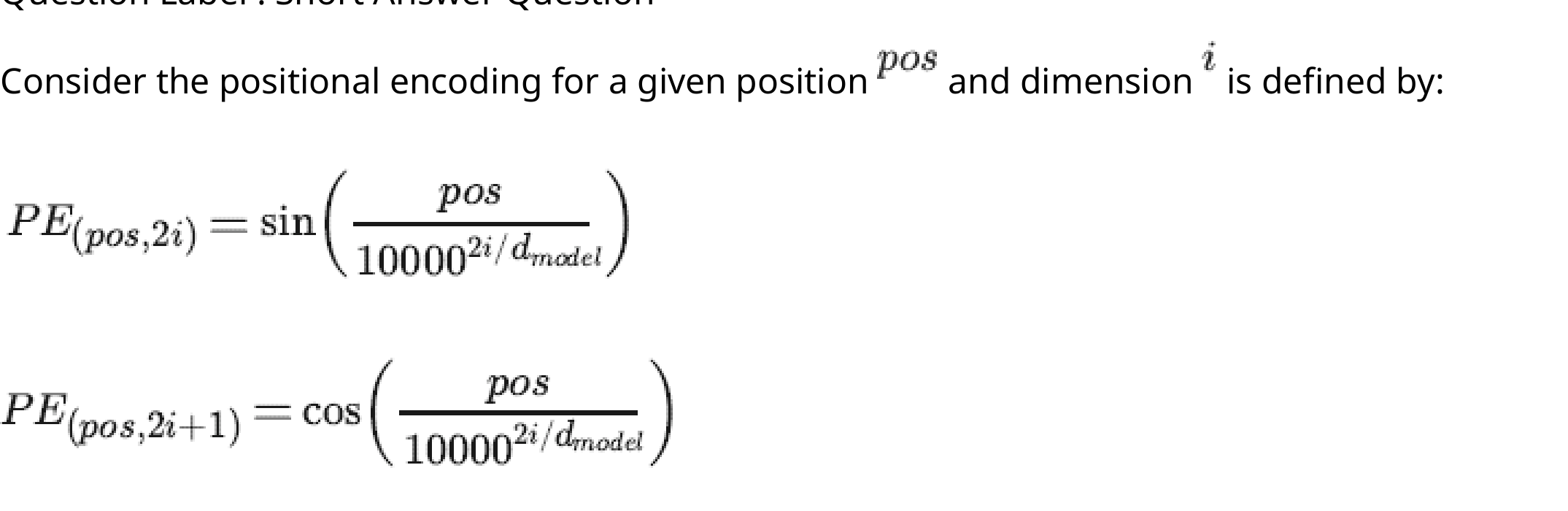
Figure 13. Question 12 prompt: sinusoidal positional encoding definitions PE(pos, 2i) and PE(pos, 2i+1)
Correct answer: -0.65 to -0.59
Source evidence: [{"page": 8, "bbox": [22.87, 185.0, 150.0, 205.0], "type": "explicit field", "detail": "Source PDF specifies official accepted answer range: -0.65 to -0.59"}]
Shared context 13-15
Question ID: 6406531961502
Type: Comprehension
PDF pages: 8, 9
Suppose you are given three encoder hidden states at time \(t\):
The previous decoder hidden state is:
Given the attention score function:
where the hyperbolic tangent function is defined as:
and
Based on the above data, answer the given subquestions.
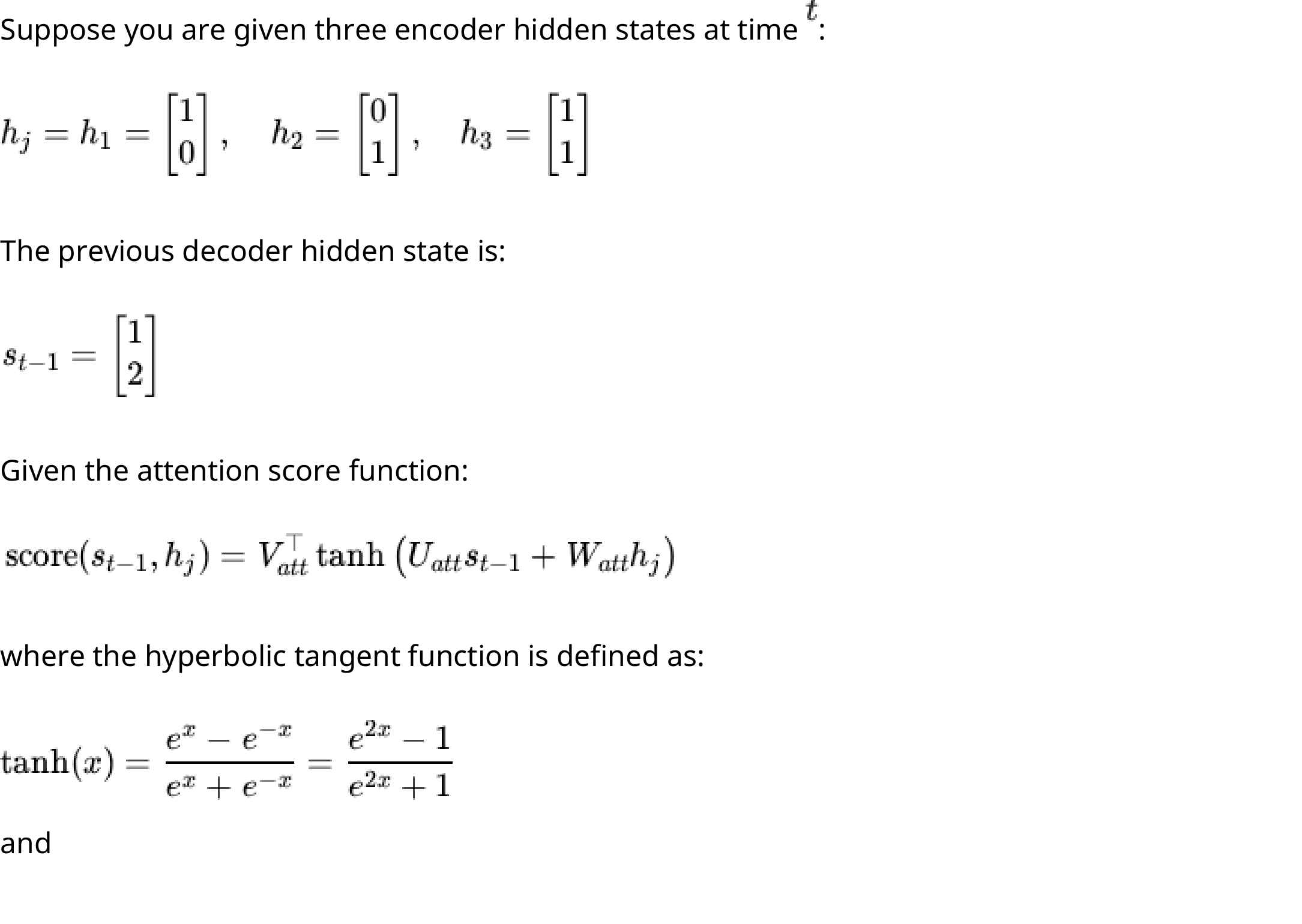
Figure 14. Comprehension passage for Q13-15: encoder hidden states h1, h2, h3, decoder state s_{t-1}, attention score function, and tanh definition

Figure 15. Comprehension passage continuation for Q13-15: weight matrices v_att, U_att, and W_att
Question 13
Question ID: 6406531961503
Type: Short Answer Question · Marks: 1
PDF pages: 9
Shared context: ctx-13-15
Compute the attention score for hidden state \(h_1\) using the given function. Enter the final answer correct to two decimal places.
Correct answer: 1.89 to 1.96
Source evidence: [{"page": 9, "bbox": [22.87, 280.0, 150.0, 300.0], "type": "explicit field", "detail": "Source PDF specifies official accepted answer range: 1.89 to 1.96"}]
Question 14
Question ID: 6406531961504
Type: Short Answer Question · Marks: 3
PDF pages: 9
Shared context: ctx-13-15
Normalize the attention scores using the softmax function to obtain the attention weights \(\alpha_t\):
Submit \(\alpha_{t1}\) (i.e., the first element of the \(\alpha_t\) vector). Enter the final answer correct to two decimal places.
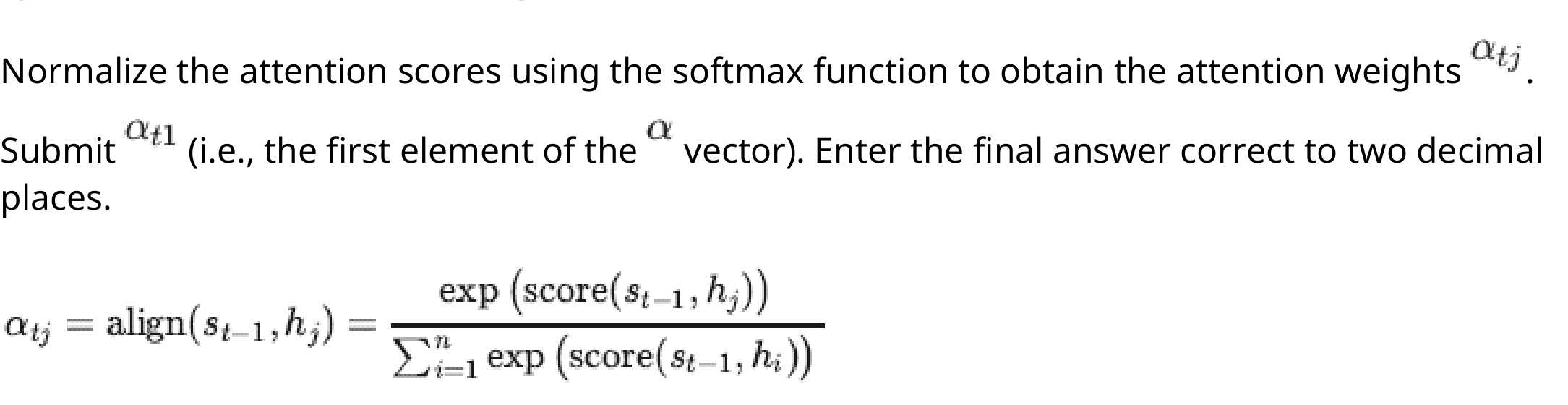
Figure 16. Question 14 prompt: softmax normalization equation for attention weights alpha_{tj}
Correct answer: 0.31 to 0.39
Source evidence: [{"page": 9, "bbox": [22.87, 650.0, 150.0, 670.0], "type": "explicit field", "detail": "Source PDF specifies official accepted answer range: 0.31 to 0.39"}]
Question 15
Question ID: 6406531961505
Type: Short Answer Question · Marks: 2
PDF pages: 9, 10
Shared context: ctx-13-15
Calculate the context vector \(c_t\):
Provide the sum of all elements of \(c_t\). Enter the final answer correct to two decimal places.

Figure 17. Question 15 prompt: context vector c_t formulation as weighted sum of encoder hidden states
Correct answer: 1.32 to 1.40
Source evidence: [{"page": 10, "bbox": [22.87, 175.0, 150.0, 195.0], "type": "explicit field", "detail": "Source PDF specifies official accepted answer range: 1.32 to 1.40"}]
Shared context 16-20
Question ID: 6406531961506
Type: Comprehension
PDF pages: 10
Consider the following Configuration for a GPT model:
• Vocabulary size: 40,000 tokens
• Embedding dimension (d_model): 768
• Maximum sequence length: 512
• Number of transformer blocks: 12
• Number of attention heads per block: 12
• Feed-forward network hidden dimension: 3,072
• Activation function: GELU
Note: In multi-head attention, the model dimension is split equally among all heads.
Based on the above data, answer the given subquestions.
Question 16
Question ID: 6406531961507
Type: Multiple Choice Question · Marks: 2
PDF pages: 10, 11
Shared context: ctx-16-20
What is the number of parameters in the token embedding matrix?
Options
A.
30,720,000
Source option ID: 6406536373653
B.
40,768
Source option ID: 6406536373654
C.
393,216
Source option ID: 6406536373655
D.
15,728,640,000
Source option ID: 6406536373656
Correct answer: A
Source evidence: [{"page": 10, "bbox": [23.62, 804.14, 119.02, 820.46], "type": "green source option", "detail": "Option 6406536373653 marked with green color 32768 in source PDF"}]
Question 17
Question ID: 6406531961508
Type: Multiple Choice Question · Marks: 2
PDF pages: 11
Shared context: ctx-16-20
What is the total number of parameters in the positional embedding matrix?
Options
A.
512,768
Source option ID: 6406536373657
B.
393,216
Source option ID: 6406536373658
C.
3,932,160
Source option ID: 6406536373659
D.
39,321
Source option ID: 6406536373660
Correct answer: B
Source evidence: [{"page": 11, "bbox": [23.62, 216.7, 119.02, 233.02], "type": "green source option", "detail": "Option 6406536373658 marked with green color 32768 in source PDF"}]
Question 18
Question ID: 6406531961509
Type: Multiple Choice Question · Marks: 2
PDF pages: 11
Shared context: ctx-16-20
For ONE complete attention head, what is the total number of parameters (Q + K + V projections combined)?
Options
A.
49,152
Source option ID: 6406536373661
B.
196,608
Source option ID: 6406536373662
C.
589,824
Source option ID: 6406536373663
D.
147,456
Source option ID: 6406536373664
Correct answer: D
Source evidence: [{"page": 11, "bbox": [23.62, 473.86, 119.02, 490.18], "type": "green source option", "detail": "Option 6406536373664 marked with green color 32768 in source PDF"}]
Question 19
Question ID: 6406531961510
Type: Multiple Choice Question · Marks: 2
PDF pages: 11
Shared context: ctx-16-20
After the multi-head attention computation, all head outputs are concatenated and projected back to the model dimension.
How many parameters are in the output projection matrix (weights only, excluding bias)?
Options
A.
768
Source option ID: 6406536373665
B.
49,152
Source option ID: 6406536373666
C.
589,824
Source option ID: 6406536373667
D.
294,912
Source option ID: 6406536373668
Correct answer: C
Source evidence: [{"page": 11, "bbox": [23.62, 701.2, 119.02, 717.52], "type": "green source option", "detail": "Option 6406536373667 marked with green color 32768 in source PDF"}]
Question 20
Question ID: 6406531961511
Type: Multiple Choice Question · Marks: 2
PDF pages: 11, 12
Shared context: ctx-16-20
What is the total number of parameters in the complete FFN (including both weight matrices and bias vectors)?
Options
A.
2,359,296
Source option ID: 6406536373669
B.
4,718,592
Source option ID: 6406536373670
C.
4,722,432
Source option ID: 6406536373671
D.
9,437,184
Source option ID: 6406536373672
Correct answer: C
Source evidence: [{"page": 12, "bbox": [23.62, 114.1, 119.02, 130.42], "type": "green source option", "detail": "Option 6406536373671 marked with green color 32768 in source PDF"}]
Answer key
| Source question | Source identity | Correct answer | PDF pages |
|---|---|---|---|
| 2 | 6406531961494 | C | 3 |
| 3 | 6406531961495 | C | 3, 4 |
| 4 | 6406531961496 | C | 4 |
| 5 | 6406531961500 | C | 4 |
| 6 | 6406531961512 | B | 5 |
| 7 | 6406531961513 | B | 5 |
| 8 | 6406531961514 | C | 5, 6 |
| 9 | 6406531961497 | A, B, D | 6 |
| 10 | 6406531961498 | A, C, D | 6, 7 |
| 11 | 6406531961499 | B, D | 7 |
| 12 | 6406531961501 | -0.65 to -0.59 | 7, 8 |
| 13 | 6406531961503 | 1.89 to 1.96 | 9 |
| 14 | 6406531961504 | 0.31 to 0.39 | 9 |
| 15 | 6406531961505 | 1.32 to 1.40 | 9, 10 |
| 16 | 6406531961507 | A | 10, 11 |
| 17 | 6406531961508 | B | 11 |
| 18 | 6406531961509 | D | 11 |
| 19 | 6406531961510 | C | 11 |
| 20 | 6406531961511 | C | 11, 12 |
Extraction notes
Status: verified
Count reconciliation: The portal declared 14 questions and 40 marks for Section 1 (LLM). The 40 marks reconcile across all 19 academic questions: Q2 (2) + Q3 (2) + Q4 (2) + Q5 (2) + Q6 (2) + Q7 (2) + Q8 (2) + Q9 (3) + Q10 (3) + Q11 (2) + Q12 (2) + Comprehension 13-15 subquestions Q13 (1) + Q14 (3) + Q15 (2) + Comprehension 16-20 subquestions Q16 (2) + Q17 (2) + Q18 (2) + Q19 (2) + Q20 (2) = 40 marks. The 14 declared portal items in the section header correspond to the 14 top-level portal question items (Q1 confirmation, Q2 to Q12, plus 2 comprehension containers 13-15 and 16-20); when counting the 19 individual academic questions (excluding administrative confirmation Question 1), this represents the standard portal container aggregation pattern.
- Every academic question and option was verified visually and programmatically against the source PDF. Official answers for MCQ/MSQ are confirmed by green highlight markers (color 32768) in source PDF; numerical answer ranges are taken directly from the official portal answer specification.
Excluded source entries:
- {"classification": "subject-confirmation", "page": 2, "bbox": [22.87, 810.0, 569.0, 842.0], "reason": "Administrative hall ticket and subject verification prompt asking candidate to confirm registration for Large Language Models degree exam.", "identity": "6406531961493"}
- {"classification": "administrative-metadata", "page": 1, "bbox": [0.0, 0.0, 595.0, 842.0], "reason": "Portal administrative and exam console setup metadata preceding Section 1 (LLM).", "identity": "Group 1 / 64065332737"}