LLM — da5004_2026T2_Q2_NA
Source: da5004_2026T2_Q2_NA.pdf · Academic questions: 18 · Separately counted children: 0
Provenance: Large_Language_Models/da5004_2026T2_Q2_NA.pdf · SHA-256 f854547ec11886a82cb2287cf5e4c7d2b6f35b3aee3d17ad91f5cf8f48b47da0
Scope: Section 1: LLM (Degree Level : Large Language Models), physical pages 1 to 9. The in-scope section starts on page 1 with Section Id 640653143422 and concludes on page 9 with Question 19 under Comprehension 18 to 19.
Questions
Shared context 2-4
Question ID: 6406532197542
Type: Comprehension
PDF pages: 2
Answer the subquestions for the given transformer architecture for one (\(N = 1\)) Encoder Decoder Block
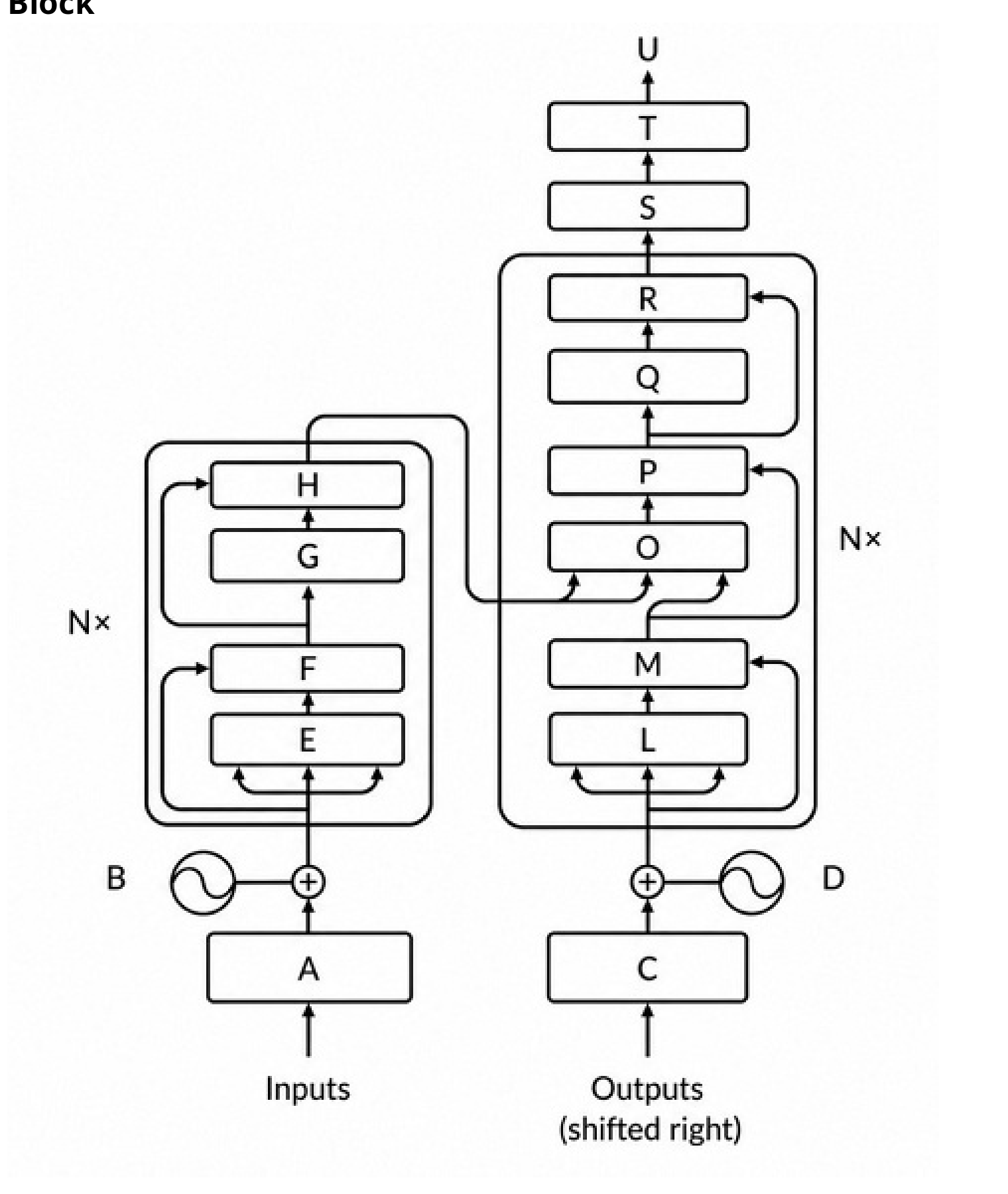
Figure 1. Transformer encoder-decoder architecture with labeled components for Comprehension questions 2 to 4
Question 2
Question ID: 6406532197543
Type: Short Answer Question · Marks: 2
PDF pages: 3
Shared context: ctx-2-4
In the given Transformer architecture for one Encoder Decoder block, identify every Add & Norm layer. Submit the corresponding component alphabets in alphabetical (ascending) order as a single uppercase string without spaces, commas, or quotation marks.
Example: If the correct components are Q, G, and S, your answer should be GQS
Correct answer: FHMPR
Source evidence: [{"page": 3, "bbox": [22.87, 335.0, 150.0, 365.0], "type": "explicit field", "detail": "Source section 'Possible Answers : FHMPR' for short answer alphanumeric response"}]
Question 3
Question ID: 6406532197544
Type: Multiple Choice Question · Marks: 1
PDF pages: 3
Shared context: ctx-2-4
Identify the function of component "L" in the given Transformer architecture.
Options
A.
Positional Encoding
Source option ID: 6406537135075
B.
Feed-Forward Network
Source option ID: 6406537135076
C.
Masked Multi-Head Self-Attention
Source option ID: 6406537135077
D.
Multi-Head Cross-Attention
Source option ID: 6406537135078
E.
Linear Output Projection
Source option ID: 6406537135079
Correct answer: C
Source evidence: [{"page": 3, "bbox": [23.6200008392334, 532.1840209960938, 119.01998901367188, 548.5040283203125], "type": "green source option", "detail": "Source option 6406537135077 rendered in green font indicating correct option"}]
Question 4
Question ID: 6406532197545
Type: Multiple Select Question · Marks: 2
PDF pages: 3, 4
Shared context: ctx-2-4
Based on the architecture shown in the given image, identify all components that appear more than once. Assume the architecture contains exactly one Encoder block and one Decoder block.
Options
A.
Positional Encoding
Source option ID: 6406537135080
B.
Feed-Forward Network
Source option ID: 6406537135081
C.
Masked Multi-Head Self-Attention
Source option ID: 6406537135082
D.
Multi-Head Cross-Attention
Source option ID: 6406537135083
E.
tokenizer
Source option ID: 6406537135084
F.
Add & Norm
Source option ID: 6406537135085
Correct answer: A, B, F
Source evidence: [{"page": 3, "bbox": [23.6200008392334, 726.884033203125, 119.01998901367188, 743.2040405273438], "type": "green source option", "detail": "Source option 6406537135080 rendered in green font indicating correct option"}, {"page": 3, "bbox": [23.6200008392334, 747.7040405273438, 119.01998901367188, 764.0240478515625], "type": "green source option", "detail": "Source option 6406537135081 rendered in green font indicating correct option"}, {"page": 3, "bbox": [23.6200008392334, 38.324012756347656, 119.01998901367188, 54.64401626586914], "type": "green source option", "detail": "Source option 6406537135085 rendered in green font indicating correct option"}]
Question 5
Question ID: 6406532197546
Type: Multiple Select Question · Marks: 3
PDF pages: 4
A researcher is exploring an alternate approach to implement masked attention in the transformer decoder. The causal mask considered is a binary lower-triangular matrix \(M\) (where \(M_{ij} = 1\) for \(j \le i\) and \(0\) otherwise). This mask (\(M\)) is applied as an element-wise multiplication (\(\odot\)) after the softmax operation on Attention Matrix (\(A\)).
Identify the correct statements from the following:
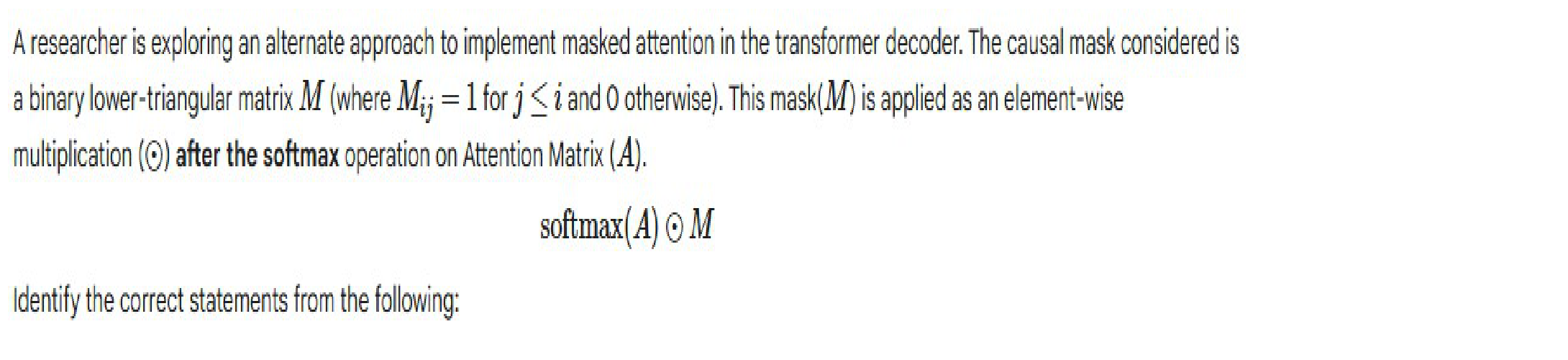
Figure 2. Question 5 prompt: masked attention implementation with element-wise causal mask M after softmax operation
Options
A.
The approach violates the autoregressive property
Source option ID: 6406537135086
B.
The approach ensures autoregressive property is not violated by ensuring that
the final attention weights of future tokens are 0
Source option ID: 6406537135087
C.
The final attention weights in the new approach will be greater than or equal
to that of the original approach
Source option ID: 6406537135088
D.
The attention weights for the final token of the sequence will always be the
same for both the approaches
Source option ID: 6406537135089
Correct answer: A, D
Source evidence: [{"page": 4, "bbox": [23.6200008392334, 338.7039794921875, 119.01998901367188, 355.02398681640625], "type": "green source option", "detail": "Source option 6406537135086 rendered in green font indicating correct option"}, {"page": 4, "bbox": [23.6200008392334, 433.8039855957031, 119.01998901367188, 450.1239929199219], "type": "green source option", "detail": "Source option 6406537135089 rendered in green font indicating correct option"}]
Question 6
Question ID: 6406532197550
Type: Multiple Select Question · Marks: 3
PDF pages: 4
Which of the following options correctly reflect the internal state updates performed during a Byte Pair Encoding (BPE) training iteration?
Options
A.
After a pair is chosen for merging, it is permanently added to the active
vocabulary list.
Source option ID: 6406537135102
B.
The algorithm recalculates the log probability of the entire corpus before the
next iteration.
Source option ID: 6406537135103
C.
The independent frequencies of the two constituent tokens that were part of
the merge are reduced by the frequency of the merged token.
Source option ID: 6406537135104
D.
The original constituent tokens of the merged pair are removed from the
vocabulary to optimize dictionary size.
Source option ID: 6406537135105
Correct answer: A, C
Source evidence: [{"page": 4, "bbox": [23.6200008392334, 607.6840209960938, 119.01998901367188, 624.0040283203125], "type": "green source option", "detail": "Source option 6406537135102 rendered in green font indicating correct option"}, {"page": 4, "bbox": [23.6200008392334, 681.9640502929688, 119.01998901367188, 698.2840576171875], "type": "green source option", "detail": "Source option 6406537135104 rendered in green font indicating correct option"}]
Question 7
Question ID: 6406532197556
Type: Multiple Select Question · Marks: 3
PDF pages: 4, 5
A baseline T5 model with denoising objective on a span of corrupted tokens is used for unsupervised pre-training. Consider the phrase "life is like a box of chocolates". If the word "life" and the span "box of chocolates" are selected for corruption, which of the following statements correctly describe the training process?
Options
A.
The input sequence replaces the corrupted spans with unique sentinal tokens
as: "
Source option ID: 6406537135123
B.
The output sequence generated takes the form "
Source option ID: 6406537135124
C.
The loss is calculated exclusively over the generated sentinal tokens and the
missing text.
Source option ID: 6406537135125
D.
The decoder reconstructs the entire original sequence autoregressively to
compute the total loss over all positions.
Source option ID: 6406537135126
Correct answer: A, B, C
Source evidence: [{"page": 5, "bbox": [23.6200008392334, 124.42398834228516, 119.01998901367188, 140.74398803710938], "type": "green source option", "detail": "Source option 6406537135123 rendered in green font indicating correct option"}, {"page": 5, "bbox": [23.6200008392334, 161.5640106201172, 119.01998901367188, 177.88400268554688], "type": "green source option", "detail": "Source option 6406537135124 rendered in green font indicating correct option"}, {"page": 5, "bbox": [23.6200008392334, 198.7040252685547, 119.01998901367188, 215.02401733398438], "type": "green source option", "detail": "Source option 6406537135125 rendered in green font indicating correct option"}]
Question 8
Question ID: 6406532197547
Type: Multiple Choice Question · Marks: 3
PDF pages: 5
During the fine-tuning of GPT-1 for Textual Entailment tasks, what is the purpose of the delimiter token ($)?
Options
A.
To trigger the softmax function.
Source option ID: 6406537135090
B.
To separate premise and hypothesis.
Source option ID: 6406537135091
C.
To mark the end of the sentence.
Source option ID: 6406537135092
D.
To initialize the linear head.
Source option ID: 6406537135093
Correct answer: B
Source evidence: [{"page": 5, "bbox": [23.6200008392334, 488.5039978027344, 119.01998901367188, 504.8240051269531], "type": "green source option", "detail": "Source option 6406537135091 rendered in green font indicating correct option"}]
Question 9
Question ID: 6406532197548
Type: Multiple Choice Question · Marks: 3
PDF pages: 5, 6
During the fine-tuning of a decoder-only Transformer for sequence classification, why is the hidden representation of the final input token used as the input to the classification layer?
Options
A.
The first token's representation relies exclusively on absolute positional
encodings and lacks semantic context for classification.
Source option ID: 6406537135094
B.
The final token's representation is computed independently of self-attention,
making its gradients more stable during the fine-tuning process.
Source option ID: 6406537135095
C.
Selecting the final token aligns with the autoregressive objective, eliminating
the need for teacher forcing during the classification forward pass.
Source option ID: 6406537135096
D.
Causal self-attention ensures that only the final token's representation aggregates information from all preceding tokens in the sequence.
Source option ID: 6406537135097
Correct answer: D
Source evidence: [{"page": 6, "bbox": [23.6200008392334, 799.1240234375, 119.01998901367188, 815.4440307617188], "type": "green source option", "detail": "Source option 6406537135097 rendered in green font indicating correct option"}]
Question 10
Question ID: 6406532197549
Type: Multiple Choice Question · Marks: 3
PDF pages: 6
In the decoding phase of a Language model, temperature scaling with \(T = 5\) is applied to the output logits before performing top-\(p\) (nucleus) sampling. Which of the following options best describes the impact of the temperature scaling on the subsequent sampling step?

Figure 3. Question 10 prompt: temperature scaling parameter and top-p nucleus sampling effect on candidate token count
Options
A.
Increases the required number of candidate tokens thus expanding the
nucleus.
Source option ID: 6406537135098
B.
Decreases the required number of candidate tokens thus shrinking the
nucleus.
Source option ID: 6406537135099
C.
Truncates the tail of the distribution causing the sampling to behave similar to top-\(k\) sampling.
Source option ID: 6406537135100
D.
Size of the nucleus remains unaffected by the temperature scaling as it only
depends on order of the tokens.
Source option ID: 6406537135101
Correct answer: A
Source evidence: [{"page": 6, "bbox": [23.6200008392334, 213.74400329589844, 119.01998901367188, 230.06399536132812], "type": "green source option", "detail": "Source option 6406537135098 rendered in green font indicating correct option"}]
Question 11
Question ID: 6406532197551
Type: Multiple Choice Question · Marks: 3
PDF pages: 6
In the WordPiece tokenization algorithm, how does the scoring formula prioritize token merges?
Options
A.
It evaluates the log-probability of the pair and selects the highest scoring
transition.
Source option ID: 6406537135106
B.
It merges the pair with the highest absolute frequency in the corpus.
Source option ID: 6406537135107
C.
It prioritizes pairs that occur together frequently but rarely appear
independently in the corpus.
Source option ID: 6406537135108
D.
None of these
Source option ID: 6406537135109
Correct answer: C
Source evidence: [{"page": 6, "bbox": [23.6200008392334, 568.1940307617188, 119.01998901367188, 584.5140380859375], "type": "green source option", "detail": "Source option 6406537135108 rendered in green font indicating correct option"}]
Question 12
Question ID: 6406532197555
Type: Multiple Choice Question · Marks: 3
PDF pages: 6, 7
Consider the T5 "text-to-text" paradigm. How does the model process fundamentally different tasks such as Semantic Similarity (continuous regression) and Sentiment Analysis (discrete classification) during the fine-tuning phase?
Options
A.
The model uses the encoder to output the regression score and decoder for
the classification tokens switching based on the input prompt.
Source option ID: 6406537135119
B.
The decoder part of the model is appended with separate prediction heads for
regression and classification which are updated based on Mean Squared Error and Cross-Entropy
respectively.
Source option ID: 6406537135120
C.
The model treats both tasks as sequence generation objectives with task-
specific prefix added in the input and all output is generated as strings.
Source option ID: 6406537135121
D.
None of these.
Source option ID: 6406537135122
Correct answer: C
Source evidence: [{"page": 7, "bbox": [23.6200008392334, 70.96402740478516, 119.01998901367188, 87.28402709960938], "type": "green source option", "detail": "Source option 6406537135121 rendered in green font indicating correct option"}]
Question 13
Question ID: 6406532197557
Type: Multiple Choice Question · Marks: 3
PDF pages: 7
In the context of the BART (Bidirectional AutoRegressive Transformer) architecture, how does the model handle corrupted input sequences compared to its output?
Options
A.
The decoder ignores the encoder output and performs standard causal
language modeling.
Source option ID: 6406537135127
B.
The encoder processes the original sequence and the decoder predicts the
corrupted tokens.
Source option ID: 6406537135128
C.
The encoder processes the corrupted sequence and the decoder predicts the
entire original sequence.
Source option ID: 6406537135129
D.
Both the encoder and decoder process the corrupted sequence to calculate
masked loss.
Source option ID: 6406537135130
Correct answer: C
Source evidence: [{"page": 7, "bbox": [23.6200008392334, 339.9440002441406, 119.01998901367188, 356.2640075683594], "type": "green source option", "detail": "Source option 6406537135129 rendered in green font indicating correct option"}]
Question 14
Question ID: 6406532197558
Type: Multiple Choice Question · Marks: 3
PDF pages: 7
When comparing the C4 dataset to an 'Unfiltered-C4' dataset that is 8 times larger, what was the observed effect on downstream task performance?
Options
A.
Performance remained identical, suggesting a saturation point in data utility.
Source option ID: 6406537135131
B.
Performance improved only for high-resource tasks like translation.
Source option ID: 6406537135132
C.
Performance improved significantly due to the increased diversity of data.
Source option ID: 6406537135133
D.
Performance degraded across all tasks despite the larger scale.
Source option ID: 6406537135134
Correct answer: D
Source evidence: [{"page": 7, "bbox": [23.6200008392334, 613.4240112304688, 119.01998901367188, 629.7440185546875], "type": "green source option", "detail": "Source option 6406537135134 rendered in green font indicating correct option"}]
Question 15
Question ID: 6406532197559
Type: Multiple Choice Question · Marks: 3
PDF pages: 7, 8
Which of the following describes the 'Adapter Layers' fine-tuning strategy?
Options
A.
Randomly freezing 50% of the attention heads in each layer during training.
Source option ID: 6406537135135
B.
Adding small dense-ReLU-dense blocks after FFN layers and updating only
those and Layer Norm parameters.
Source option ID: 6406537135136
C.
Updating all parameters in the model but using a much smaller learning rate.
Source option ID: 6406537135137
D.
Increasing the dimension \(d_{\text{model}}\) of the existing Feed-Forward networks.

Figure 4. Question 15 Option D: increasing the dimension d_model of the existing Feed-Forward networks
Source option ID: 6406537135138
Correct answer: B
Source evidence: [{"page": 7, "bbox": [23.6200008392334, 775.4840087890625, 119.01998901367188, 791.8040161132812], "type": "green source option", "detail": "Source option 6406537135136 rendered in green font indicating correct option"}]
Question 16
Question ID: 6406532197560
Type: Multiple Choice Question · Marks: 3
PDF pages: 8
Which of the following is a reported negative effect of including significantly duplicated content in LLM training data?
Options
A.
It decreases the model's overall inference speed during deployment.
Source option ID: 6406537135139
B.
It causes the model to generate repeated sequences much more frequently.
Source option ID: 6406537135140
C.
It permanently reduces the maximum supported context window length.
Source option ID: 6406537135141
D.
It causes the model to lose the ability to process multilingual input.
Source option ID: 6406537135142
Correct answer: B
Source evidence: [{"page": 8, "bbox": [23.6200008392334, 244.2040252685547, 119.01998901367188, 260.5240173339844], "type": "green source option", "detail": "Source option 6406537135140 rendered in green font indicating correct option"}]
Question 17
Question ID: 6406532197561
Type: Multiple Choice Question · Marks: 3
PDF pages: 8
If you have a fixed compute budget (\(C\)) and choose to train an extraordinarily large model (massive \(N\)) on a relatively small dataset (small \(D\)), what is the likely outcome according to scaling laws?

Figure 5. Question 17 prompt: scaling laws trade-off with fixed compute budget C, massive model size N, and small dataset D
Options
A.
The model will be over-trained and memorize the dataset.
Source option ID: 6406537135143
B.
The model will be under-trained and less capable than a smaller model trained
on more data with the same compute budget.
Source option ID: 6406537135144
C.
The model will perfectly memorize the small dataset and generalize flawlessly.
Source option ID: 6406537135145
D.
The model's inference speed will increase dramatically.
Source option ID: 6406537135146
Correct answer: B
Source evidence: [{"page": 8, "bbox": [23.6200008392334, 502.9139709472656, 119.01998901367188, 519.2340087890625], "type": "green source option", "detail": "Source option 6406537135144 rendered in green font indicating correct option"}]
Shared context 18-19
Question ID: 6406532197552
Type: Comprehension
PDF pages: 8, 9
Consider the following corpus consisting of 4 words (ignore spaces and punctuation).
there is no spoon
The vocabulary is constructed using the whole words in this corpus and the individual characters in this corpus. The vocabulary should now have 13 tokens. Use this vocabulary for the given subquestions.
Question 18
Question ID: 6406532197553
Type: Multiple Select Question · Marks: 3
PDF pages: 9
Shared context: ctx-18-19
Using the vocabulary constructed, two new continuous strings: "prison" and "rhino" are to be segmented. Which of the following proposed segmentations are valid?
Options
A.
prison
Source option ID: 6406537135110
B.
p, r, is, o, n
Source option ID: 6406537135111
C.
p, r, is, on
Source option ID: 6406537135112
D.
r, h, i, n, o
Source option ID: 6406537135113
E.
r, h, i, no
Source option ID: 6406537135114
Correct answer: B, D, E
Source evidence: [{"page": 9, "bbox": [23.6200008392334, 225.52403259277344, 119.01998901367188, 241.84402465820312], "type": "green source option", "detail": "Source option 6406537135111 rendered in green font indicating correct option"}, {"page": 9, "bbox": [23.6200008392334, 267.1639709472656, 119.01998901367188, 283.4839782714844], "type": "green source option", "detail": "Source option 6406537135113 rendered in green font indicating correct option"}, {"page": 9, "bbox": [23.6200008392334, 287.9839782714844, 119.01998901367188, 304.3039855957031], "type": "green source option", "detail": "Source option 6406537135114 rendered in green font indicating correct option"}]
Question 19
Question ID: 6406532197554
Type: Multiple Choice Question · Marks: 3
PDF pages: 9
Shared context: ctx-18-19
Using a unigram language model, identify the segment with the highest probability from the given options:
Options
A.
n, o, i, s, e, s
Source option ID: 6406537135115
B.
no, is, e, s
Source option ID: 6406537135116
C.
nois, e, s
Source option ID: 6406537135117
D.
no, i, s, e, s
Source option ID: 6406537135118
Correct answer: B
Source evidence: [{"page": 9, "bbox": [23.6200008392334, 461.8639831542969, 119.01998901367188, 478.1839904785156], "type": "green source option", "detail": "Source option 6406537135116 rendered in green font indicating correct option"}]
Answer key
| Source question | Source identity | Correct answer | PDF pages |
|---|---|---|---|
| 2 | 6406532197543 | FHMPR | 3 |
| 3 | 6406532197544 | C | 3 |
| 4 | 6406532197545 | A, B, F | 3, 4 |
| 5 | 6406532197546 | A, D | 4 |
| 6 | 6406532197550 | A, C | 4 |
| 7 | 6406532197556 | A, B, C | 4, 5 |
| 8 | 6406532197547 | B | 5 |
| 9 | 6406532197548 | D | 5, 6 |
| 10 | 6406532197549 | A | 6 |
| 11 | 6406532197551 | C | 6 |
| 12 | 6406532197555 | C | 6, 7 |
| 13 | 6406532197557 | C | 7 |
| 14 | 6406532197558 | D | 7 |
| 15 | 6406532197559 | B | 7, 8 |
| 16 | 6406532197560 | B | 8 |
| 17 | 6406532197561 | B | 8 |
| 18 | 6406532197553 | B, D, E | 9 |
| 19 | 6406532197554 | B | 9 |
Extraction notes
Status: verified
Count reconciliation: The portal section header declared 16 questions and 50 marks for Section 1 (LLM). The 16 declared items correspond exactly to the 16 top-level portal question units: Question 1 (administrative subject confirmation), Comprehension container (2 to 4), Questions 5, 6, 7 (Sub-Section 3), Questions 8, 9, 10, 11, 12, 13, 14, 15, 16, 17 (Sub-Section 4), and Comprehension container (18 to 19) (Sub-Section 5). Excluding Question 1 (confirmation) and unpacking the two comprehension containers yields exactly 18 top-level academic questions (Q2 to Q19). The 50 marks reconcile perfectly across all 18 academic questions: Sub-Section 2 [Q2 (2) + Q3 (1) + Q4 (2) = 5] + Sub-Section 3 [Q5 (3) + Q6 (3) + Q7 (3) = 9] + Sub-Section 4 [Q8 (3) + Q9 (3) + Q10 (3) + Q11 (3) + Q12 (3) + Q13 (3) + Q14 (3) + Q15 (3) + Q16 (3) + Q17 (3) = 30] + Sub-Section 5 [Q18 (3) + Q19 (3) = 6] = 5 + 9 + 30 + 6 = 50 marks.
- Question 1 is the administrative subject confirmation, semantically excluded from academic question count while retaining full evidence.
- Question 5 stem contains raster equation text in source PDF; high-resolution 288 DPI crop captured and formula transcribed as \text{softmax}(A) \odot M.
- Comprehension 2 to 4 references an embedded Transformer encoder-decoder diagram; high-resolution crop captured as asset assets/ctx-2-4-passage-01-p002.png.
- Questions 10, 15, and 17 contain inline mathematical symbols/parameters rendered as raster images in the source PDF; preserved high-resolution visual crops and restored mathematical notation in question text with explicit repairs.
Excluded source entries:
- {"classification": "subject-confirmation", "page": 1, "bbox": [22.87, 735.0, 565.0, 842.0], "reason": "Administrative subject verification asking candidate to confirm registration and cross-check hall ticket for DEGREE LEVEL : LARGE LANGUAGE MODELS.", "identity": "6406532197541"}